
Massachusetts Biomedical Initiatives officially opened a Pilot Biomanufacturing Center in Worcester Wednesday, which CEO Jon Weaver called the next step in its efforts to make the city the global hub for biomanufacturing.
The center at 17 Briden St. includes 10 new biomanufacturing labs that are meant to support startup companies in process development and the early stages of manufacturing, and 10 support offices overlooking the labs, according to a press statement from the company.
The opening of the center follows the opening of Startup and Scale-up centers by MBI in 2020.
Weaver told a crowd gathered at the Pilot Biomanufacturing Center Wednesday that due to the pandemic they expected it to take three years to fill the Startup and Scale-up centers. However, they were able to fill the space within 10 months, and since then, the space has served 33 companies that have raised more than $280 million and created more than 130 jobs.
Massachusetts Life Sciences Center provided $3.5 million from its Research Infrastructure Program to help fund the expansion into biomanufacturing.
The new lab space that opened Wednesday supports companies as they make the transition from research to manufacturing, as they move “from concept to clinical trial,” Weaver said.
Worcester City Manager Eric Batista called the creation of the space “another key milestone as Worcester continues to expand its status as a premier life sciences hub and a welcoming incubator for the startup community.”
Due to Worcester’s concentration of urban amenities, higher education, and access to regional capital markets, according to Batista, “Worcester is where the talent wants to be.”
Making Worcester a place where talent wants to be is “crucial for sustained growth and to retain the pipeline of talented students graduating from our local colleges and universities,” Batista said.
Two companies are already moving into the Pilot Biomanufacturing Center, according to Weaver, and one of them – Enable Life Sciences – started in MBI’s StartUp and Scale Up center.
Multiple people mentioned Worcester’s ranking as the number 15 metro area for life sciences research. Real estate and investment firm CBRE gave the heart of the commonwealth the ranking in 2022.
Yvonne Hao, secretary of the Massachusetts Executive Office of Economic Development, noted that President Joe Biden selected the state to host Advanced Research Projects Agency for Health Investor Catalyst Hub and credited Worcester’s work in life sciences as part of the reason.
Hao called the Pilot Biomanufacturing Center the embodiment of what the Healey-Driscoll administration is trying to do with its state economic development plan.
Some of the startups using MBI facilities include JURA Bio, Inc, a cell therapy company looking to cure autoimmune diseases; Enamel Pure, a company developing a CO2 laser system that it says will be more effective at cleaning teeth; Conigen Bioscience, Inc., which is working to help support antibody drug discoveries; SpadXTech, a company working to develop a cellulose-based material that can replace plastic and is better for the environment; and Leal Therapeutics, a company developing novel therapeutics for central nerve system disorders.
Shixia Wang, the chief scientific officer of Conigen Bioscience, Inc., was a professor at UMass-Chan Medical School for 25 years and said the startup chose Worcester because they are local to it, they have connections with the colleges and universities here and the facilities were available to generate whatever research they wanted.
Amanda Spann, an associate scientist for Leal Therapeutics, said it’s been amazing to work in Worcester and that everyone that works for MBI is “super personable and caring.”
“MBI does a nice job of not only providing the space, but helping you navigate through starting the company,” CEO and Founder of SpadXTech Lina Gonzalez said. MBI helped her figure out where to purchase her equipment and has given her guidance writing grants, according to Gonzalez.
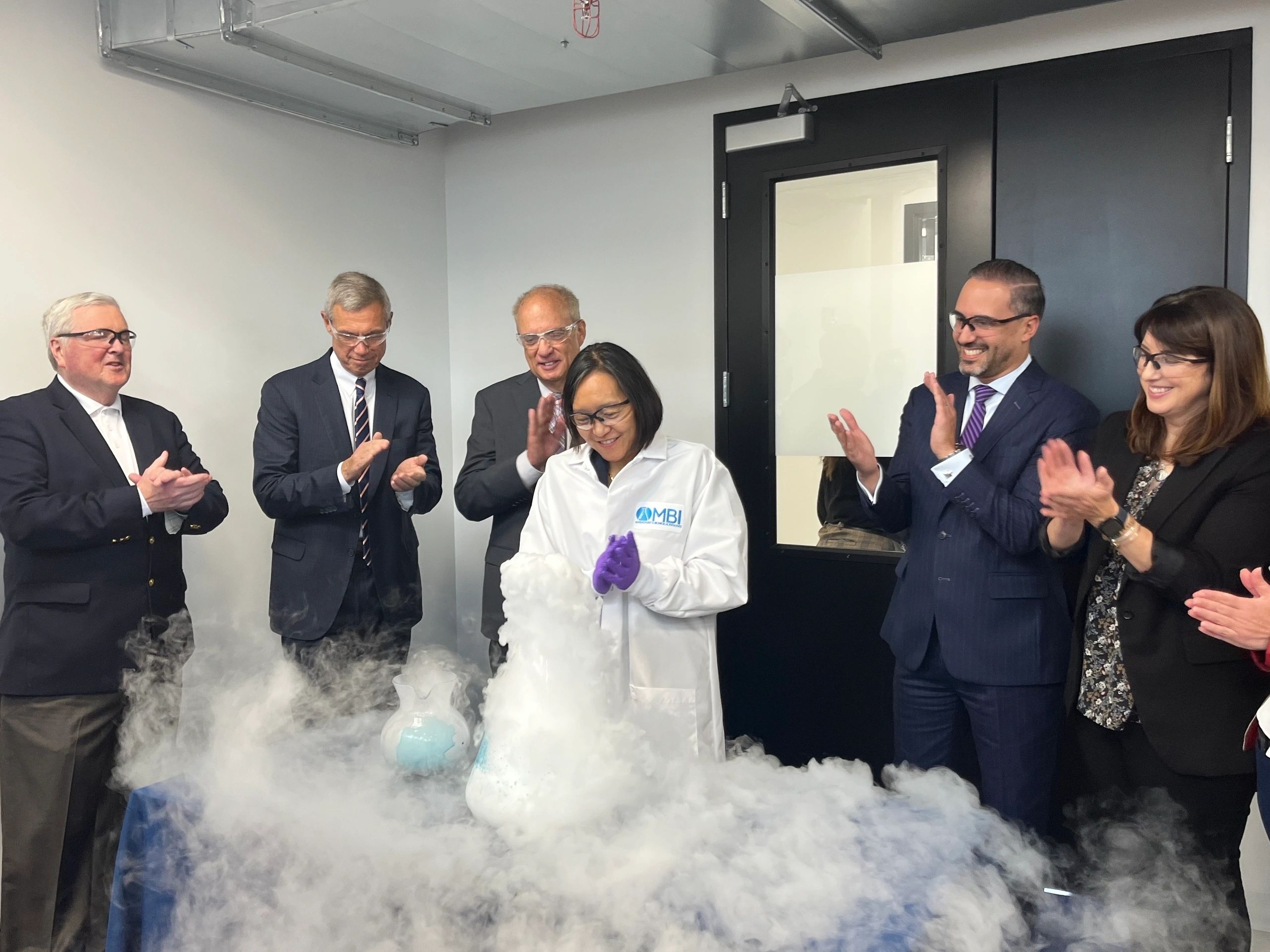
Hao officially opened the facility, not with a ribbon cutting but with an experiment. Weaver had Hao pour water onto solid carbon dioxide, “it can have a catalyzing reaction and that’s what we think is really symbolic of what we’ve been able to do here with this project.”
When Hao poured the water over the carbon dioxide a cloud of smoke emanated out of the flask and across the table.
Kiernan Dunlop is an award-winning journalist who has spent the past five years reporting in Worcester, New Bedford and Antigua and Barbuda. She’s been published in Bloomberg, USA Today, Canary Media, MassLive, and the New Bedford Standard Times, among other outlets. She can be contacted at kdunlop@theworcesterguardian.org