
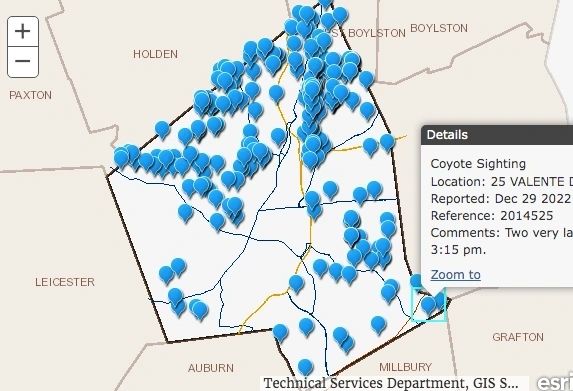
Coyotes can be spotted “all over the city,” but there’s no predicting where they will turn up. As woods are cleared for more development on the city’s outskirts, the coyote population has increased. From the east and north side to the center of Worcester to towns outside the city limits, these animals have been reported. Residents are urged to use caution and be prepared, as sightings are on the rise.
WORCESTER – With a simple keystroke, Worcester residents can alert city officials to the presence of coyotes in their neighborhoods.
About four years ago, a button was added to the city’s website in response to multiple reports of coyote sightings. Citizens can report where the animals have been seen; these reports then populate a map so residents can keep track of where the sightings have been noted. There are dozens notated on the map, which spans one year.
Since then, these reports of coyote sightings have indicated a pattern. Namely, that there is no particular pattern.
“They’re all over the city,’’ Worcester Animal Control Officer Patrick Cherry said.
Sightings have been reported on the east side of the city, near Shrewsbury, Grafton and Millbury, and north of the city, near Holden and West Boylston.
And based on reports on Worcester’s Eastern Coyote Watch, the animals are no strangers to the city center either.
The coyote has a similar size and shape to a medium-sized dog, but its fur is longer and denser. The tail is long, black-tipped, and bushy. Their coat is usually gray but color can vary, ranging from creamy blonde to red to nearly solid black. Typical weights for females are 33 to 40 pounds; males are heavier, at an average of 34 to 47 pounds, although especially large males can weigh about 60 pounds, according to Massachusetts Division of Fisheries and Wildlife, also known as Mass Wildlife.
But, they often look heavier than they are because of their thick fur.
As woods are cleared for more development on the city’s outskirts, Cherry said, the coyote population has increased within city limits. And in the city, coyotes find plenty of food.
Coyotes are opportunistic feeders, meaning they will take advantage of whatever is available.
The animals eat a variety of foods, including rodents, rabbits, birds, insects, fruits, and berries. They will scavenge road kills and garbage and pet food left outdoors.
And unfortunately, Cherry notes, they will sometimes attempt to make a meal of a pet cat or small dog.
But there are ways to minimize this risk.
Change up your dog-walking routine, Cherry advises, especially if you have seen a coyote during a walk. They will stalk prey, and may be doing just that when they observe someone walking a small animal. Going out at different times and varying the walking route can be helpful, he said.
“Change up your time frame,’’ he said, and remember that “coyotes are smart.’’
If you do encounter a coyote while out walking, pick up your pet immediately, Cherry said. Then make noises to scare the coyote away, he advised, and attempt to look larger, maybe by opening your coat.
“They don’t like noises and they don’t like people,’’ he said. When faced with a person yelling and screaming, “they’ll back off,’’ he said.
Some residents have advocated hunting the animals to minimize their numbers, but this approach does not diminish the population, Cherry said. Instead, the animal’s tendency is to “keep the population steady’’ by offsetting population loss through additional births.
Similarly, coyotes by law cannot be moved from their location. A sick or problematic animal can be euthanized but cannot be relocated, Cherry said.
So the overall solution to living with coyotes is to be aware of their preferred habitat and take steps to ensure that your yard and neighborhood does not attract them.
Here are some tips to keep coyote interactions to a minimum, as provided by Mass Wildlife.
- Remember, they are wild animals, don’t try to feed or pet them. Feeding them, whether directly or indirectly, can cause coyotes to act tame and may lead to bold behavior. Coyotes that rely on natural foods remain wild and wary of humans, which helps keep people, pets and the coyotes themselves safer.
- Secure garbage and compost. Coyotes raid open trash materials and compost piles. Secure your garbage in tough plastic containers with tight fitting lids and keep them in secure buildings when possible. Take out trash when the morning pick up is scheduled, not the previous night. Keep compost in secure, vented containers, and clean barbecue grills to reduce odors.
- Close off crawl spaces, such as under porches and sheds. Coyotes will use these areas to rest and raise young.
- Don’t forget that you are larger than they are. Don’t hesitate to scare or threaten coyotes with loud noises, bright lights, or water sprayed from a hose.
- Keep property edges clear. Brushy edges provide cover for coyotes and their prey.
- And most importantly, share this information with neighbors. If they are providing nearby food and shelter for coyotes, any steps you take will be futile.
Sandy Quadros Bowles is a journalist with more than 40 years of experience in print and online journalism. In her free time, she enjoys traveling, reading and interacting with any and all animals that cross her path.