
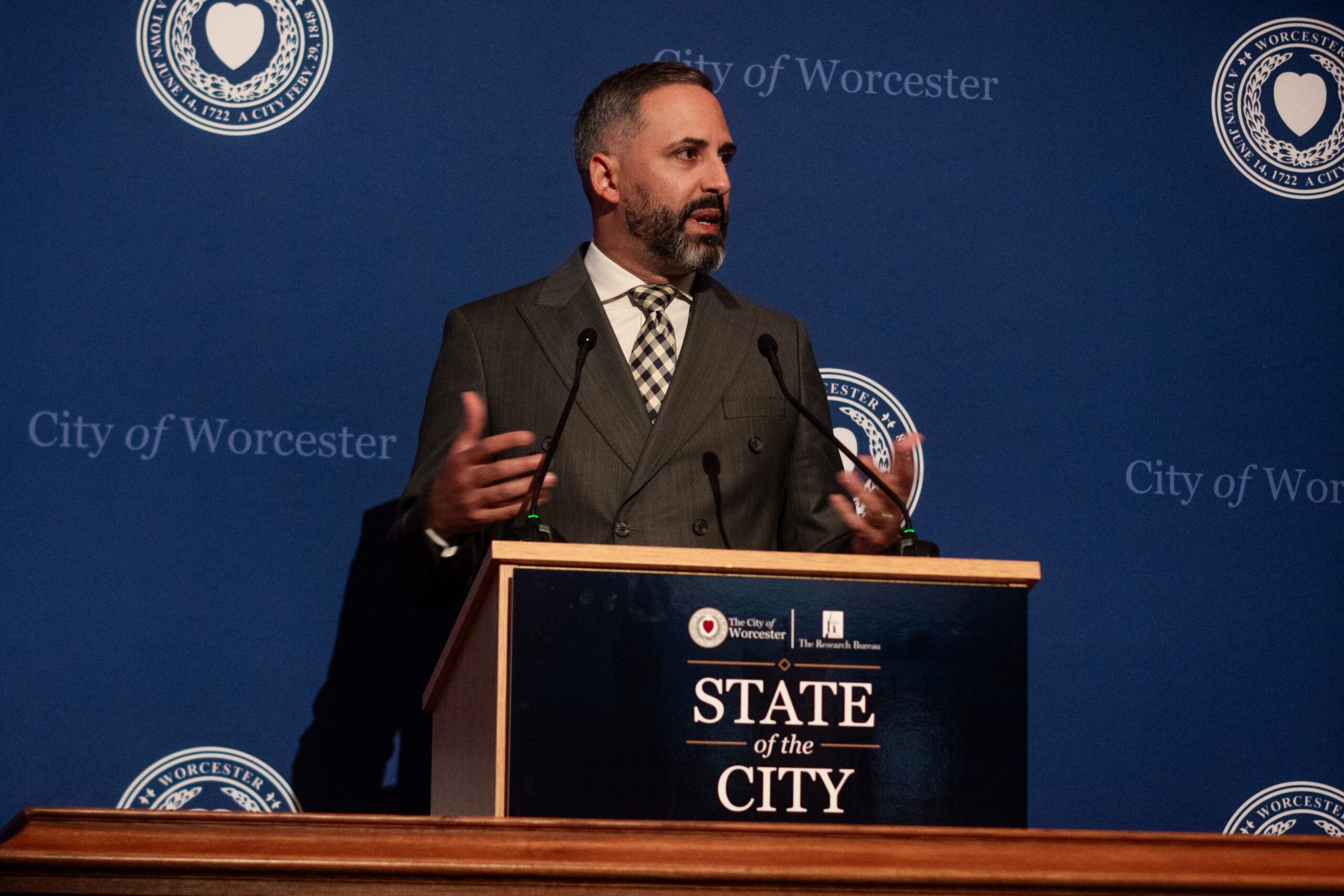
It may be one of the shortest city council agendas of the year, but the lone item before councilors Tuesday is a heavy one.
After the Pledge of Allegiance, roll call, and public participation, the council’s only scheduled business is its annual evaluation of City Manager Eric Batista, giving councilors an opportunity to publicly assess the city’s chief executive, review his administration’s accomplishments and determine how well Worcester is meeting the goals laid out in its strategic plan.
The evaluation, originally scheduled for last week, serves as the council’s annual report card on the administration. Batista turned in a lengthy self-evaluation highlighting what he describes as progress in financial management, housing, transportation, public safety, economic development, environmental initiatives and municipal operations despite what he characterizes as increasingly difficult conditions facing cities and towns across Massachusetts.
In his introductory letter to councilors, Batista compares the challenges facing municipalities to “a perfect storm” of financial pressures, uncertainty and rising costs but argues Worcester has been able to avoid many of the fiscal problems confronting other communities.
“I am proud to report that we are successfully weathering that storm,” Batista wrote. “But we’re not doing that by hunkering down and waiting things out. We’re continuously navigating new ways forward, despite the adversity around us.”
Batista points to Worcester’s continued population growth as one measure of the city’s stability, noting that roughly 2,000 residents moved in to the city between 2024 and 2025, bringing the estimated population to about 213,000. He also acknowledges the administration has not always met expectations, citing winter storm costs and the wave of potholes that followed as examples of areas where improvements were needed.
Financial management occupies a significant portion of the self-evaluation. Batista notes Worcester avoided seeking a Proposition 2½ override even as dozens of Massachusetts communities turned to voters for additional revenue. He credits long-term budgeting practices, maintaining reserve funds, rescinding unnecessary borrowing authorizations and increasing the city’s unused tax levy capacity to nearly $26 million with helping Worcester absorb unexpected expenses, including a $2.7 million reduction in state aid, winter storm overruns and the Holden water settlement.
The report also highlights declining crime statistics, including a drop in homicides from 16 in 2024 to two in 2025, along with decreases in violent crime, property crime, traffic crashes and overdoses. Batista also points to investments in housing, including nearly $20 million through the Affordable Housing Trust Fund supporting 768 housing units, expanded outreach to people experiencing homelessness and continued work on the future Day Resource Center on Gold Street.
Other accomplishments cited include the city’s first $1 billion budget, implementation of the Housing Production Plan, expansion of bicycle infrastructure and pedestrian safety improvements, continued investments in parks and environmental initiatives, efforts to streamline permitting for businesses, preparations for the Burncoat High School building project and modernization of municipal technology and operations.
The council’s evaluation follows changes made to the city’s performance review process and is intended to measure progress toward the municipality’s Fiscal Year 2025-2029 Strategic Plan while providing councilors an opportunity to publicly discuss the administration’s priorities and leadership.
Worcester City Council meets Tuesday, June 30, at City Hall in the Esther Howland (south) at 6:30 p.m. It is also livestreamed on the city’s website.
Have news, tips, or a story worth telling? Reach Editor Charlene Arsenault at carsenault@theworcesterguardian.org—because good stories (and great scoops) deserve to be shared.
