
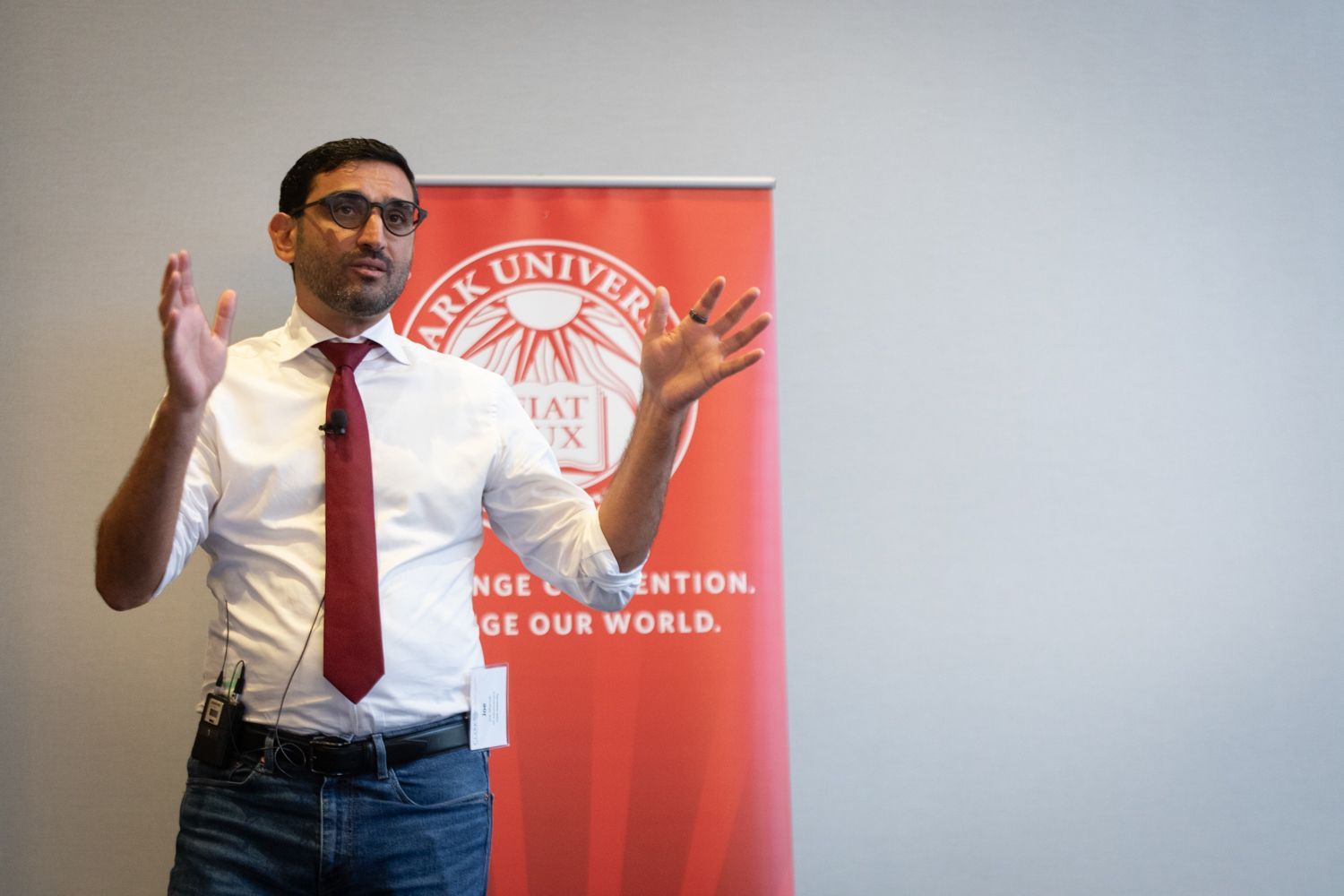
More than 400 leaders from universities, health care organizations, foundations and nonprofits descended on downtown Worcester this month for a new Clark University forum focused on a question rapidly moving from theoretical to practical: What happens when artificial intelligence becomes part of the workforce?
Clark, working with Amazon Web Services, convened representatives from more than 100 organizations Aug. 18 for its inaugural AI Agents Academy, a daylong program examining how increasingly autonomous AI systems could change the way colleges and other mission-driven institutions operate.
The gathering brought together university advancement officials, nonprofit executives, technologists and other institutional leaders from around the country for discussions on fundraising, alumni engagement, communications, operations and organizational design, according to an announcement from Clark.
More than 650 people registered for the academy, with more than 400 ultimately attending, according to the university.
While generative AI tools have already become commonplace across higher education, the academy focused specifically on AI agents — systems designed to carry out tasks and workflows with varying degrees of autonomy — and the implications of integrating them more deeply into institutional operations.
Sessions included case studies, demonstrations and hands-on exercises covering workflow automation, fundraising, advancement operations, governance, ethics and institutional risk. Participants also examined how organizations might be structured when employees increasingly work alongside AI systems.
“Universities and nonprofits have a unique opportunity, and responsibility, to shape how artificial intelligence is adopted in ways that reinforce trust, human connection, and institutional values,” Clark President David Fithian said in the university’s announcement.
“The AI Agents Academy reflects Clark University’s commitment to convening leaders around one of the defining challenges and opportunities of our time,” Fithian added. “By learning from one another and sharing practical approaches, we can ensure AI strengthens the people, relationships, and missions that define our institutions.”
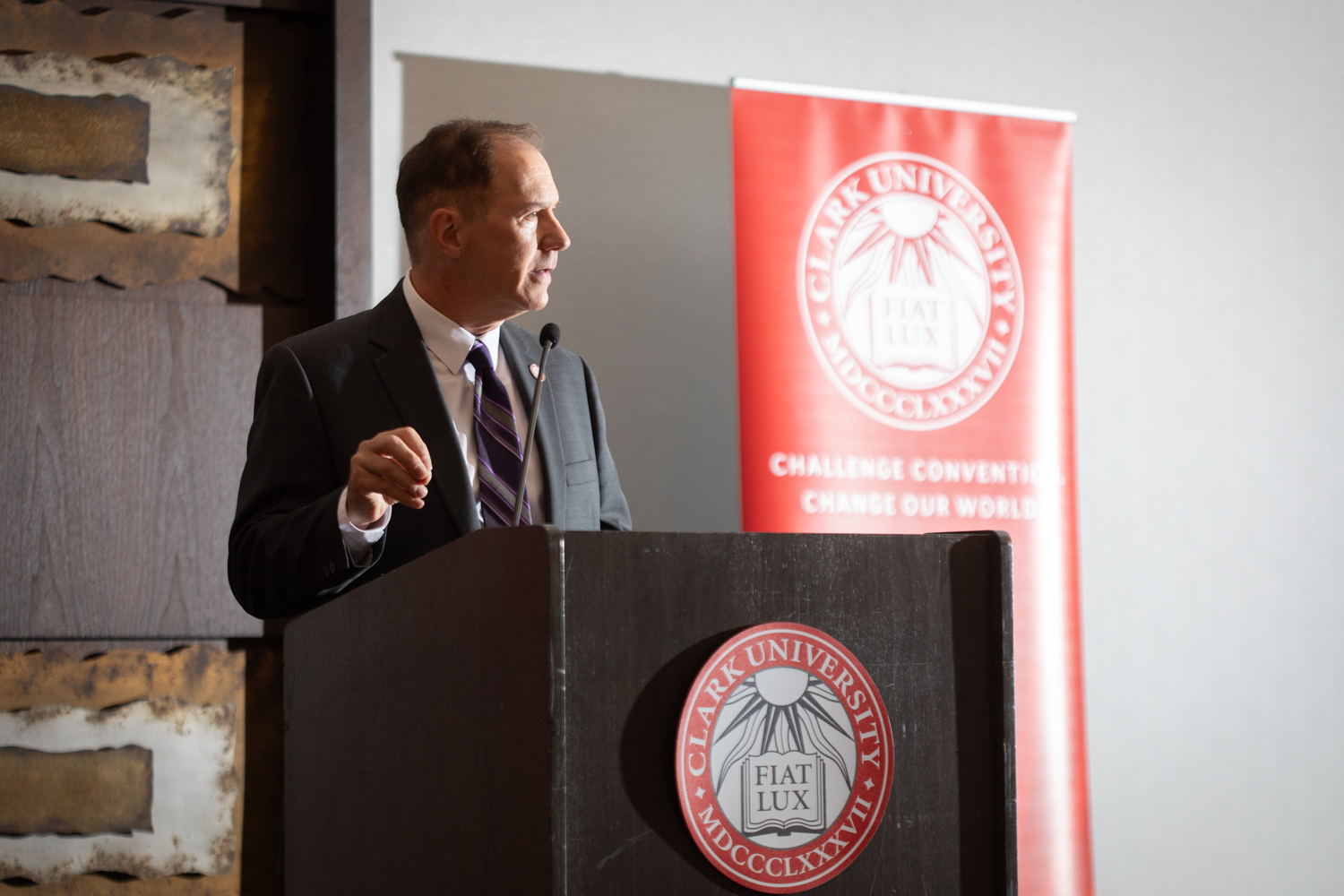
Speakers came from Clark, Amazon Web Services, Quantiphi, Pomona College, the Massachusetts Department of Higher Education, and consulting firm Marts & Lundy.
According to Clark, presenters shared examples of AI already changing work traditionally performed by administrative, operational and research teams. Discussions also pushed beyond the technology’s potential to make existing work faster, examining whether AI could ultimately change how organizations divide responsibilities and structure their staffs.
The academy is part of a broader effort at Clark to establish a role in the rapidly developing conversation around responsible AI use in higher education.
In May, Clark University Press published “Becoming AI-Ready: Designing Future Nonprofit Teams,” co-authored by Joe Manok, Clark’s vice president of University Advancement. The book examines how nonprofits can prepare their workforces and organizational structures for greater integration of artificial intelligence.
Clark is also pursuing work involving AI through research, executive education and university advancement, according to the announcement.
And the August gathering will not be a one-off event.
Organizers said the level of national interest has prompted plans to turn the AI Agents Academy into a year-round community, with participants convening online to exchange approaches to AI adoption and returning to Clark for an annual gathering.
That would give the Worcester university an ongoing role in a conversation higher education institutions increasingly cannot avoid: not whether artificial intelligence will change their work, but how — and how much of that change they want to control.
