
Two of the city’s most contentious debates return to City Hall Tuesday, as councilors get another crack at a proposed ban on public camping and consider a sweeping police reform plan authored by Worcester resident and journalist Tom Marino, a reporter for This Week in Worcester, that would reshape pieces of Worcester Police Department policy and accountability in the aftermath of the federal civil rights investigation.
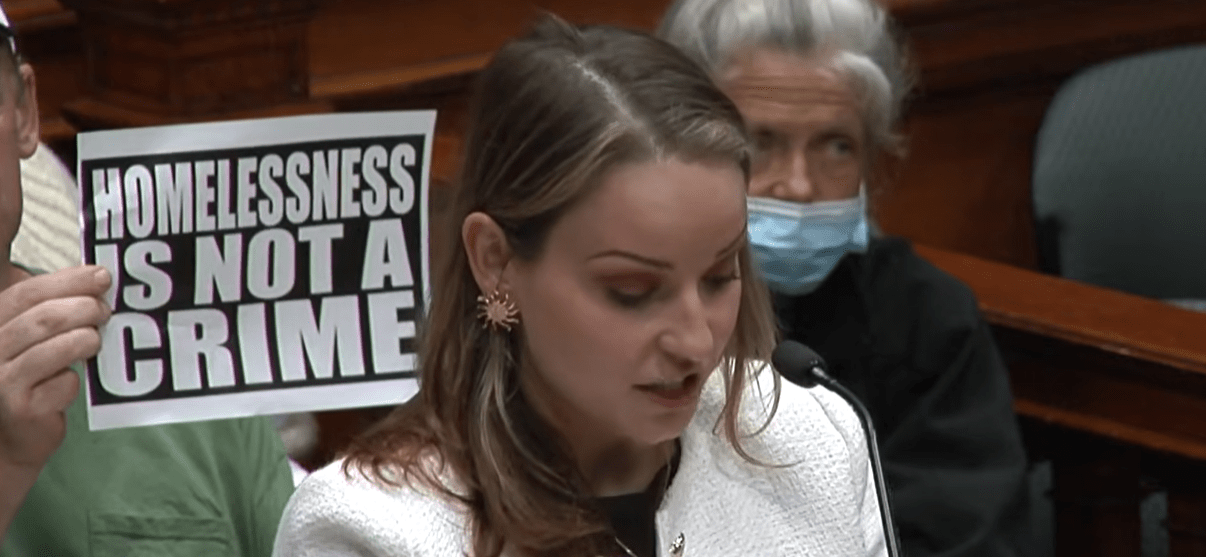
The public camping ordinance, part of City Manager Eric Batista’s broader “Disrupting the Cycle” homelessness strategy, was supposed to receive its first council airing last week. Instead, Vice Chairman Khrystian King held it under personal privilege hours before the meeting, saying he wanted more time to review the proposal and receive a fuller briefing from the administration. The delay did little to quiet the debate: numerous residents still used the meeting’s public comment period to oppose the ordinance.
The measure would prohibit camping, sleeping or lying on streets, sidewalks, bike paths and other public property and restrict the use of cars, campers and recreational vehicles for living purposes on public ways or parking lots for more than 24 consecutive hours. City workers would first conduct outreach and make reasonable efforts to offer shelter, treatment and supportive services, and the ordinance calls for notice up to 72 hours before an encampment is cleared. After outreach and notice, violations could be handled through civil, criminal or noncriminal enforcement, with a $25 fine for each day a violation continues.
Batista argues the ordinance cannot be separated from the rest of “Disrupting the Cycle,” a three-part framework that would also expand shelter capacity and overhaul the way agencies coordinate housing and services. Worcester currently has 197 permanent year-round shelter beds, with another 136 temporary beds added last winter, according to the plan. The administration also wants a real-time dashboard of shelter availability, a centralized system for people seeking beds, expanded transitional and single-room occupancy housing and stronger data-sharing among city departments, health care providers and nonprofit agencies. Batista has said being unhoused “is not a crime and will not be treated as such,” while describing the ordinance as an enforcement mechanism intended to strengthen outreach and connections to services.
King, who delayed the administration’s plan last week, arrives Tuesday with a series of homelessness orders of his own. He is seeking updates on earlier council requests for a broader homeless strategic plan, a day center and public facilities, federal assistance and policies governing city involvement when the state clears encampments. He also wants monthly records from the Homelessness Steering Committee published online, with an annual accounting of its goals and progress, and is requesting a report within 45 days on how Worcester could establish a municipal identification program.
Police accountability provides the other major thread running through Tuesday’s agenda. A petition from Marino, held last week by Councilor Robert Bilotta, asks the council to consider adopting all or portions of an extensive police-reform proposal built around the Department of Justice’s 2024 findings on the Worcester Police Department and changes Marino contends remain necessary after the federal investigation was closed. The justice department found in 2024 that WPD engaged in a pattern or practice of excessive force and that the department allowed certain officers to engage in sexual contact with women suspected of involvement in the commercial sex trade during undercover investigations; it also raised concerns about sexual-assault investigations and racially discriminatory policing.
Marino describes his plan as a voluntary local reform package rather than a federal consent decree. Its eight sections address use of force, sexual misconduct and sexual-assault investigations, racial disparities in stops and searches, internal investigations and discipline, supervision, behavioral-health crisis response and independent oversight. Among other provisions, the proposal calls for stronger complaint procedures, a disciplinary matrix, additional oversight of specialized police units and a working group to evaluate independent oversight models, including the possibility of a municipal inspector general. Marino’s proposal also acknowledges reforms WPD has already made and identifies several changes that he says would have to be pursued through collective bargaining rather than imposed unilaterally.
Another set of proposals would change how the council itself keeps tabs on City Hall. Councilor Satya Mitra is asking the Municipal and Legislative Operations Committee to consider three new council rules: requiring city departments to submit annual reports with measurable goals and prior-year budget information; allowing council standing committees to send budget priorities to the city manager by March 1; and requiring the manager to provide a preliminary budget report by March 15. The proposals would give councilors more information — and potentially more influence — earlier in the annual budget process.
Those orders arrive as Worcester continues a larger discussion about its governing structure. City Clerk Nikolin Vangjeli is sending councilors information on which charter changes can be made without an elected Charter Commission, which changes would require one and how the council can place a nonbinding question before voters. Under the clerk’s report, a councilor could propose ballot language and six council votes would ordinarily be required to put an advisory question before voters; the next regular municipal election is Nov. 2, 2027. The Municipal and Legislative Operations Committee is scheduled to continue its charter discussion Sept. 28.
Development and public subsidies also surface in several places. The council is scheduled for roll-call votes on establishing a tax increment financing zone for the 30-acre GreenTech Park development area along Interstate 190 and on a 20-year housing tax incentive for a proposed $88 million development at Lakeside and Garland avenues. That project calls for 103 mixed-income affordable housing units; under the proposed agreement, the developers would pay taxes on the property’s base value plus 10% of the increase in value over the 20-year term, amounting to an average 90% exemption on the new value.
Separately, Councilor Gary Rosen wants the administration to explain why Optiline Enterprises is working as a subcontractor on the 364-unit residential project at 274 Franklin St., which Rosen’s order says is receiving $11 million in local property-tax relief over 15 years. The order alleges that Optiline has documented labor and employment violations and says the company was previously barred from taxpayer-funded Worcester projects in June 2025. Rosen is asking whether its involvement at 274 Franklin St. complies with Worcester’s Responsible Development Ordinance. Those assertions come from Rosen’s council order; the material submitted for Tuesday’s agenda does not include a response from Optiline or the developer.
Other highlights on the agenda
- Turn it down—and pay more if you don’t: Worcester’s long-running noise debate returns with a Public Safety Committee recommendation involving the city’s excessive-noise ordinance. An earlier proposal asked the committee to explore special noise variances for churches, festivals and organizations holding certain events; the committee is recommending that order be placed on file. A separate chairman’s order now asks the city solicitor to draft an ordinance increasing fines for excessive-noise violations. The result could shift the conversation away from who should receive exceptions and toward whether the existing penalties are strong enough to deter repeat problems.
- Slow it down on Hermon Street: The administration could be asked to take another look at traffic around 42 Hermon St., where a Public Works Committee chairman’s order seeks measures to reduce congestion. The order asks the Department of Transportation and Mobility to determine what traffic improvements would be appropriate and calls for increased police enforcement of parking regulations in the area. No particular redesign or traffic-control device is prescribed, leaving transportation officials to determine what changes, if any, make sense.
- More attention around the Hotel Vernon: Another committee order calls for increased attention to what it describes as illegal activity in the vicinity of the Hotel Vernon at 16 Kelley Square. The request asks the police chief and the city’s Quality of Life Team to focus additional attention on the area. It does not specify particular alleged offenses or propose a new enforcement program, so the practical response would be left to the administration and police.
- Should motorized bikes and scooters need city registration? Councilor Tony Economou wants the administration to draft rules requiring operators of motorized scooters, bikes and similar vehicles to have them licensed and registered. His order also specifically calls for pedestrian-safety considerations to be incorporated into whatever regulations are proposed. The request does not itself establish a registration system or specify fees, age limits or enforcement rules; those details would have to come back in a future proposal.
- Housing help — and a new playbook for developers: Councilor Robert Bilotta wants the city’s development office to work with housing organizations on a New Homeowner and Tenant Summit covering available programs, benefits and tenants’ rights. In a separate order, he is seeking a standardized city policy governing mitigation and community benefits for new development, including clearer standards for mitigation payments and neighborhood improvements intended to offset project impacts. Councilor Gary Rosen, meanwhile, is asking the Public Health and Human Services Committee to meet jointly with the Board of Health on issues including public health, older residents, youth services, public housing, disability issues and community development funding.
- Where can you find a bathroom downtown? King is asking the administration to begin identifying locations for permanent public bathrooms, starting in District 2. His order also asks the city to consider temporary portable toilets while permanent facilities are being identified and built. The proposal frames bathroom access as a public-health need rather than simply an amenity, and comes alongside King’s broader set of orders involving services and facilities for unhoused residents.
Worcester City Council meets Tuesday, Sept. 22 , at City Hall in the Esther Howland (south) at 6:30 p.m. It is also livestreamed on the city’s website.
Have news, tips, or a story worth telling? Reach Editor Charlene Arsenault at carsenault@theworcesterguardian.org—because good stories (and great scoops) deserve to be shared.