
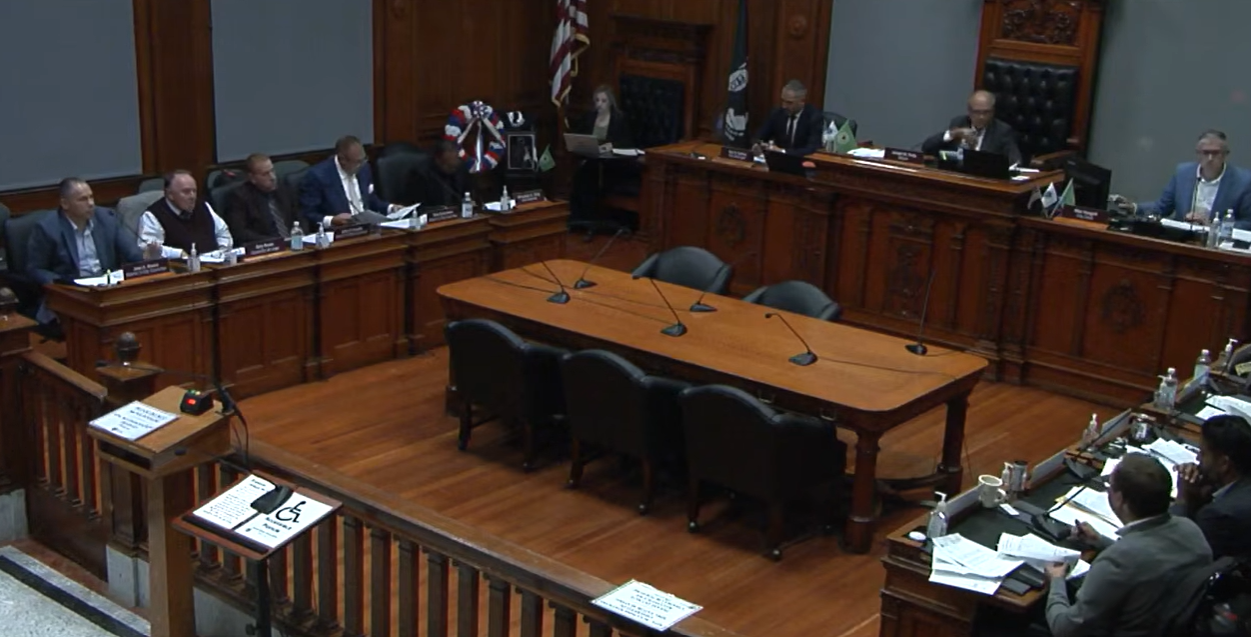
After two weeks of debate over a proposal to add more public restrooms downtown, the Worcester City Council agreed Tuesday to send the matter to City Manager Eric Batista for a report, with councilors emphasizing that businesses and residents should have a say in where facilities are located and what form they take.
The council first discussed the issue last week, when the item was held under privilege by councilor Khrystian King. Taking it up again at its Oct. 6 meeting and hearing from more members of the public, councilors raised concerns about how the city should decide on locations and types of bathrooms, as well as the possibility of installing temporary porta-potties.
Councilor Morris Bergman said he used the week-long interim to talk with business owners, some of whom were hearing about the proposal for the first time.
“They were not only surprised, not only that is was before us, but even more surprised that reference was made to some sort of discussions with the members of the business community, because they had no knowledge of it,” Bergman said. “They’re not happy about it – not happy about the idea, they’re not happy about being excluded from the conversations.”
Bergman also said he felt the idea was being fast-tracked without proper input.
“To ask the city manager to do something without there being a process, and without their being input and buy-in from the neighborhood and the business owners would be problematic and wrong,” he said.
King noted that he had amended the order since last week to specify that “the process will include community and business interfacing and feedback,” adding that he and Councilor Robert Bilotta had done outreach that seemed to support the need for bathroom facilities.
“There is an immediate need,” King said. “We have businesses who are subjected to feces and public urination in their places of business, and issues as it relates to cleanup.”
Batista, when asked about conversations he has had on the topic with the Worcester Business Improvement District and the city’s Health and Human Services Department, said there were preliminary conversations with the BID years ago, but HHS was recently asked for a report on options and the cost of adding bathrooms.
King said HHS had looked into options other cities have used, including motion sensor-operated facilities, and urged Batista to work with businesses.
Mayor Joe Petty said he felt the council was largely on the same page and noted that the Housing Alliance’s Day Resource Center will alleviate some of the problem when it opens next spring, as it will have restrooms, showers, laundry machines and phone-charging stations.
“We have to do it right, and make sure everybody’s involved,” Petty said. “The idea is to let the neighborhood know, let the businesses know…we won’t do this without public process.”
“We all agree that we need that,” Councilor Satya Mitra said, adding that placing restrooms, temporary or permanent, would not go over well if they were not located appropriately.
“I don’t think any business owner would like to have any kind of bathroom in front of their business,” Mitra said.
Councilor Gary Rosen said he is also not thrilled about the idea of seeing portable lavatories in several locations in the city, even temporarily.
“I do not support porta-potties, for any reason, anywhere in the city of Worcester,” Rosen said. “I just think that would be ridiculous on our part…That’s not what downtown needs. That’s not what the business community needs,” Rosen said. “I want to know what kind of bathrooms we’re going to have.”
King said porta-potties were only ever mentioned as a potential temporary solution to the urgent need.
“The assertion that we’re going to drop porta-potties randomly is false.”
Councilor Kate Toomey asked for a budget for the facilities, as well as information about any available grants. Batista said that if the matter proceeds, plans including funding would be brought forward.
Bilotta said the matter came up because of outcry from businesses in the Canal District over people relieving themselves outside in various places, creating a health hazard that the city needs to address. He said the project would not move forward without input from residents and businesses and a clear plan for maintaining the facilities.
“I would not move forward with any proposal unless we had significant staffing or maintenance,” Bilotta said. “That’s what other cities have done – they’ve invested in portable or permanent bathrooms with staff, and it works.”
The council ultimately referred the matter to the city manager for a report.
