
WORCESTER—A petition seeking to remove internet-connected devices from Worcester’s youngest classrooms will undergo further review after parents challenged the school district’s response and school committee members debated how to balance technology use with traditional instruction.
The school committee voted Thursday, Nov. 12, to refer the petition and the administration’s response to its Standing Committee on Teaching, Learning and Student Success for further discussion. The decision followed hours of discussion about classroom technology, including Chromebook use, screen time and the role of digital learning tools in elementary education.
The petition, filed in June, calls for revising the district’s one-to-one device program to remove individually assigned, internet-connected devices from preschool through second-grade classrooms.
During public comment, several parents expressed frustration with the administration’s response, arguing that it failed to adequately address their concerns.
Kate Johnson, who has spoken at several public meetings about the petition, described the response as “lackluster” and called for a clearer explanation of the district’s position.
“If you read the statement as a general ‘we’re working on this, more to come’. I hope to see a much stronger more to come,” Johnson said. “There needs to be visibility for the community to the answer for this petition, whether it’s a ‘yes, let’s remove them’ or a ‘no we’re not because of why.’ It’s the same spirit as to what so many of my own teachers told me, show your work. The community deserves to understand the why of it all. More information needs to be in a true response to this petition.”
Noelia Chafoya, who filed the petition in June, urged committee members and administrators to give greater consideration to parents’ experiences.
“Many decision makers may not have first-hand experience of the concerns families see at home involving young children regarding the technology used and devices being issued from our schools,” Chafoya said. “Those experiences need to be heard.”
The committee also reviewed reports on educational applications used by Worcester Public Schools and the work of its Future Ready Technology Committee, an advisory group of school leaders, staff and community members evaluating student technology use.
Much of the discussion focused on a district report detailing how much time students spend using Chromebooks in classrooms. According to the administration, kindergarten students average 28.5 minutes of device use per day, compared with 32 minutes for first-graders and 39 minutes for second-graders. The average rises to 52.5 minutes in third grade and reaches 87.5 minutes for high school juniors.
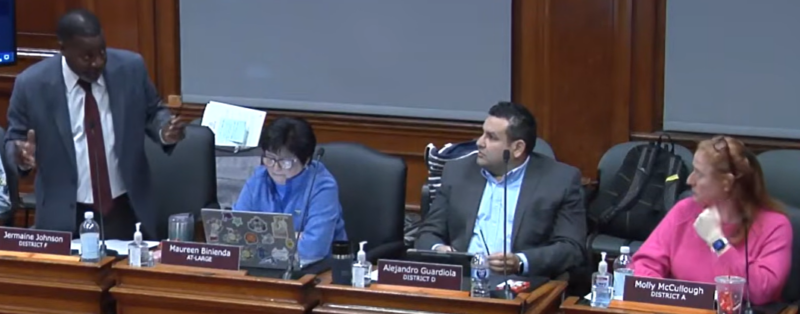
School committee member Jermaine Johnson, who requested the report, said the figures show that technology accounts for only a portion of the school day. While acknowledging parents’ concerns, Johnson said his visits to district schools have shown that teachers continue to incorporate hands-on activities and traditional instruction.
“The creativity of the work that they’re doing kind of tells me that there are other things going on in the classrooms besides kids sitting in front of the computer,” Johnson said. “There is writing. There is reading and arithmetic. Those things are going on using pen and paper.”
He added that he has not observed the kind of overwhelming reliance on screens that some parents fear.
“I’m not sitting here telling you that it’s not occuring because it is,” Johnson said, “it’s part of the curriculum, but I’m not seeing the overall picture that these kids are just behind a screen and it’s a distraction and they’re not learning anything. I’m just not seeing that.”
Committee member Alex Guardiola cautioned against allowing concerns about technology to become criticism of teachers, arguing that the discussion should focus on appropriate uses of digital tools rather than assumptions about classroom instruction.
“We can absolutely have a conversation about appropriate screen time, that effectiveness of digital learning as a tool, and whether we are striking the right balance between technology and traditional instruction,” he said. “Those are legitimate question and I think we have an obligation to ask them, but we also have an obligation to be fair to our educators. Our teachers are professionals. They are developing lesson plans, differentiating instruction, working with individual students, managing classrooms, making instructional decisions every day. To suggest directly or indirectly that these students are simply sitting in front of screens for the majority of the day is an unfair characterization of what’s happening in our classroom.”
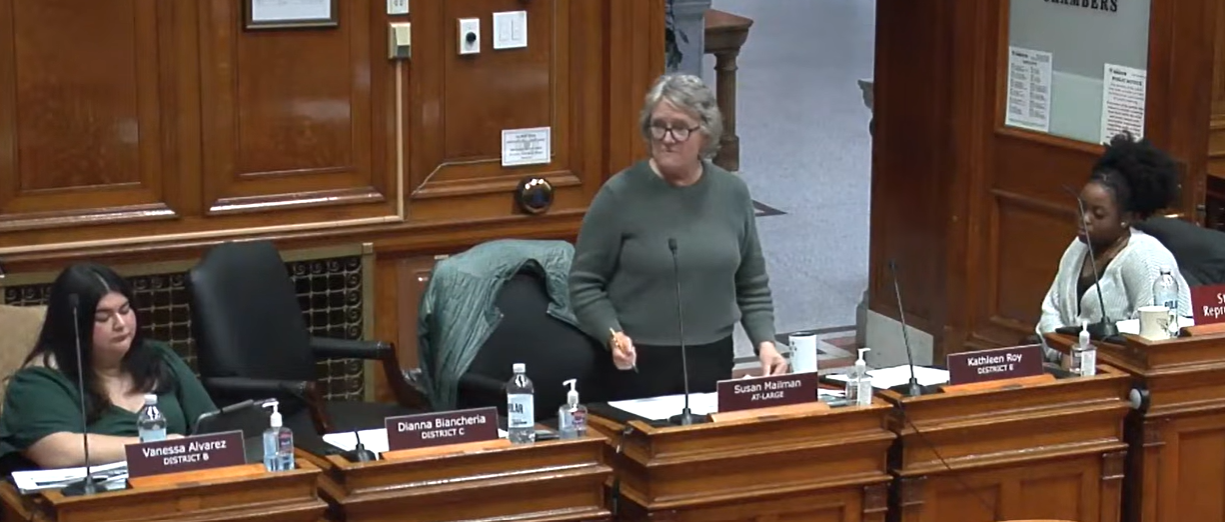
School committee member Sue Mailman pushed back on the suggestion that parents were accusing teachers of relying exclusively on screens. She said the bigger question of whether technology belongs in early elementary classrooms deserves consideration, particularly as school districts nationwide grapple with similar concerns.
“I think it’s worthy of consideration,” Mailman said. “I’d like to hear from the district and the leadership. I understand the policies we’re trying to create and as time go on we’ll be better at monitoring those policies, but I want to emphasize that I for one do not think anybody has said that we have kids sitting in front of Chromebooks all day and I want us to really think about these early grades and to hear more from the district on what are the proactive things that we’re going to do to make sure we’re keeping kids safe and taking care of the things that families are concerned about.”
The referral leaves the petition unresolved, with further discussion expected before the district determines whether changes to its device policy are warranted.
For now, the debate reflects a question facing school districts well beyond Worcester: How to prepare students for an increasingly digital world without allowing technology to displace other forms of learning.
Jason Bleau can be reached at bleau.jason@yahoo.com