
WORCESTER—The Worcester City Council reviewed a new strategy for addressing homelessness Tuesday, along with a revised public camping ordinance that drops a controversial $25 daily fine for unauthorized encampments.
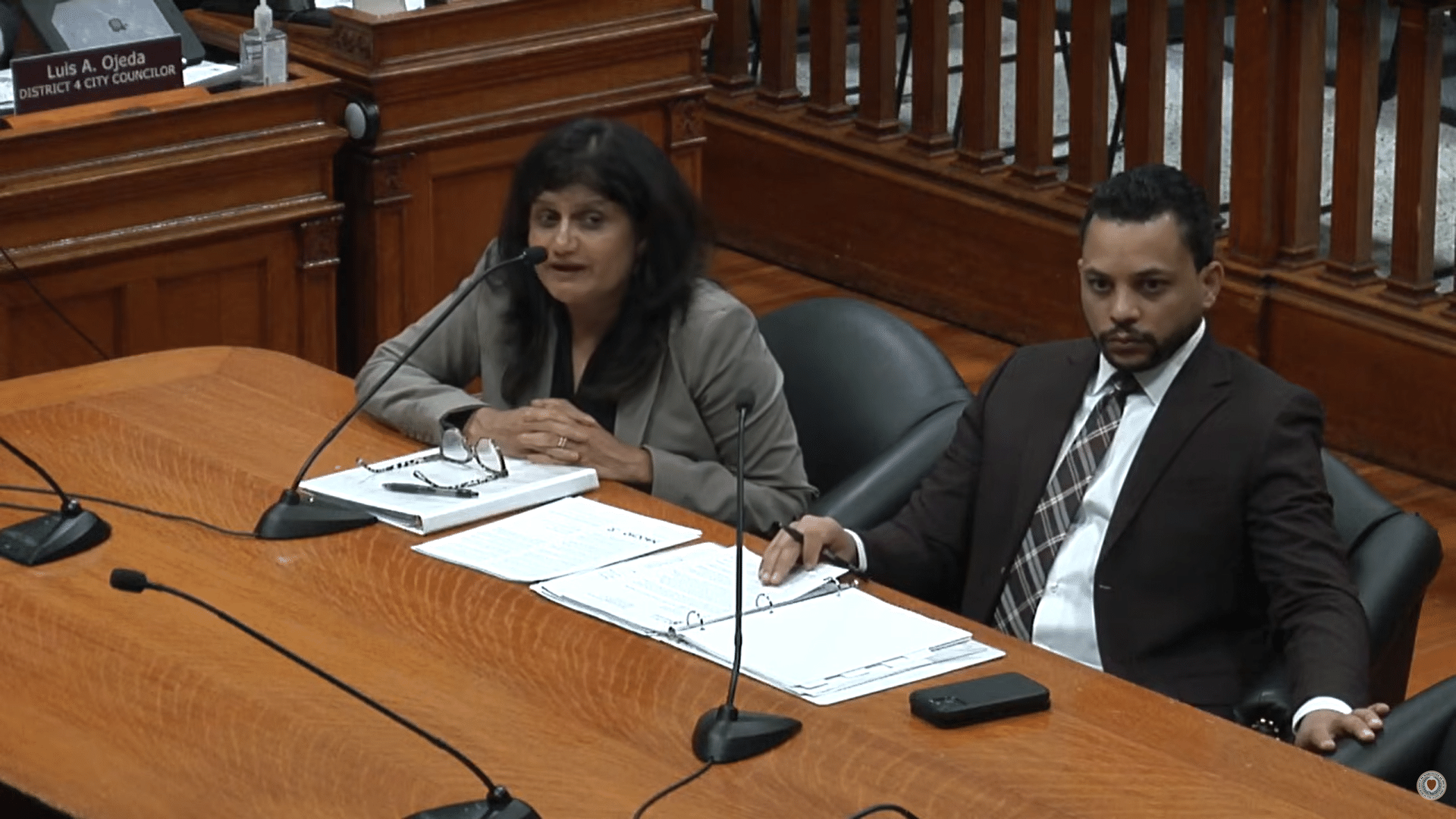
The strategic framework, “Disrupting the Cycle,” was developed by Health and Human Services Commissioner Seema Dixit and presented to the council as a broader, more coordinated approach to homelessness.
The plan calls for greater collaboration among local social service and mental health providers, state and national agencies, and other municipalities. It proposes standardized training, centralized outreach and better data sharing among partners, along with expanded shelter capacity, pathways to permanent housing and services addressing mental health, food insecurity and substance use.
A previously proposed $25-per-day fine for unauthorized encampments had drawn opposition from councilors and residents. The fine, which city officials said was intended to encourage engagement with unhoused individuals, was removed from the latest version of the ordinance.
“What we’ve been doing for decades isn’t working,” Councilor Gary Rosen said, adding that the city has no desire to criminalize homelessness. “It’s not a question of forcing them to go into shelters, it’s saying ‘What you’re doing is dangerous. It could be fatal. We want to help you.’”
Councilor Tony Economou asked what happens after the city becomes aware of someone experiencing homelessness. Dixit said an initial assessment helps determine which services or resources a person needs. The challenge, she said, is that some individuals refuse services or are unable to make decisions necessary to protect their well-being, requiring further intervention.
“Unfortunately, many times, the individual refuses services, or are not in a situation to make a decision that is best for themselves,” Dixit said, “in which case, if they are at severe risk of losing their life, or having an overdose, or not in a position to be left alone, then further action is taken.”
Economou said bringing more service providers into the process is essential because the city cannot address homelessness on its own. He urged the administration to invite outside agencies to meetings of the city manager’s homelessness steering committee.
“We don’t need just intake, we need mental health, drug abuse, alcohol abuse, domestic violence, child abuse – we need services for all of that. The City of Worcester does not have the capability of providing all of those services. We need them to help us work together to help alleviate that problem,” Economou said. “We need everybody at the table. This is not just some of us. This is all of us.”
Dixit said the coordinated approach would help standardize training and ensure people are connected with appropriate services.
Councilor Kate Toomey said Worcester has developed several homelessness plans over the years without achieving the desired results. She said the new framework offers an opportunity to create a more cohesive and sustainable approach.
“We have dedicated organizations and compassionate professionals doing important work throughout Worcester, but too often they are working independently, rather than part of a coordinated system,” Toomey said.
Councilor Satya Mitra said the city is doing more to help people experiencing homelessness than many residents realize. Having accompanied outreach workers as they approached people living in encampments, he described their efforts as “extremely compassionate.”
Mitra said he also spoke with individuals who refused services, illustrating the difficulty of connecting people with the help they need.
“I do think the time has come that we do take some action,“ he said. “I think we are doing our best. We’ve got to do something more drastic so we can take them all, to the right place, so we can rehab them, or get them the mental health [services] they need.”
Dixit said many agencies already use similar approaches to helping unhoused residents, but gaps emerge when information is not shared.
“One of the goals is to make sure it’s not just a two-person army, but all of us are coordinated,” she said, adding that better data sharing would improve accountability.
“What we have done so far is not working, and there needs to be more accountability from us, from the businesses, from the social service agencies. What we are proposing through the strategic framework is to make sure that everybody enters their data in the HMIS which is the centralized housing system, so there is accountability of who has been reached out to, are they connected to care, and what is the follow-up.”
Mayor Joe Petty agreed that coordination would be critical to making the strategy work.
“There’s a lot of people who want to do the right things, but sometimes you just have to rein everything in and bring it all together, as a team,” he said.
City Manager Eric Batista said the framework would guide the city’s Homelessness Task Force in identifying where resources and additional efforts are most needed.
“The purpose of this framework is to identify the gaps within this system, where we actually need to improve with the agencies,” Batista said, adding that while service providers do not agree on every issue, the goal is to build consensus.
“We are not in a place right now where I can say right now that ‘this’ is exactly what we need – more outreach workers, or we need more case management. What we do have a consensus on between the partners and the city, is we do need more permanent shelter beds, so how do we get there? How do we put more resources behind that?”
The council filed the homelessness strategy report without referring it to a committee.
Rosen moved to refer the proposed public camping ordinance to committee, but the motion failed. A subsequent motion called for advertising the ordinance ahead of an anticipated Dec. 1 council vote on its adoption.
