
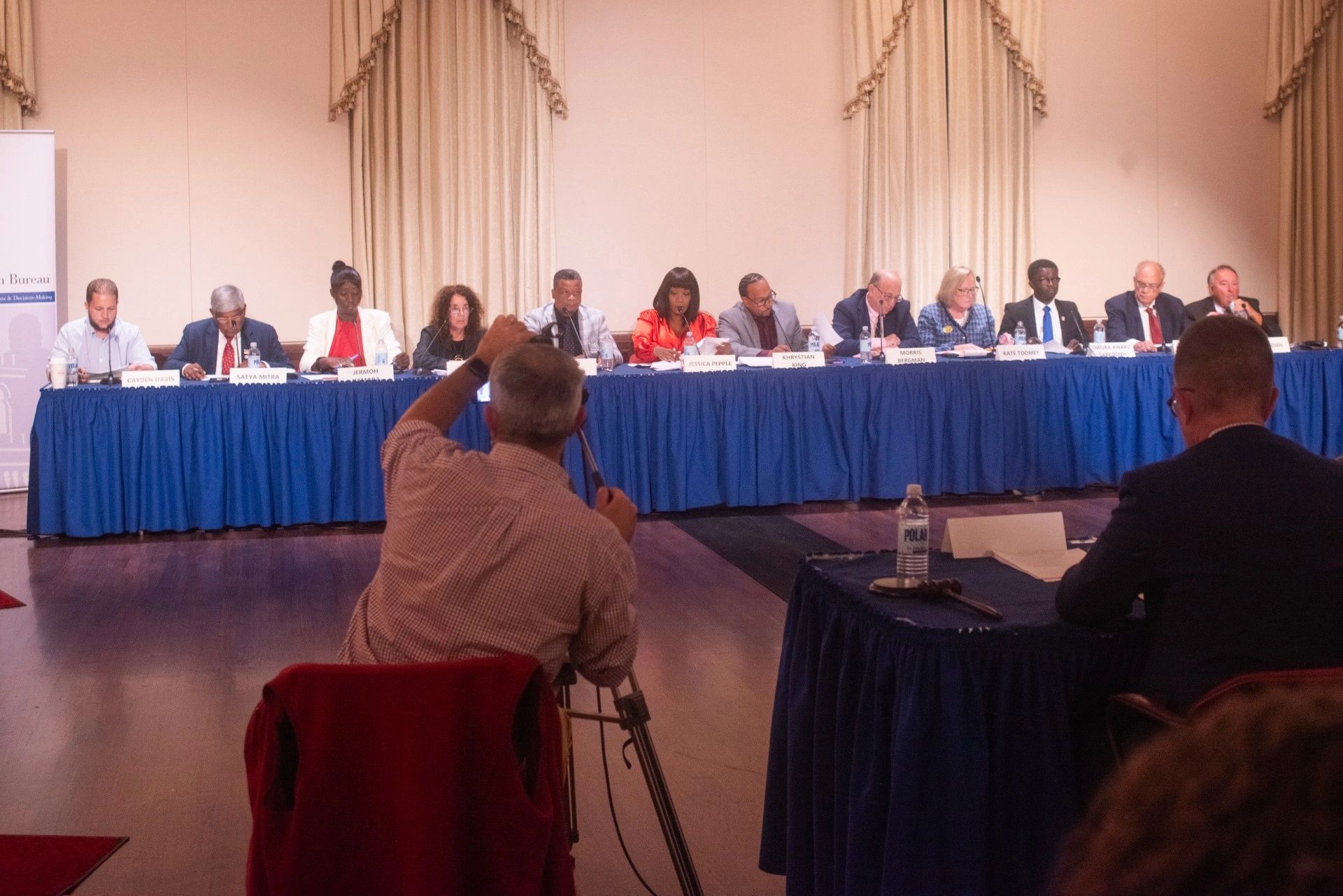
WORCESTER—The 12 candidates vying for at-large seats on the Worcester City Council took part in a debate on Oct. 8, presented by the Worcester Regional Research Bureau and the Telegram & Gazette, and hosted at Mechanics Hall.
One of the questions asked of all candidates focused on how Worcester should respond to large cuts in federal funding that could affect several essential services.
Cities such as Worcester rely heavily on federal support for health and social services. With proposed reductions to programs such as Medicaid, SNAP and other funding streams, candidates were asked how Worcester should respond to protect residents and maintain services.
Owura-Kwaku Sarkodieh said a deep-dive look at the effects of those cuts should come first.
“I believe Worcester can take care of itself from within,” he said, “especially if the federal programs or the grants are not in line with Worcester’s objectives.”
Defining the shortfalls and what programs are available will help prioritize what is most needed.
“We could also cut some programs that are not so important,” he said, suggesting reallocating funds to areas where they are most needed.
Some candidates, including Gary Rosen, said Worcester should look to the state for help, including from state and federal representatives.
“As we know, what’s going on at the federal level is a lot of law-breaking and a lot of presidential edicts that are not legal,” Rosen said. “We have to fight against that. We have to make sure that people in need in this city continue to get the financial help they need. I would talk to our senators and congressmen and say, ‘This is not acceptable.’ We have to do better, and they are the people we elected to help us.”
Candidate Satya Mitra said he would take a closer look at what Worcester can do on its own.
“I think it boils down to see what we can do with what we have,” he said. “Then we’ll see what programs are essential and what are not essential, to reduce them so we can live within the limits that we have.”
The budget process, he said, is where those savings might be found.
“When we do a new budget, we can see that everything we are doing is important — housing, schools, safety of the roads, which are probably the primary things we can keep,” Mitra said. “But at the same time, I think the new budget should come from the city manager to the city council. It’s not for the city council to recreate the budget. It should come from the city manager, and then we should work on it.”
Mayor Joseph Petty also advocated working with legislators to save crucial services, while emphasizing cooperation within the city.
“There is going to be some community impact, but we’ve always worked together as a community, and that’s important as we cut funds,” Petty said. “We have to work together.”
Petty cited a looming $16 million cut to fuel assistance as an example of a problem the city must address collectively.
“With this shutdown, they’re talking about a $16 million gap in the fuel assistance program,” Petty said. “That’s going to be a big number that we’re all going to have to address as a community, and I think we have the right people to do it.”
Morris Bergman agreed that most of the battles would take place at the state and federal levels but offered local suggestions.
“We need to make sure our budget is lean, so we can use available cash resources that may be able to help certain programs be subsidized,” Bergman said. “We need to at least reach out to the larger corporations in the city of Worcester to see if we can partner with them, to see if they can provide some assistance. The religious organizations have always been partners with the City of Worcester in times of dire need. Certainly they can be engaged and hopefully can contribute to offset some of the needs that are going to be in the community with these cuts.”
Donna Colorio said tax cuts for some large corporations could help.
“One would be to leverage the tax cuts to attract more businesses,” Colorio said, adding several other ideas. “Operational efficiencies; consolidate services and digital processes to save three to five percent of administrative costs; launch a lean Worcester audit; go to the state and federal advocacy; form coalitions with Massachusetts cities to lobby for state buffers and federal waivers.”
Jermoh Kamara also urged the city to work with legislators, but said Worcester should better leverage state “millionaire tax” funds.
“Worcester should be able to leverage this to get its fair share to support its needs should anything happen,” she said, also criticizing recent security upgrades at City Hall.
“We can use that, and cut that away and go back to how things were,” Kamara said, “because there is no real threat in Worcester. Worcester PD monitors downtown, and it’s a safe downtown.”
Jessica Pepple said that besides talking with legislators, the city should strengthen partnerships with churches and soup kitchens to bolster local support systems, while prioritizing school meals.
“It is going to happen, and while we’re figuring out what we’re going to cut and what not to cut, I think some cost/benefit analysis will help us determine what may need to be cut in order for us to fill this gap.”
Councilor Kate Toomey suggested a local impact audit, followed by the creation of a federal cuts contingency fund — a dedicated reserve of free cash and stabilization funds to buffer short-term shocks.
“We need to strengthen our partnerships with nonprofits, advocate for state-level support, and push for state back-filled funding for Medicaid and SNAP,” she said, adding that the city should also take a closer look at capital projects and explore new revenue streams.
Incumbent Khrystian King said the city is already facing a $2 million cut in state funding, and that $45 million in federal cuts could follow.
“Well, here’s what we know,” said King. “We’ve had a $2.1 million dollar decrease in state aid that had nothing to do with the Feds. It had to do with state aid and their budget. We know there’s been a $130,000 cut in the Food to Table program in Worcester Public Schools. We also know that $45 million dollars comes from Federal funding through the city for social services and could potentially be cut.
“We need to monitor those entitlement funds if in fact this happens. There are three things we can do. We can use Free Cash, we can look at new growth that’s over the budget and we can reduce some of the awards that we give out. And also, we can look at contingency funding. And those are what we need to do to keep our head above board. But make no doubt about it; all politics are local.”
Cayden Davis argued that social services will be hit hard.
“We are going to be faced, as leaders, with very difficult decisions,” Davis said. “I commit to prioritizing spending on what matters most — health, prevention, housing, and investment in community-based services. To me, these are not just moral obligations; they are fiscally responsible, because we know these investments save money in the long term.”
Edson Montero said the city should take a detailed look at expenses to find savings wherever possible — for instance, by finding cheaper but comparable products such as trash receptacles.
“We don’t need a $2,000 trash container,” said Montero. “We can find a cheaper solution, then we do the same job. We can start to review how we spend, how we can renegotiate and find cheaper solutions. Cheaper doesn’t mean worse.”
Steve Smith, a veteran reporter with 17 years at The Hartford Courant, now brings his passion for photojournalism to Worcester. An award-winning photographer, he has covered major events like U.S. soccer, pro football, and UConn basketball. He is also the official photographer for the Miss Massachusetts competition and works as a realtor. Contact him at steve@stevephotographysmith.com
