
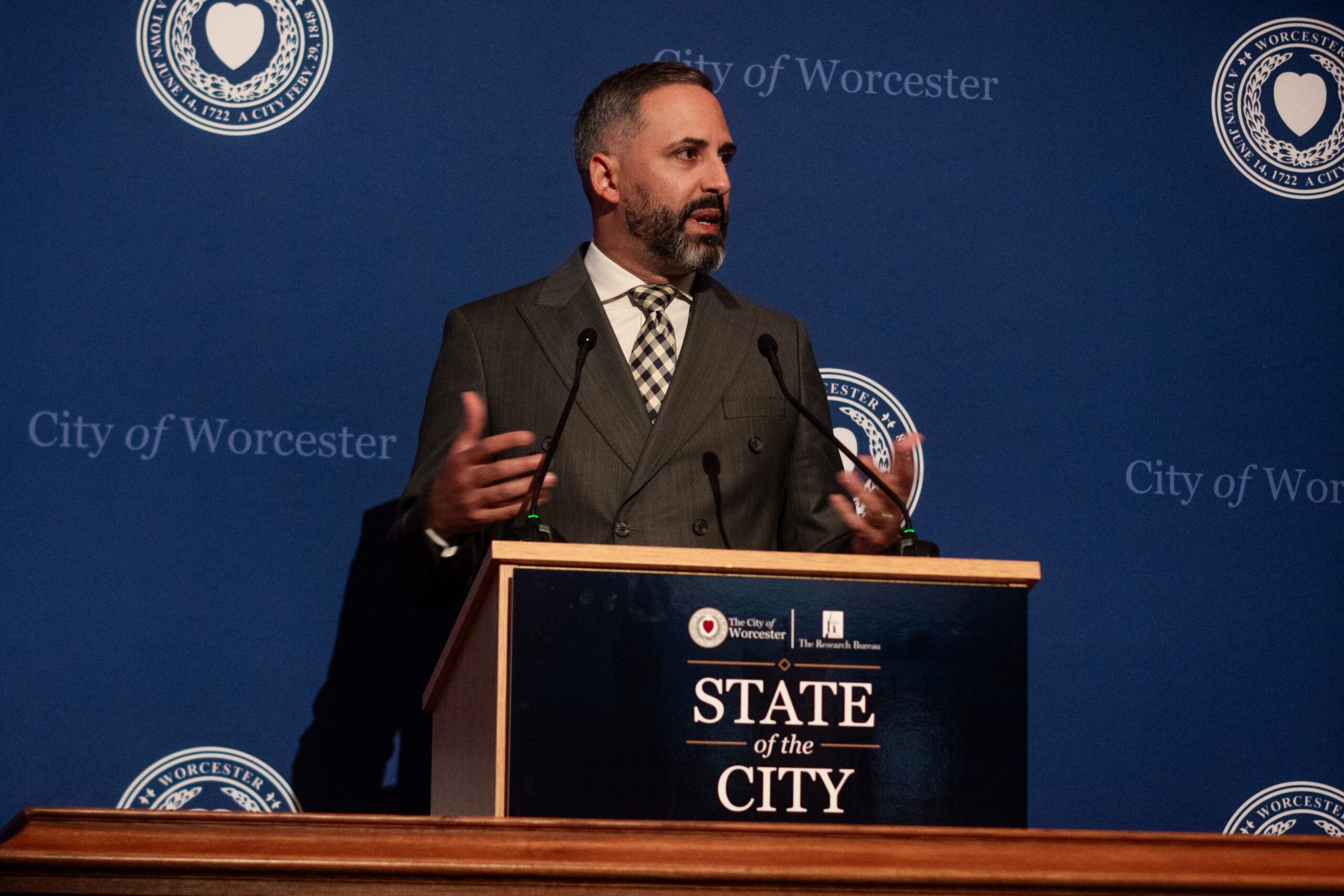
Financial stability, infrastructure investment and optimism about Worcester’s future took center stage Wednesday as City Manager Eric Batista delivered his third annual State of the City address at City Hall.
Speaking a day after the city council approved Worcester’s first $1 billion budget, Batista said the city is better positioned than many Massachusetts communities to weather economic uncertainty while continuing to invest in services, housing, infrastructure and public safety.
Batista began by describing the annual address as an opportunity to update residents and stakeholders on city initiatives and accomplishments. He praised the council, state legislators, business leaders and municipal employees for their role in helping move Worcester forward.
Two years ago, Batista said Worcester was entering an “era of opportunity that will lead to an era of accomplishment.”
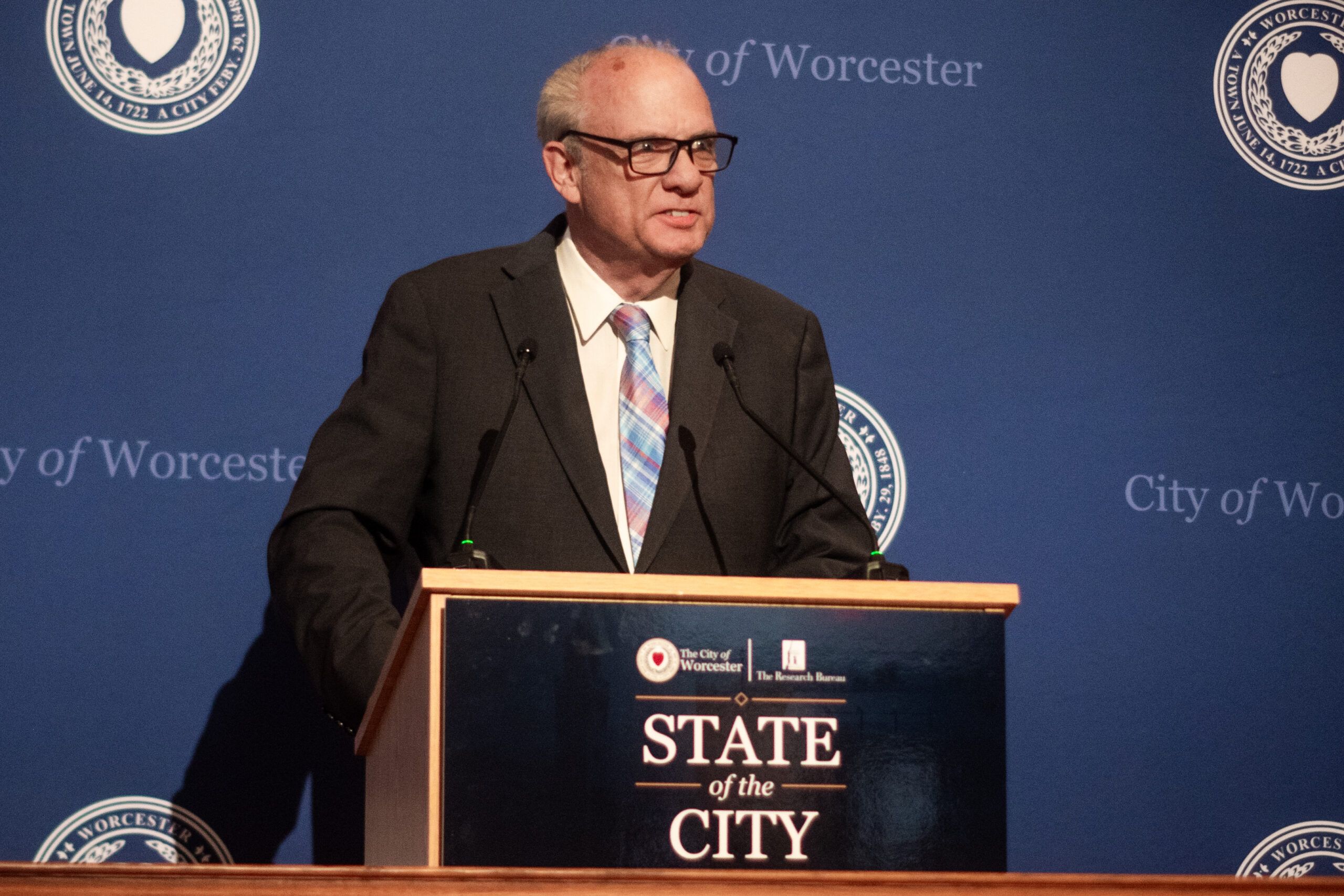
Now, he said, much has been accomplished, but new challenges have emerged.
“Decisions are playing out at a national and global scale that have impacted us here in central Massachusetts. It’s been a time of change that requires bold action. Fortunately, Worcester has a history of not just facing change, but being at the forefront of it,” he said.
Batista said municipalities across Massachusetts are confronting financial pressures, including reductions in federal and state aid. He credited his administration and the City Council with taking a cautious approach in recent years that helped prepare Worcester for uncertainty.
“Last year, I told you that were proposing a budget with minimal new expenditures, to guard against risks, along with a $5 million contingency as a buffer for unexpected reductions throughout this year,” he said. “Those strategic decisions have left us on solid financial footing, and allowed us to withstand those unpredictable times without having to take drastic measures.”
The city’s financial position, he said, has helped limit tax increases and avoid cuts to municipal services.
“I’m proud to say that because of those efforts and the hard work of the entire municipal staff, the state of the city is still strong,” Batista said.
Batista said Worcester continues to grow as new residents move into the city, while municipal services have largely kept pace with that growth.
Infrastructure remains one of the administration’s top priorities. Batista highlighted investments including a $25 million South Division Fire Station, $5 million in repairs to police headquarters and $20 million in school projects. The city has also continued investing in technology intended to improve municipal operations and expand internet access.
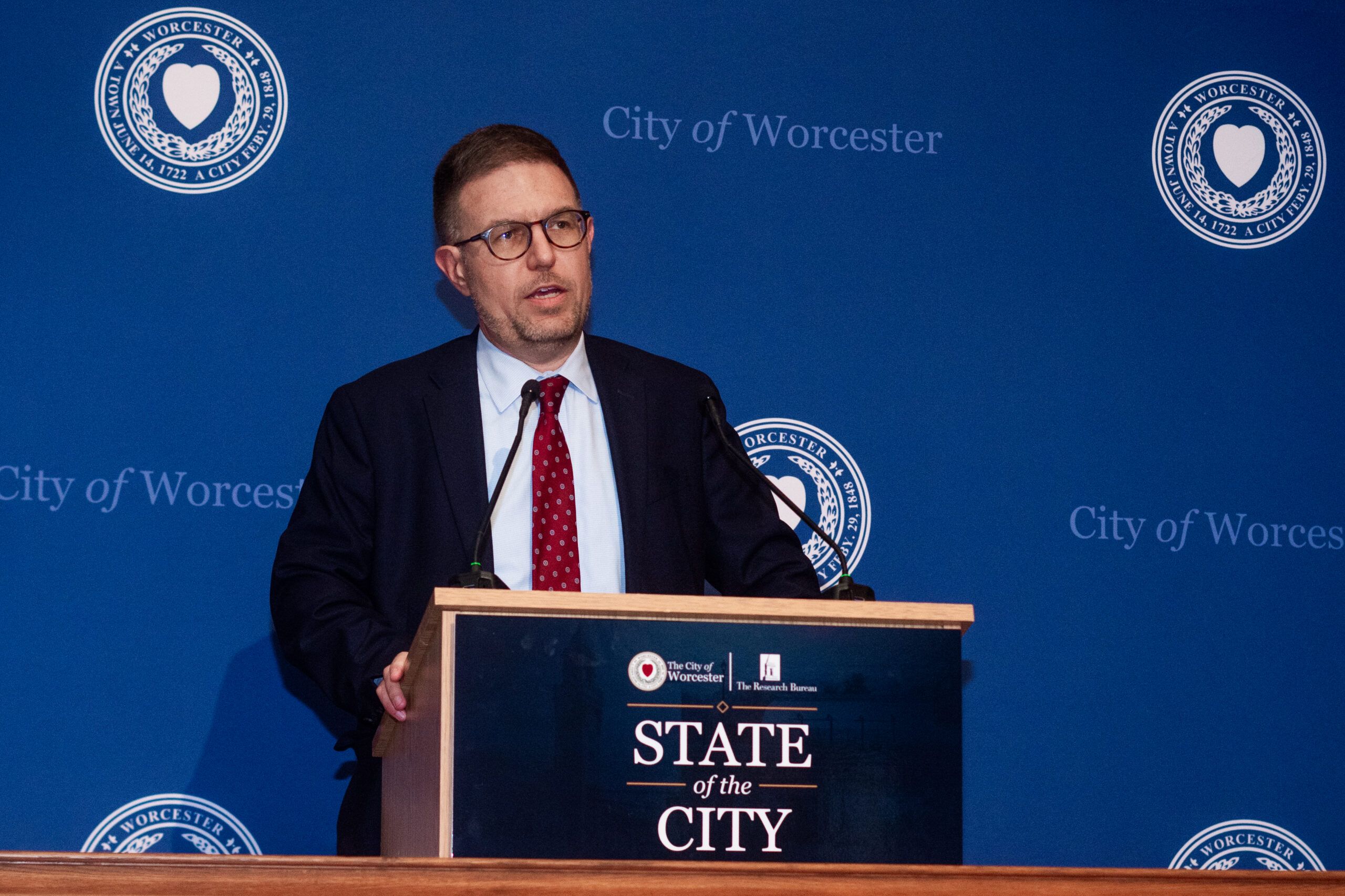
“These efforts have taken resources, changes in work practices and millions of dollars, but they’re all to ensure our municipal government can thrive in a modern, digital landscape,” he said. “We want high-speed, reliable affordable internet for every household, business, school and non-profit. We’re getting there by contacting vendors—industry stakeholders—to maximize that access.”
Road conditions remain a challenge, Batista acknowledged. A difficult winter contributed to a surge in potholes and helped drive a significant increase in road and infrastructure spending.
“These investments go above and beyond the funding recommendations of our pavement management plan,” Batista said, “so we can prevent deterioration in our infrastructure and equipment before it actually happens. We’re investing now, and we’re acting now.”
The audience laughed when Batista referenced the Department of Public Works’ ongoing effort to “fill all of the potholes” and announced operational changes intended to improve the city’s repair process.
Batista also emphasized economic development, saying the city continues working to support existing businesses while attracting new employers. He pointed to efforts to streamline regulations, review policies and hire additional inspectors as part of that strategy.
Those efforts, he said, are helping strengthen Worcester’s growing reputation in technology, life sciences and biomanufacturing.
Immigrants, Batista said, have long played a central role in Worcester’s growth and continue to contribute to the city’s cultural and economic vitality.
At the same time, he acknowledged that Worcester faces a housing shortage and said the administration is focused on increasing housing production, including affordable housing, through its recently adopted Housing Production Plan.
“Efforts like these are why 28% of housing units actively under construction are affordable,” Batista said. “We were able to permit more units thanks to the Affordable Housing Trust Fund, including our zoning and our accessory dwelling unit ordinance.”
Addressing homelessness remains another priority, Batista said. He highlighted the city’s Housing and Homelessness Steering Committee, which is developing recommendations that will soon be presented to the City Council.
“We will expand shelter capacity, and we will get unhoused individuals out of the unsafe, and sometimes deadly conditions they face in the woods, and on the streets and sidewalks, and into services they need,” Batista said.
Batista also highlighted public safety initiatives, including Resilient Worcester, which expands trauma-response services for young children, and community policing efforts within the Worcester Police Department.
“That comfort and reassurance is exactly the feeling we want, to retain more residents,” Batista said, noting that officers are now required to spend at least 30 minutes of each shift walking Worcester neighborhoods and engag—ing with residents.
“Efforts like these have continued to make Worcester one of the safest mid-size cities in the country,” Batista said. “We know it’s working, because in 2025, we saw a drop in crime across the board. Worcester remains a safe place to live, to work, and to raise your families, and it is my pledge to keep it that way, even as we work to adapt to changes around us.”
Batista also pointed to community events including the World Cup watch party on Worcester Common and the Drake Maye MayeDay Family Foundation Celebrity Softball Classic at Polar Park as examples of the city’s growing momentum.
“It was made possible because we built one of the best minor league baseball parks in the country,” Batista said. “We used that momentum to bring new life to our Canal District—hundreds of new, market-rate and affordable units, new businesses in places that had lost them—it’s all because we dared to imagine more for a parking lot.”
Batista closed by urging residents to remain optimistic and engaged despite future challenges.
“I will not let difficult times define our city. Instead, it will be defined by how we rose to the moment, and in the face of uncertainty, change for the better. Just like we have for the past 250 years. Worcester does not get knocked down, and for better or worse is not afraid of a challenge. Join me in building a future – the future of Worcester we need and we all want to see.”
Steve Smith can be reached at steve@stevephotographysmith.com
Have a story tip, community concern, or insight to share? Email Editor Charlene Arsenault at carsenault@theworcesterguardian.org.
The Worcester Guardian is a nonprofit newsroom serving Central Massachusetts. Help keep independent reporting alive by making a donation today.