
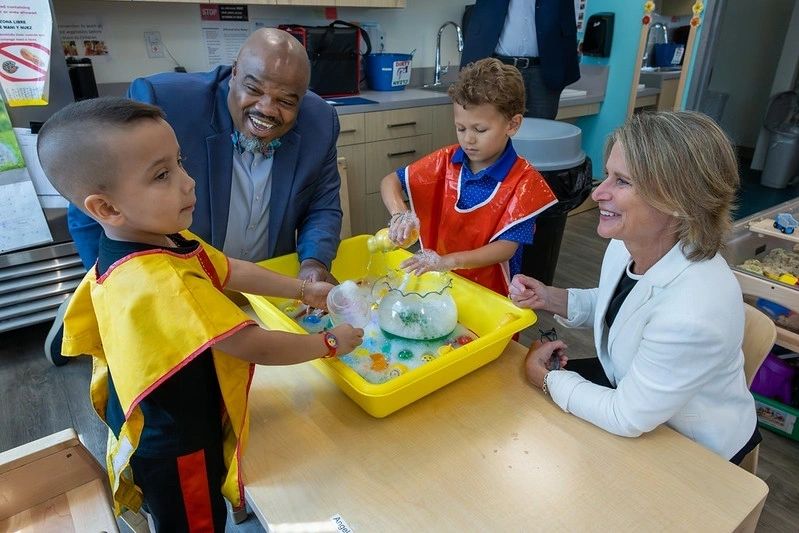
WORCESTER—Childcare costs and availability factor big into the family budget, often making a parent question whether it makes sense to work. Many families struggle with the reality that “it costs more for childcare than what I’m bringing home.” Still, demand for childcare remains high, and the industry continues to adapt amid shifting regulations and financial pressures.
In Massachusetts, the child care sector continues to grow, with new data showing increased capacity and improved workforce conditions. However, industry observers say accessibility and affordability remain persistent challenges.
Recent figures presented to the Board of Early Education and Care reveal that Central Massachusetts has added approximately 1,800 new childcare slots in the past year, marking a 4% increase in capacity. More specifically, over the last two years, Central Massachusetts added 3,088 center-based and family childcare seats for children.
Statewide trends and government support
Statewide child care licensed capacity continues to increase, with the capacity to serve 8,700 more children (4% increase) compared to the same time last year. Over the last two years, the state added 17,423 center-based and family child care seats for children.
Massachusetts Governor Maura Healey points to the Commonwealth Cares for Children (C3) program as a key driver of this expansion: “Under our administration, Massachusetts is the only state to maintain C3 funding at the same level the federal government did,” Healey said. “I am proud that we made this program permanent last year, which has been a game changer for not only maintaining but growing the number of childcare seats in every region of the state.”
Workforce challenges and wage increases
The data, collected from a comprehensive survey completed by 87% of licensed and funded programs between August and September 2024, shows that Central Massachusetts has created 3,088 new center-based and family childcare seats over the past two years. Statewide, the C3 program now supports more than 7,500 programs and helps employ more than 45,000 educators.
“Two years ago, C3 funding helped our childcare system expand beyond pre-pandemic capacity,” said Lieutenant Governor Kim Driscoll. “I’m excited to see the system continue to grow this past year, adding more affordable seats across the state, increasing educator wages and reducing the number of open staff positions.”
Affordability concerns persist
Worcester Mayor Joe Petty said that his office has taken part in groups with the city manager, Edward Street, the YMCA, YWCA, the Guild of St. Agnes, and other organizations that have been advocating for greater availability and support within the sector of early education and childcare.
“I believe that these collaborations show our commitment to creating supportive child care needs, and we are eager to be creative in our approach to navigating early education and childcare demands,” said Petty.
The workforce data has shown mixed results. While vacancy rates have decreased from 11% to 9% compared to 2023, staffing remains a significant challenge for many providers. Educator wages have increased by approximately 20% over the past two and a half years, outpacing average inflation during this period. Programs are now directing 68% of C3 funding toward workforce-related expenses, up from 66% in 2023, covering payroll, benefits, and salary increases.
However, industry analysts note that despite these improvements, early education workers’ wages still often lag behind comparable professions, potentially affecting long-term retention and recruitment. “Finding and retaining qualified early educators has been difficult because wages in child care simply do not compete with other industries,” said Wilson Kiriungi, president of Early Steps Childcare in Worcester. “This impacts everything—if we can’t staff classrooms, we can’t enroll more children, even when demand is high.”
Worcester’s progress and ongoing challenges
About half of center-based programs in lower-income communities report stable tuition rates, with no increases planned for six months. Additionally, 72% offer reduced tuition for staff members’ children. Still, childcare costs remain a major burden for many Massachusetts families, especially in cities like Worcester.
“The cost of child care is high relative to income, and while state subsidies help, there are still gaps in coverage,” said Kiriungi. “Many families earn just above the eligibility limit for assistance but still struggle to afford tuition.”
Statewide data indicates that Massachusetts has added 45,000 childcare slots since spring 2021, when the sector reached its pandemic low. Access to affordable care remains uneven across different communities and income levels.
Worcester has seen growth in childcare capacity, but it’s unclear whether this expansion fully addresses longstanding gaps in access. Families in different neighborhoods continue to face varying challenges in finding affordable, quality care.
“We can continue to make early education more affordable and accessible for families,” said Sen. Robyn Kennedy, D-Worcester, “but if they’re not educators in the classrooms, those slots are going to continue to go unused.”
The C3 program’s impact extends beyond capacity expansion. Programs receiving C3 funding report providing additional financial support to families beyond state assistance programs, suggesting ongoing efforts to address affordability concerns. However, Kennedy noted sustainable solutions to long-term affordability challenges: “We are fortunate here that with the Fair Share Amendment and the dedicated funds from there towards education, that revenue continues to grow,” Kennedy said. “And so, you know, we’ll be able to hopefully continue to prioritize early education.”
Kiriungi emphasized that expanding subsidy eligibility and capping out-of-pocket childcare costs based on income would ease the burden on many Worcester families. He also noted that increased funding for centers serving voucher families and children with special needs would help create more equitable access to care.
While progress has been made in expanding childcare options across Massachusetts, affordability and workforce challenges get in the way. Advocates and policymakers continue to push for sustainable funding solutions to help all families access quality early education. The coming years will determine whether initiatives such as the C3 program and new funding sources can create lasting improvements in affordability, accessibility, and workforce stability.
