
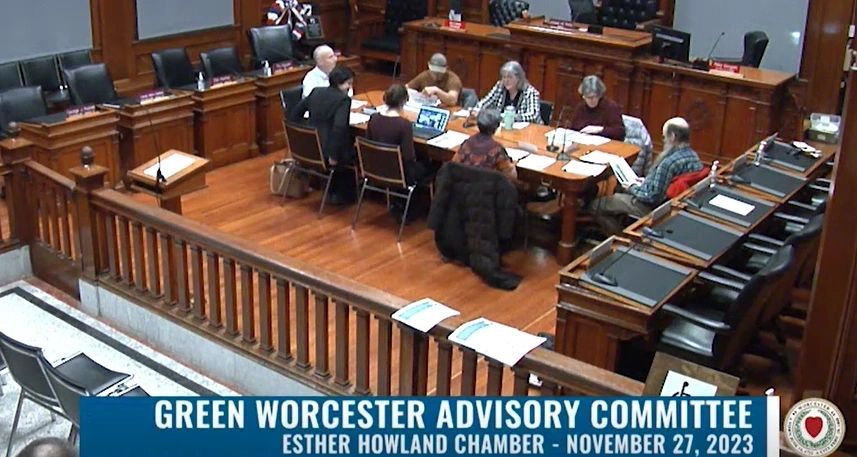
WORCESTER—The Worcester Green Advisory Committee reviewed and discussed a draft of the Green Worcester Plan’s progress report at its meeting Monday night with some committee members drawing attention to the lofty goals the city set for itself in the plan.
“I was both thrilled and a bit dumbfounded that we were going to take on these incredibly aggressive goals,” Committee Member Ted Conna said Monday. “I’m glad we did, but now that we’ve done it, we need to be realistic about where we are on that path and how we’re going to get there and if that means that (the Department of Sustainability and Resilience) need[s] a bigger staff and double the budget then we need to start saying that.”
Conna pointed to certain targets in the report that he said seemed difficult to reach, including the goal to make municipal operations and buildings net-zero by 2030. Operating at net-zero would mean the city produces the same amount of greenhouse gas it removes from the environment.
“[The draft report] says we’ve reduced carbon emissions from municipal buildings by 16 percent,” Conna said, “but the uncomfortable question arises that we have 84 percent to go and there’s only seven years left.”
The draft report neglects to specify how close the city is to net zero operations, but says the work toward reaching the goal is in progress and it is a 2024 priority action. The draft states the city has installed three solar PV systems on municipal buildings and hired the company Honeywell to conduct an assessment of the city’s facilities to “increase energy efficiency providing cost savings for our municipal operations.”
The city also has the goal of having 30 percent of private sector buildings heated by renewable energy by 2030.
“I don’t have any idea how we’re going to pull this off, I’m not sure anyone does,” Conna said of that goal.
John Odell, the city’s chief sustainability officer, said Monday that his office is working with National Grid and Eversource on outreach efforts to encourage customers to make homes more efficient and switch over from heating their homes with gas or oil to heat pumps.
Odell said the city has programs in place to start the process of converting its own municipal buildings, including school buildings, from gas to heat pumps.
“Gas is the primary heating fuel and we’re looking at ways to start the conversion process in combination with actually making those buildings more energy efficient so that they need less energy to stay to provide heating and cooling in the summer,” Odell said.
The challenge, he said, is to heat spaces in larger buildings with electricity as opposed to gas currently, but that the “equation is becoming more solvable as heat pump units are becoming increasingly more efficient.”
One of the accomplishments listed in the draft report is the city adopting a highly efficient energy building code known as the Specialized Stretch Code which will go into effect in July 2024.
“This Specialized Stretch Code will require all new buildings to be essentially net zero ready – by promoting electrification and extensive weatherization that will reduce the cost and energy needed to heat and cool buildings,” the draft report states.
Mary Knittle, committee chair, shared her agreement with Conna that the goals are daunting, but said she feels “we’re on the curve of an actual revolution.”
“The resources available to people to do anything they used to do just aren’t even going to be there,” Knittle said. “They’re…going to stop building gasoline powered cars, the equipment, the stoves, everything is changing.”
Knittle said because of those changes she hopes there will be a quick escalation in the adoption of renewable energy and energy efficient choices.
The city released the Worcester Green Plan in 2021, describing it as a roadmap to bring sustainability values to all aspects of city life. One of the plan’s goals was to establish the Department of Sustainability and Resilience (DSR) itself, which was established in July 2021 and now has 12 full and part-time staff members, according to the draft progress report.
Another goal was establishing the Green Worcester Advisory Committee, which includes members that do not work for the city to advise its sustainability and resilience activities, according to the city’s website. The committee began meeting in 2022.
The city’s other completed plan actions include establishing the Green Worcester Fund which (DSR) can use to partially fund its staff and pursue carbon mitigation projects, creating a dashboard highlighting the city’s accomplishments and outlining how residents can help it achieve its sustainability goals, joining the Urban Sustainability Network and creating the Department of Transportation and Mobility in July 2022.
The city is working to increase its tree canopy to 30,000 to 35,000 by 2050. In its efforts to achieve that the city was awarded a grant of $409,000 to plant two Miyawaki forests and design two resilient community place-making spaces. The small but biodiverse forests are known for reducing heat and flooding and will be planted by July 2024.
The city’s Urban Forest Master Plan was also discussed at the Green Worcester Advisory Committee meeting Monday. The committee voted to urge the plan be more aggressive, calling for the tree replacement ratio for trees removed in both public and private projects to be changed to a three to one ratio rather than a one to one ratio, meaning three trees would need to be planted for every one that was removed.
Other progress the city has made on its Green Worcester Plan includes moving 33 percent of the way to its goal to establish electric vehicle charging stations in all city-owned parking areas with 20 or more parking spaces, hiring a zero waste coordinator in August to advance the plan’s zero waste goals, and receiving $7.8 million from the EPA to work on brownfield remediation programs.
Committee members provided several comments to DSR about the draft progress report, which they are also able to submit via email. The department will work on addressing the comments and provide the committee with a final draft to be discussed at its next meeting in January.
Kiernan Dunlop is an award-winning journalist who has spent the past five years reporting in Worcester, New Bedford and Antigua and Barbuda. She’s been published in Bloomberg, USA Today, Canary Media, MassLive, and the New Bedford Standard Times, among other outlets. She can be contacted at kdunlop@theworcesterguardian.org