
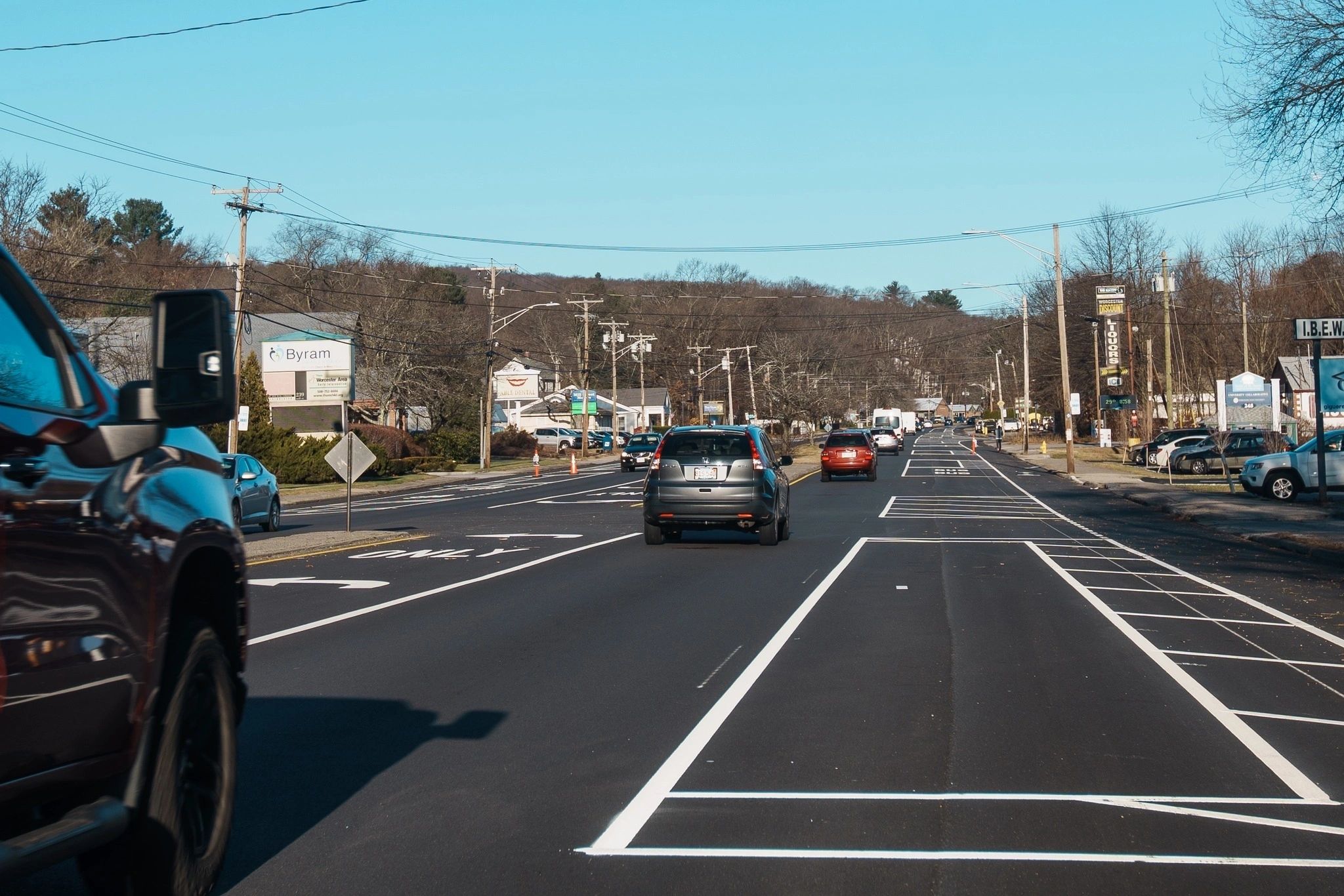
WORCESTER—A year and a half after the city reconfigured Mill Street in the name of safety, a new traffic report shows fewer crashes and slower speeds. But at Tuesday’s city council meeting, some councilors weren’t completely buying the narrative just yet.
Instead, there was some pushback, particularly from Councilors Morris Bergman and George Russell, on the data, the process, the costs and the next phase of the project, which now includes a $2.5 million design effort funded through federal and local dollars.
Crash rates down—but questions up
The safety review, submitted by Commissioner of Transportation and Mobility Stephen Rolle and City Manager Eric Batista, cites what they called “strong and positive” trends since the city narrowed Mill Street and added flex-post barriers, bike lanes, and new signage. The redesign, officially completed Dec. 1, 2023, was touted as a critical step in Worcester’s “Vision Zero” campaign to eliminate serious traffic injuries and fatalities.
According to the report, average speeds have dropped 13% from 40 mph to 35 mph. Crash rates fell from a previous 3.1 per month to 2.3 in the first half of 2025. But Councilor Morris Bergman wasn’t convinced. He questioned whether the improvement was real—or simply the result of fewer cars using the street at all.
“If the number of cars going through there dropped, then the numbers you’re suggesting are an improvement have less consequence,” Bergman said, pressing Rolle for vehicle volume data that was notably absent from the report. Rolle acknowledged the omission, saying, “There hasn’t been that analysis,” and added that such data could be collected going forward.
Councilors demand harder numbers, accountability
Bergman also raised his own review of crash data from the state, noting Mill Street saw 28 crashes in 2022, 61 in 2023, and 40 so far in 2024. “That was the first full year of the redesign,” he said. “Better than 2023, but worse than 2022. So my question is: Isn’t saying it’s a positive trend a little premature?”
Rolle stood by the report’s framing, which compared the three years before the redesign to the last 18 months, and more narrowly, the past nine months since new flex-posts were installed. While acknowledging that short time frames limit the reliability of crash data, he maintained, “The trend is strongly positive.”
Russell, meanwhile, took solid aim at the cost. The city is poised to spend $2 million in federal funds and $500,000 in local matching dollars—not to build anything, but simply to design the next round of improvements. “I’m just flabbergasted,” he said. “So that $2.5 million is just to design, and not actually to do any work?”
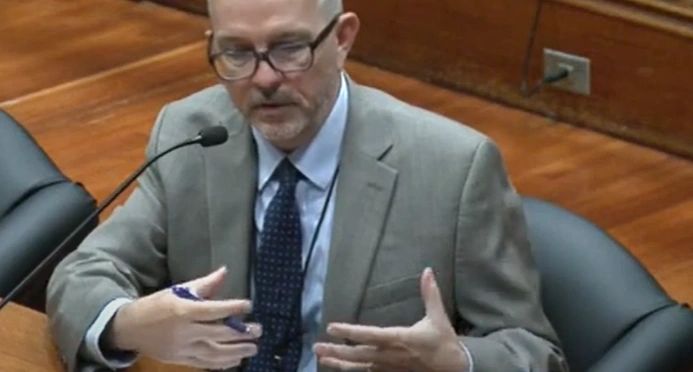
Pushing back, Batista maintained corridor redesigns are complex and expensive. He pointed to Worcester’s Main Street project, which ultimately cost $11 million from start to finish. “The design is going to take into consideration catch basins, water and sewer, center islands,” he said. “This is going to be that kind of project. So we need to do it right.”
Russell pressed further, questioning the wisdom of allocating $2.5 million strictly for design work and asking for a comparison to recent paving projects like Massasoit Road. Rolle declined to estimate without checking the figures. Batista again defended the cost, describing it as a “significant design effort” requiring multiple engineers, coordination with state agencies, and detailed analysis of infrastructure.
“At the end of the day,” Batista said, “they’re going to tell us how much this is going to cost to build the entire project—and that could mean a lot more than $2 million.”
A divided view of progress
Rolle added that a public meeting last fall gave residents an early glimpse of what could come, including permanent protected bike lanes, improved pedestrian crossings, and overall safer configuration. But for now, the earmarked money is for planning and design only.
For some councilors, the disconnect between data and lived experience remains an issue. Bergman noted that residents and business owners on Mill Street have told him traffic feels lighter since the redesign, and that aggressive drivers now have “nowhere to go but into a parked car” if they attempt to pass.
Rolle agreed that driver behavior remains a concern—not only on Mill Street, but citywide. “We’re seeing aggressive driving everywhere,” he said, citing anecdotal reports and data showing crash rates have already rebounded past pre-pandemic levels. He emphasized that Worcester’s Vision Zero strategy requires “a multi-faceted approach”—design, enforcement, education, and regulations all working in tandem.
Methodology, community feedback, and next Steps
District 5 Councilor Etel Haxhiaj, who has been supportive of the redesign effort, asked Rolle to explain the methodology used in compiling the report. Rolle said his team analyzed crash logs from both Worcester police and MassDOT, mapped and categorized incident types, and excluded 2020 and 2021 due to pandemic-related anomalies. “We did this to make sure we captured everything and made a fair comparison,” he said.
Haxhiaj noted that many changes—such as the pending 20 mph safety zone at Mill Swan School and a new crosswalk at Binienda Beach—were added in response to resident feedback. She praised city staff for walking, biking, and driving the corridor regularly to better understand how it functions. “These are not just Mill Street issues,” she said. “These are citywide behavioral issues.”
Rolle echoed the point, emphasizing that firsthand experience helps inform better street design. “We need to understand the context of the data,” he said. “And I think we’ve been successful. People know how to drive the corridor now.”
Councilor Khrystian King raised pedestrian safety concerns, especially the long distances between crosswalks. “It becomes a dodging game,” he said, referencing his daughter’s time at the school on Airport Drive. He asked for a strategic map and timeline for additional crossings, noting how gaps in crosswalks have contributed to pedestrian fatalities on other city streets.
Rolle said new crosswalks were added in the initial redesign, including at June Street, Mill Swan, and Logan Field, with more to follow. A high-priority crosswalk near Binienda Beach is expected to include a pedestrian island and flashing beacons, with hopes to install it before winter.
Call for clarity before moving forward
While no councilor outright rejected the progress made, several requested formal reports for the next meeting. Those include a timeline for crosswalk installations, traffic volume data, funding spent to date, and a clearer breakdown of the total projected cost.
Beyond City Hall, residents have also been vocal. Christina Giza, who lives at Coes Pond Apartments off Mill Street, told the Worcester Guardian the city’s focus on Mill has overshadowed the dire condition of nearby streets.
“First Street is an ABOMINATION!” she wrote. “The potholes have potholes!” She noted the street serves more than 350 older residents, along with buses, ambulances, and emergency vehicles. Despite years of complaints to city departments and local police meetings, she said, the city’s patchwork fixes haven’t solved the problem. “Please have the city replace the entire street,” she wrote, “NOT patch it up every spring (while also leaving many potholes behind).”
As Batista and his team gear up for another major redesign of Mill Street—one that could take years and many more millions—some councilors made clear: they want numbers, not just trends, before the city steps on the gas again.
Have news, tips, or a story worth telling? Reach Editor Charlene Arsenault at carsenault@theworcesterguardian.org—because good stories (and great scoops) deserve to be shared.
- The Worcester Guardian is an independent nonprofit news organization. Support local journalism by making a DONATION today.