
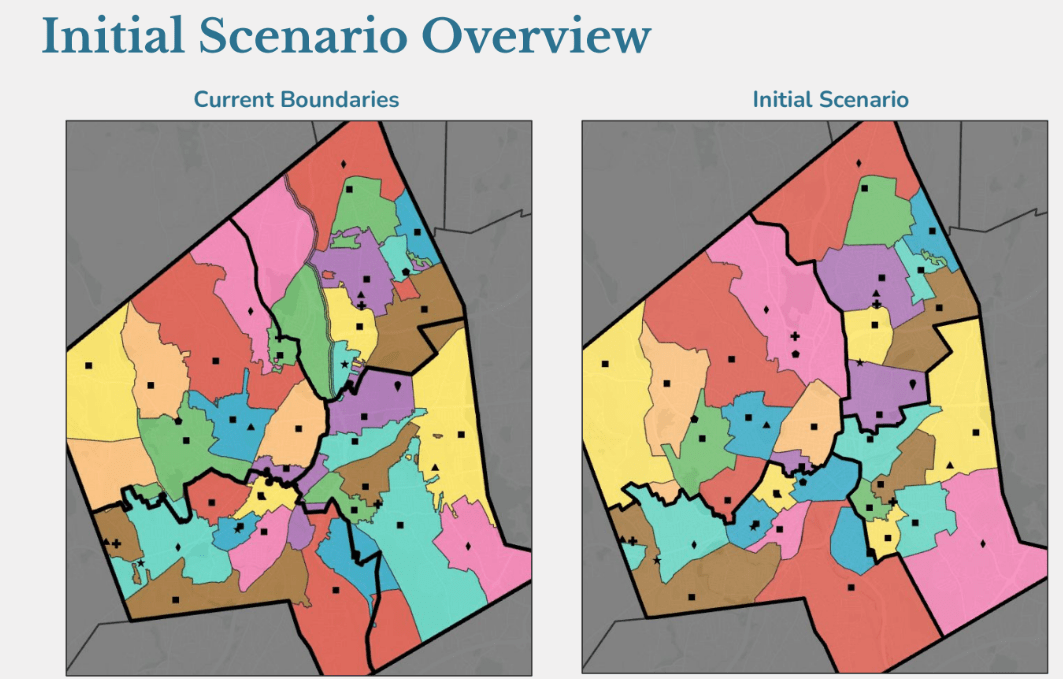
The first of four potential plans to redraw Worcester Public Schools boundaries would shift several schools between quadrants, convert one magnet school to a neighborhood school and relocate Worcester Arts Magnet across the city. It is a proposal that quickly emerged as the most contentious part of the district’s first public hearing Tuesday night.
The Standing Committee on Operations and Governance got its first look Aug. 18 at the initial scenario for district boundaries and realignment. Three more options will be presented throughout the fall before the School Committee considers a final proposal as early as December.
The hours-long presentation and discussion at Doherty Memorial High School was led by Nick Stellitano, managing director and co-founder of Dillinger Research and Applied Data, or DillingerRAD, a Connecticut-based nonprofit working with Worcester Public Schools to develop the realignment plans.
Work on the proposals began in January and has included consultations with a working group, six community forums, student and principal input, and responses through feedback forms. Stellitano said the research found some schools are underutilized while others are beyond capacity.
The proposals take into consideration recent and projected population growth, with goals that include bringing school utilization within a desired range of 80% to 90% capacity, creating a 1:1 elementary-to-middle-to-high-school feeder pattern, expanding pre-K access in all quadrants and simplifying transportation zones.
Stellitano said the first scenario provides a strong baseline for each of the subsequent proposals to build on.
“We feel good about 90% of the boundary lines. We have not gone into excruciating detail because we know some of these boundary lines are going to change,” Stellitano said. “We’re trying to identify those logical boundary lines to help create more seamless and more obvious borders.”
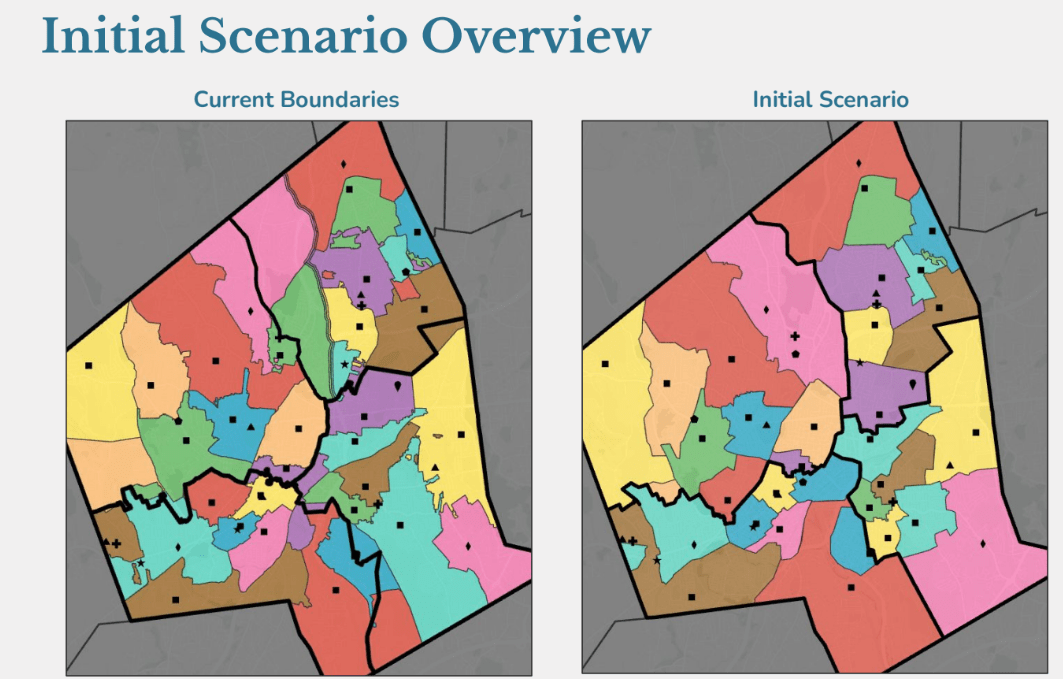
Under the first scenario, the Burncoat Quadrant would lose some western territory while expanding south to add Belmont Street Community School. Most notably, the plan proposes moving the Worcester Arts Magnet program across the city to Francis J. McGrath Elementary School in the Doherty Quadrant and creating a zoned elementary attendance area at the current Worcester Arts Magnet site to accommodate expected population growth from The Phoenix at Curtis Apartments redevelopment project.
In addition to inheriting the Arts Magnet program, the Doherty Quadrant would take on some territory currently in the western portion of the Burncoat Quadrant, including the entire Nelson Place Elementary School footprint. It would also expand slightly to the south, moving Columbus Park Preparatory School into the quadrant.
Jacob Hiatt Magnet School would move into the South Quadrant and be converted into a zoned neighborhood school. The North Quadrant would lose Belmont Street Community School, and several of its remaining schools would see decreases in enrollment.
The presentation also proposed exploring additions to the Worcester Technical High School lottery and routing career and technical education lottery options to the new Doherty Memorial High School.
The potential relocation of Worcester Arts Magnet drew the strongest opposition from members of the public, with parents and educators urging the district to keep the program at its current location. After public comment, Stellitano said those concerns were heard, but that avoiding a relocation may prove difficult.
“It’s not something that we’re taking lightly,” Stellitano said. “I will say this, there are too many students in that area at the moment, so we have to be thinking about if and what the lottery means for that area as well as what and how we can manage the current enrollment and future enrollment. We are really butting up against just the practicality of the facilities in play.”
Speakers also urged the district to consider students with Individualized Education Programs and the impact reconfiguration could have on those children.
Joey Ford, founder of the independent education watchdog group Parent Data Force, made his second appearance before members of the school committee in as many weeks, this time raising concerns about DillingerRAD’s involvement in a lawsuit in Andover.
Stellitano defended the company and its work.
“We are not named (in the lawsuit),” said Stellitano. “Basically, when it comes to this type of work, there are people who get disgruntled with the decision that the school committee makes. We stand by all of the data we put out, and we are very clear and transparent in regards to where we got the data, how we’re calculating it, and ultimately how you all can use it.”
Tuesday’s hearing was the first of several scheduled over the next few months as the district develops its eventual recommendation.
The Standing Committee on Operations and Governance is scheduled to review three additional scenarios Sept. 16 at Worcester Technical High School, Oct. 13 at Vernon Hill School and Oct. 26 at Forest Grove Middle School. Each meeting will offer in-person and virtual participation and focus on a different proposal.
Additional community forums are scheduled for Sept. 2 at Belmont Tower Apartments, Sept. 29 at Quinsigamond Elementary School, Oct. 19 at Chandler Elementary School and Nov. 7 at Goddard School as the district gathers feedback on the options.
Jason Bleau, a seasoned reporter from Connecticut’s Quiet Corner, has more than 11 years of news media experience. He has worked as a news anchor for WINY 1350 AM, contributed to Stonebridge Press publications, and covered racing as a Press Box coordinator at Thompson Speedway. Outside journalism, he is a movie enthusiast, freelance film reviewer, banker and solo musician. He can be reached at bleau.jason@yahoo.com
