
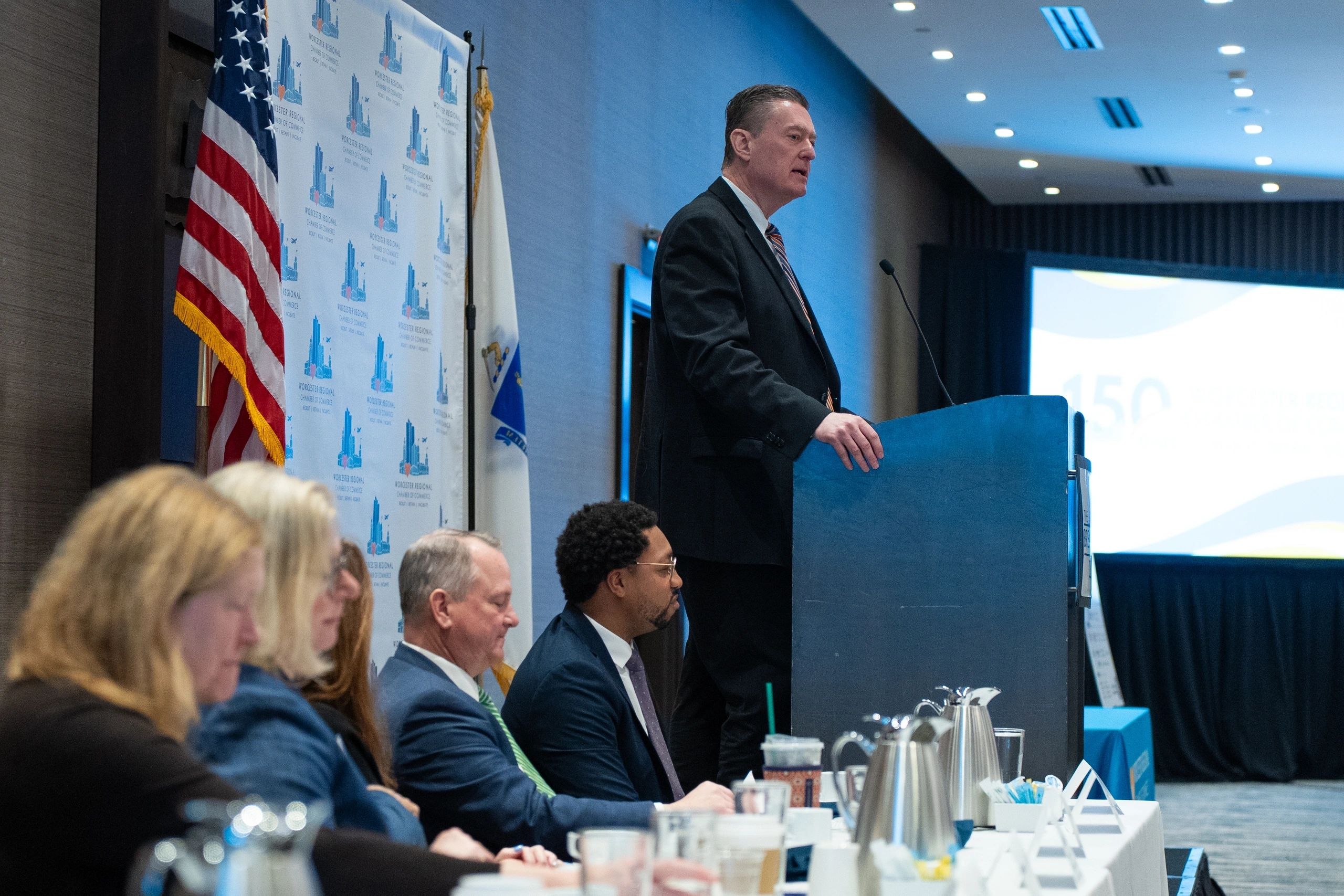
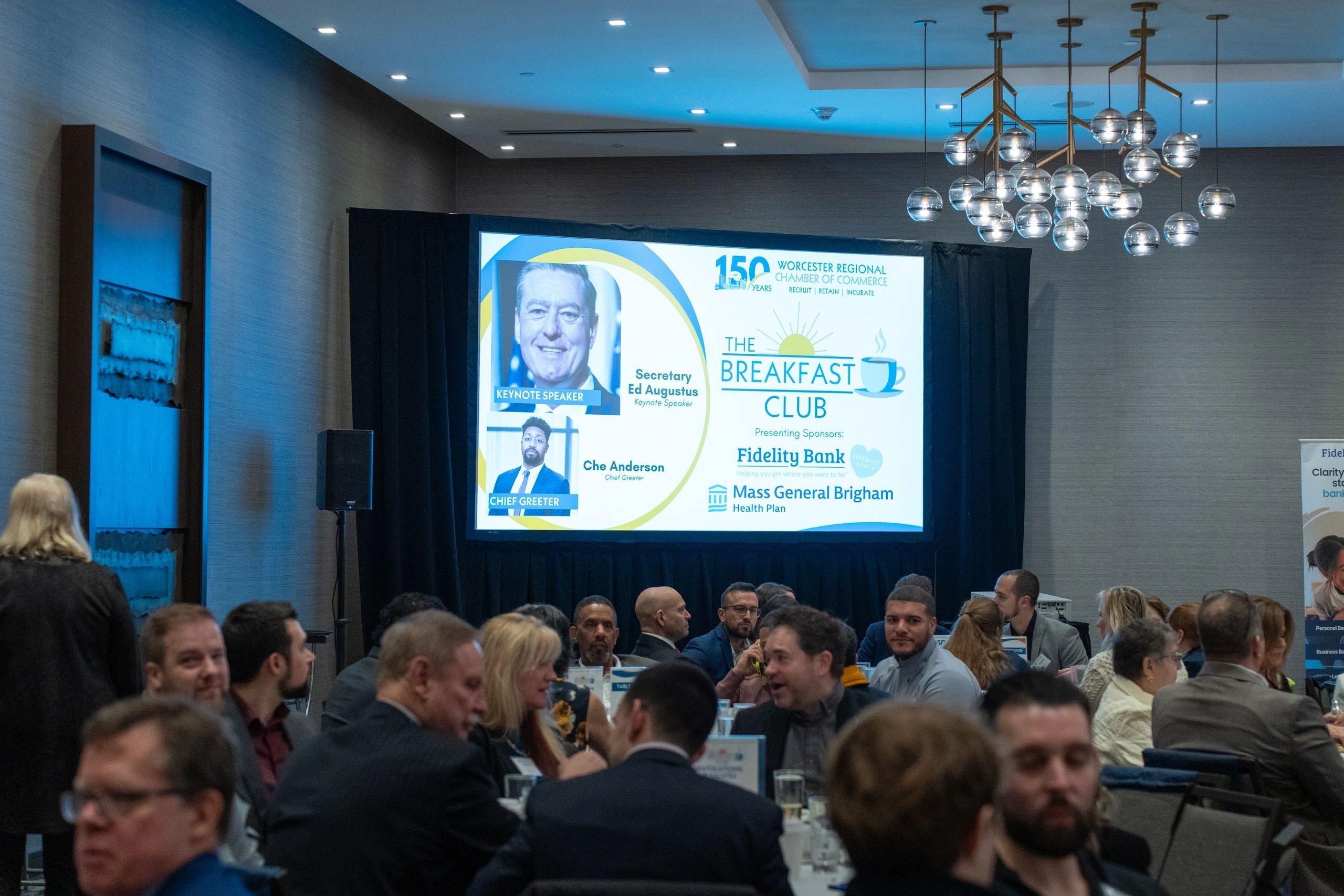
WORCESTER—Secretary Ed Augustus of the Executive Office of Housing and Livable Communities of Massachusetts spoke to a crowd of hundreds of business leaders at the Worcester Regional Chamber of Commerce’s quarterly Breakfast Club meeting on March 6.
Augustus, a former Worcester city manager, said the city is at the forefront of affordable housing among the commonwealth’s municipalities, but the ever-growing needs of the community will present challenges.
“Worcester has a clear vision,” Augustus said, adding that it’s not surprising that Gov. Maura Healy included Worcester when forming the Office of Housing and Livable Communities, turning to Worcester’s City Manager Eric Batista, who she also tapped for the state’s Housing Advisory Council.
“Worcester has a seat at the table with the state, and has a powerful voice,” he said.
The secretary said part of Worcester’s accolades are the renaissance of commerce and culture, especially in its downtown area, because the city and the communities within took action.
“The critics would have had us do nothing, but instead, we acted,” he said. “We made the city a shining example of what committed people can do when they work together. People who shared the vision rolled up their sleeves and worked together.”
He touts the city’s development of Polar Park and the surrounding area, which included the upgrading of 1,000 units of affordable housing, and the city’s first-ever inclusionary zoning policy.
Simply adding housing isn’t, in itself, a solution, he said. A major problem is that if housing in the city, as well as surrounding towns, remains unaffordable, Worcester will lose commerce and industry. The current national administration isn’t helping either.
“We are at risk of losing our workforce unless we can provide enough housing to meet the needs of our residents,” he said. “Adding to those challenges the chaos and uncertainty in Washington right now certainly adds more obstacles that are not insignificant. The tariffs threaten to raise the costs and create uncertainty. Our markets don’t like uncertainty. Uncertainty keeps equity on the sidelines. It makes projects seem riskier and take longer. We can’t control all of that here in Massachusetts, but there’s too much at stake to sit on the sidelines.”
What the state can do is be a steady and reliable partner to its communities, he said. The MBTA Communities Act, passed by the state legislature in January of 2021, requires 177 communities to create zoning areas for multi-family housing, near public transit, which Augustus said is good policy, and 119 of those communities have already created that zoning.
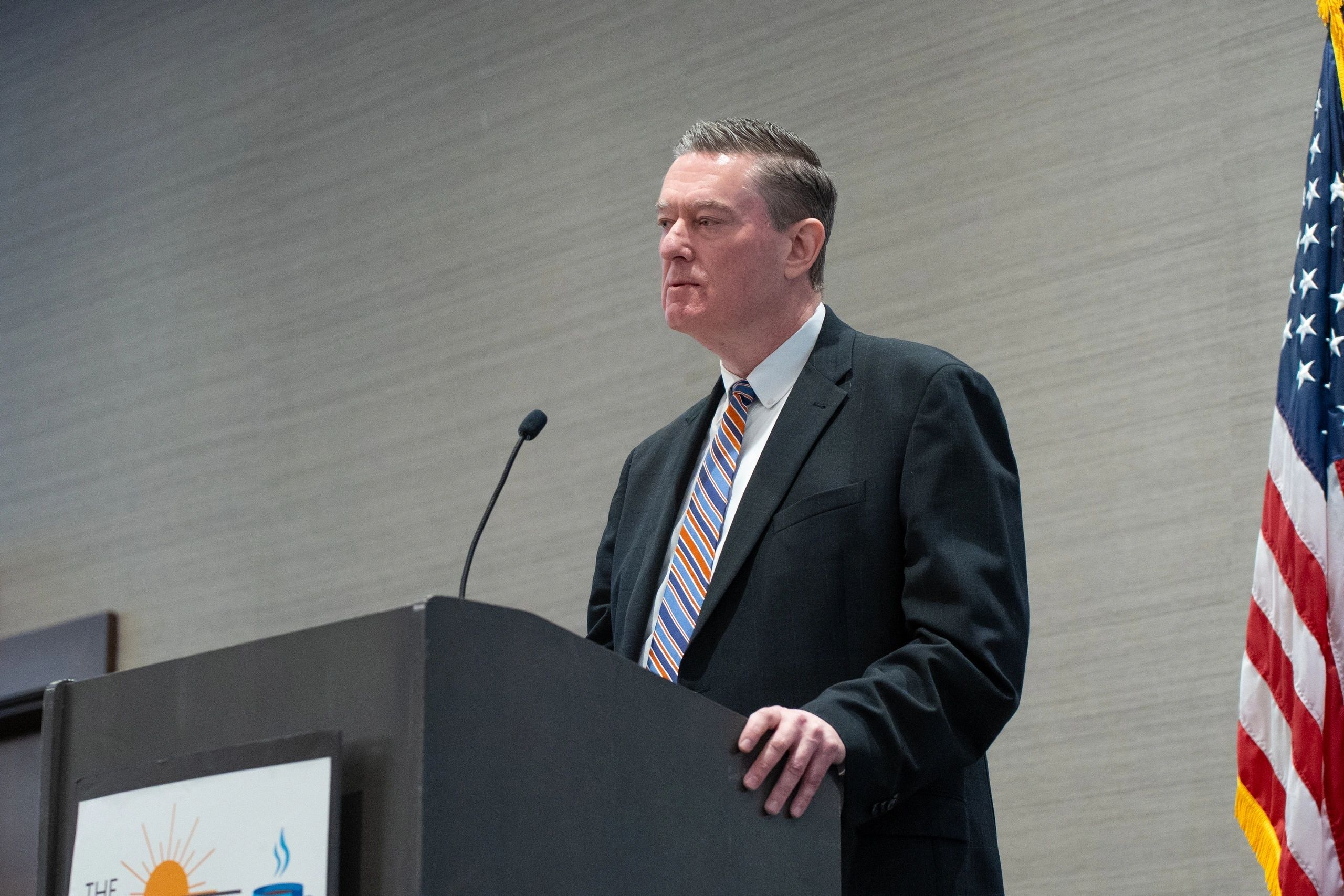
“That law is working,” he said. “It’s making a difference. It’s creating housing. Augustus added that Worcester is ahead of the game, when it passed its own accessory dwelling unit bylaw, even before the governor made that policy effective statewide, through the Affordable Homes Act.
“[Worcester has] used housing as a transformative tool, adding thousands of new units over the past several years. Despite all of the challenges and headwinds, there are thousands more on the horizon. This isn’t happening by accident, but by the careful, calculated work you all are doing.”
Worcester’s transformation of its public housing, and providing more housing as the sprawl of Boston’s metro area spreads westward, have replaced dilapidated units built about 80 years ago, with modern units.
A prime example, Augustus said, is Curtis Apartments on Great Brook Valley Ave., which is going to be a “national example of how to do public housing right,” by changing tightly-packed blocks into vibrant, multi-income neighborhoods where people can live with pride and dignity, replacing units that were built in the 1940s with new, energy-efficient apartments.
The state also recently approved funding for a similar project at Lakeside Apartments in the Webster Square area.
Vitality is coming back to downtown Worcester, as well, with 80 new 55-plus apartment units that are slated to open in Lincoln Square, while preserving the area’s history. Three large empty buildings on North Main Street are being transformed into affordable housing, including the former courthouse, which has 118 units.
The upper floors of 204 Main St. are also being transformed into 20 apartments. The former police headquarters, which has been office space for many years, is being transformed into 44 apartments including 9 affordable units, and the former Chestnut Place across the street will have 22 condominiums for homeowners earning up to 20-percent of the Area Median Income (AMI), along with 199 market-rate units.

“These are just a few of the developments in the works right now,” Augustus said. “More projects like that are happening across the state, made possible through Mass Housing’s new commercial conversion initiative. These developments not only provide the housing we need, they’re also re-purposing empty and under-utilized buildings, putting people back in our city centers. People going home at the end of the day from downtown are being replaced by people coming home to downtown at the end if the day.”
While the recent growth is encouraging, Augustus said more effort will be needed to sustain the housing growth in Worcester and beyond.
Earlier this year, the Executive Office of Housing and Livable Communities released a study—the first-ever comprehensive housing plan—created by the Housing Advisory Council, titled “A Home For Everyone.”
“This plan is a roadmap for the future,” Augustus said. “Its destination is a place where housing is abundant, affordable, and safe for all Massachusetts residents.”
The report said 222,000 new homes will have to be built across the state over the next ten years, to accommodate growth and end homelessness. It also showed that Worcester has been “punching above its weight class” in the creation of housing, by adding more than 9,000 housing units between 2010 and 2020, increasing the stock by 13-percent.
Still, that isn’t enough. The number of homes for rent in Worcester is still 25-percent less than 10 years ago, and the median home price has more than doubled from 2012 to 2021.
“The pressure is still on. Many new homes are needed,” Augustus said, applauding that besides the state’s commitment to new homes, Worcester has created its own housing production plan, which is taking on the challenge of the 12,000 new homes needed in the city in the next 8 years.
Cooperation between the state and the city (and other cities) is needed to identify what types of housing Worcester needs, and how to create zoning and land-use policies, permitting and processes that meet those needs.
His department, he said, will join with Worcester, its businesses, developers, and its citizens, to speed up production to meet the demands of the growing population.
“I know Worcester is up to the challenges, and we at the state will be with you every step of the way.”
Have news, tips, or a story worth telling? A good recipe or a funny joke? Reach Editor Charlene Arsenault at carsenault@theworcesterguardian.org—because good stories (and great scoops) deserve to be shared.
- The Worcester Guardian is an independent nonprofit news organization. Support local journalism by making a DONATION today.