
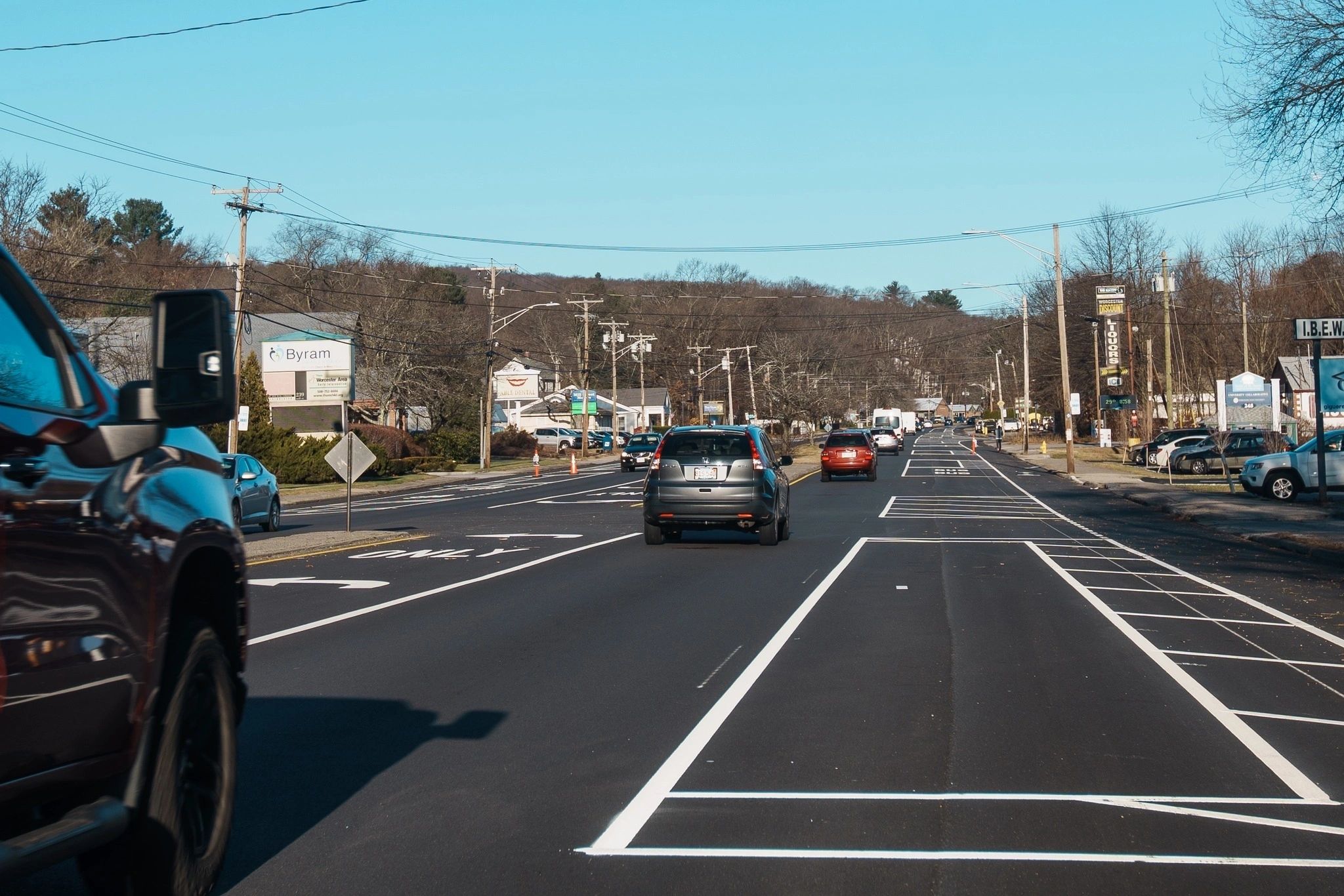
WORCESTER—A topic that continues to draw public interest is among the agenda items at Tuesday’s Worcester City Council meeting, with Interim Police Chief Paul Saucier’s submission of a crash report for Mill Street.
The reconfiguration of Mill Street, which was completed on Dec. 1, 2023, involved altering its striping and traffic patterns, adding parking spaces to protect bike lanes on the inside of both sides of the split street.
The controversial street update has generated concern and questions from the community and several council members, including Donna Colorio, chairperson of the traffic and parking committee. She previously requested the report on the number of accidents on Mill Street since its reconfiguration.
Issued to council for its April 2 meeting, City Manager Eric Batista writes, “The redesign has drawn a lot of public attention, and understandably so; it involves a configuration not yet seen in Central Massachusetts, even though it is well established and tested elsewhere.”
Saucier’s report indicates that since Dec. 1 there have been 13 reported calls for crashes on Mill Street, which is less than the 16 during the same period the year prior and “in line with the five-year average.” There were five crashes in December, three in January, three in February, and two (so far) in March.
With the exclusion of December 2020 to March 2021, when traffic was drastically lower because of COVID-19, the five-year look at crashes for the five-year average ranged between 10 and 16, with an average of 13.
“The decision to redesign Mill Street was not made lightly and is consistent with long-standing city policies,” said Batista in his letter to city council.
In 2018, Worcester City Council approved a Complete Streets Policy “calling for and establishing processes to develop streets with safe and convenient accommodations for all modes of transportation and people of all ages, abilities and means.” Its former configuration, proponents of the redesign said, caused drivers to treat it like a highway as opposed to a residential street, and drivers would too often travel at speeds of 45 mph or higher, rather than the 30 that is posted.
In 2021, the Massachusetts Department of Transportation granted funds for the Complete Streets Prioritization Plan for Worcester, which identified 22 projects to “improve the safety and multimodal accommodations on the city streets, including both interim and long-term improvements to Mill Street.”
The Mill Street redesign, according to Batista, is considered an interim Complete Streets project, which uses pavement markings and semi-permanent materials to make improvements in the short term. The city has received funding to further update Mill Street, including expanding sidewalks, additional sidewalks, separated bicycle facilities, upgraded streetscapes, safety and traffic control improvements at intersections, and roadway configurations to control speeds.
Also on the Worcester City Council agenda Tuesday:
- A communication from Soloe Dennis, director of the Department of Health and Human Services, on procedures businesses must follow to sell tobacco products
- A request from Samantha Plney, director of Homeless Addicts Leadership Organization, for council to recognize the urgent need for access to public restrooms for unhoused people in the community
- A communication from Jay Fink, commissioner of the Department of Public Works and Parks, about the Dodge Park cost analysis and master plan to update this 13-acre park off Burncoat Street.
Worcester City Council meets on Tuesday, April 2, at City Hall in the Esther Howland (south) Chamber at 6:30 p.m.
Charlene Arsenault can be reached at carsenault@theworcesterguardian.org
