
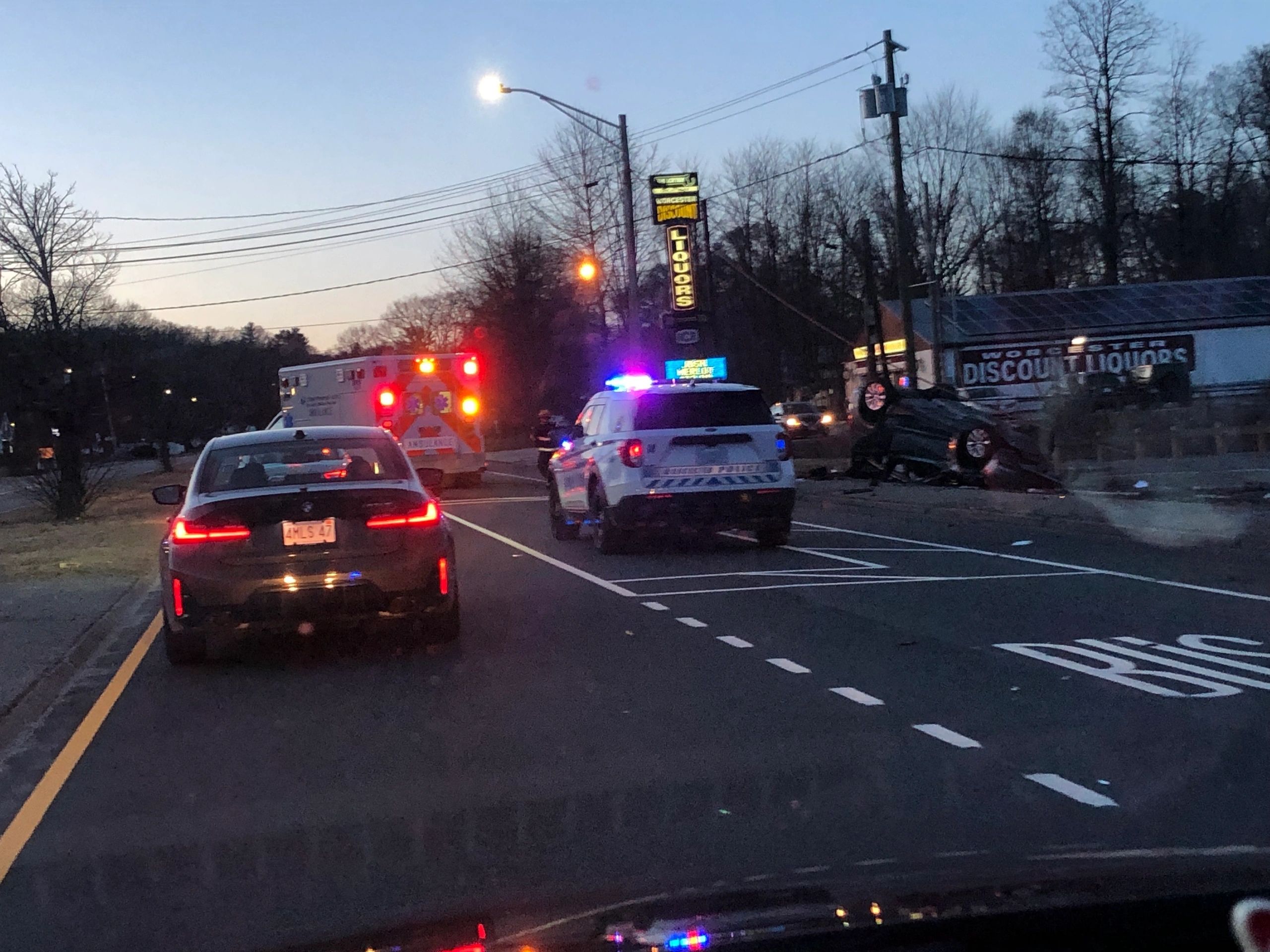
WORCESTER—Concerns around the city’s redesign of Mill Street, featuring parking-protected bike lanes and reduced travel lanes initiated to address safety concerns stemming from a high incidence of vehicle crashes, highlighted the Worcester City Council meeting on Tuesday night.
Completed in November of last year, the city altered the striping and traffic patterns on Mill Street, adding parking spaces to protect bike lanes on the inside of both sides of the split street.
The change has been controversial, prompting council member Donna Colorio, chairperson of the traffic and parking committee, to request a report on the number of accidents on Mill Street since its reconfiguration from the commissioner of transportation and mobility. The report essentially came back “inconclusive,” according to council member Morris “Moe” Bergman.
Bergman suggested a one-year study of the travel lanes proposal, which asks the Commissioner of Transportation and Mobility to consider pausing the elimination of travel lanes on public streets as a traffic-calming measure, with new on-street parking spaces in their place, such as on Mill Street.
Local chiropractor George Wood, who has an office on Mill Street, and others have voiced serious safety concerns since the redesign. During the council meeting, Wood shared a tragic incident involving a parishioner who was rear-ended and later died, questioning the visibility and logic behind the parking arrangement on the redesigned street.
Bergman indicated that more should be done to investigate better ways to reduce speed and protect bicyclists, suggesting that the city “give it an entire year,” and then look at the data and decide whether to use these traffic patterns elsewhere.
Advocating for bike lanes to be planned uniformly throughout the city, District 3 Councilor George Russell said that the changes on Mill Street are confusing for the public because it places the bike lane in a different location than on most other streets. Questioned by Councilor Khrystian King as to whether there are similar plans to those changes on Mill Street to be applied to future developments, City Manager Eric Batista said, “they are not.”
Councilor Jenny Pacillo expressed concern that decisions on policy relating to the Mill Street traffic design can’t be made until the council has a comprehensive evaluation report.
Temporary housing solutions for the homeless
Housing insecurity and the treatment of the unhoused was also a prominent theme during Worcester City Council’s meeting Tuesday night, both with feedback from audience members and council members.
Worcester resident Grace Ross pointed to illegal evictions and the need for temporary housing solutions. Proposals for sanctioned encampment zones and temporary comfort stations reflect a community grappling with immediate and humane responses to homelessness.
King inquired about tracking the movements of unsheltered residents seasonally. Batista said that homeless residents spend the majority of their time in the woods during warm weather, and their locations can be identified from where they are while requesting services. King described the issue as a “symptom of systemic lack of resources explaining why this continues to come before us,” then asked, “How do we fill that gap between the unsheltered population and their need for housing?”
He also asked about the city’s plan to use funds allocated by the state to help this population and if the city has requested access to funding made available by the governor. Batista advised that the state-funded shelter is scheduled to close at the end of April, though the city is requesting operations be extended through the end of June.
The role of the local library
Colorio and Library Executive Director Jason Homer also presented to council the role of the Worcester Public Library as a multi-faceted city asset, which symbolizes a microcosm of broader community safety and welfare discussions. Referencing Homer’s report, Colorio asked about the 44% increase in crime at the library between 2022 and 2023, and if his staff is equipped to deal with the challenges.
“We continually work on training to ensure our staff has the resources,” said Homer, “but it’s important to remind this body that we are librarians, so our work is rooted in information and access, but the world calls on all librarians to do more right now.”
Homer and his staff received expressions of gratitude from councilors for their work as a valuable city resource.
Paul Carr has a deep history in communications and publishing. He grew two businesses, first as founder and principal of a niche advertising agency (Strategen) serving the medical device industry and as publisher of a monthly regional publication, The Sturbridge Times Magazine. Now retired, Paul writes for businesses, non-profits, and The Worcester Guardian. He will launch an electronic version of Vegan Villager Magazine in early 2024, and can be found at paulcarrwriter.com.He can be reached at paulcarr500@gmail.com