
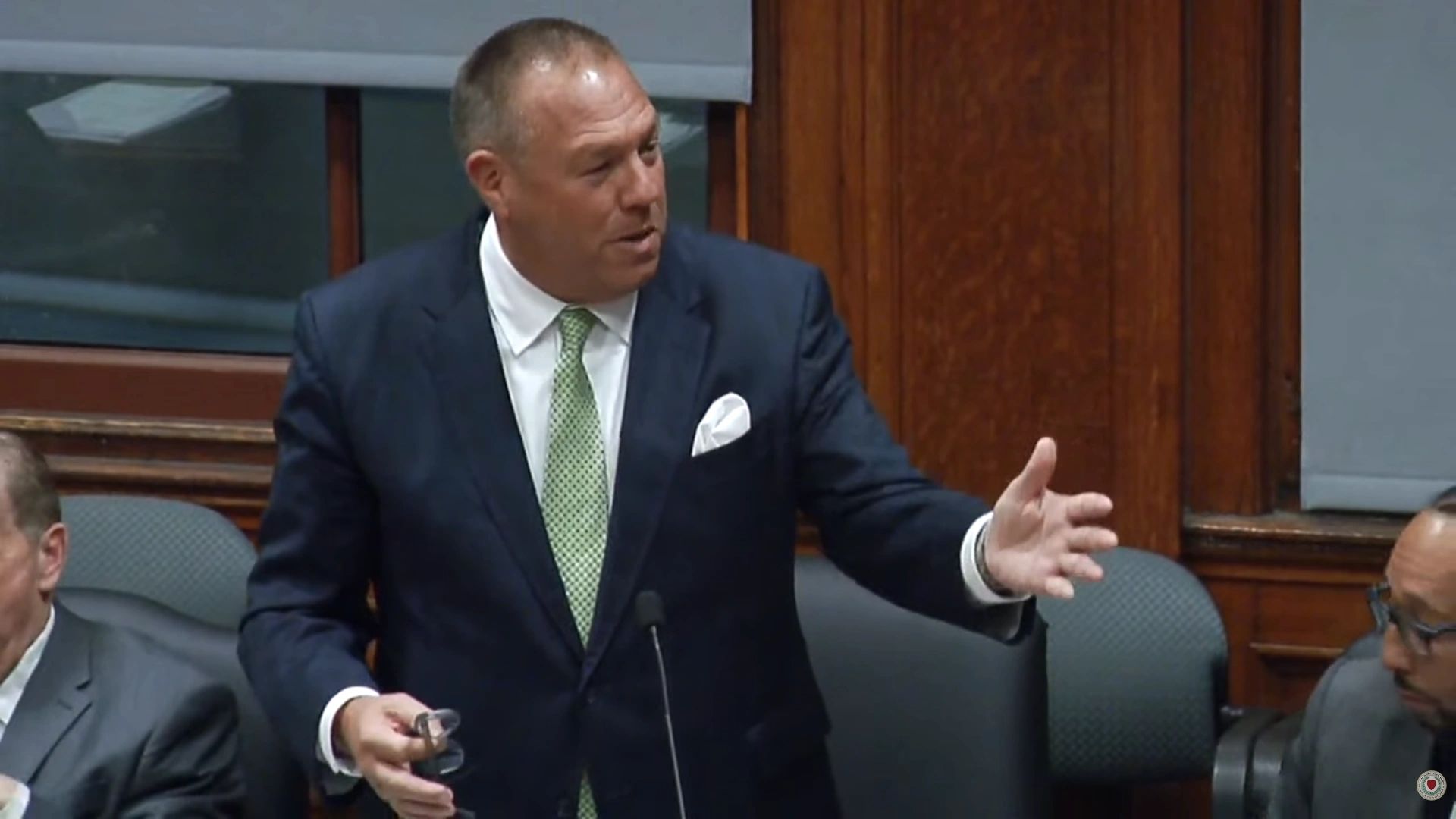
WORCESTER—Potholes—some large enough to fit the Blarney Stone—and how the city responds to them took center stage at the Worcester City Council’s St. Patrick’s Day meeting on March 17, as officials debated whether the current approach is keeping pace with growing complaints.
Councilor Tony Economou said the city’s 311 system, which residents use to report potholes, has strengths but may not be enough to address the scale of the problem this winter. While praising the city’s efforts, he said the volume of damage appears to be outpacing repairs and called for a more systematic approach.
“I do feel we need to hold our team accountable as to how much is getting done in a day, are we getting to it in a timely fashion, [and] how many calls are coming in?” Economou said. “We need to go systematically, street-by-street, fill them, [and] fill them properly.”
Councilor Gary Rosen said the issue is not with the 311 system itself, but with how quickly departments respond once reports are submitted. He said residents often see repairs completed in isolated spots while nearby potholes remain.
“[311] takes all the calls, and they refer them to different departments,” Rosen said. “The problem seems to be not with 311…it’s just the departments and individuals they refer these to, are not responding in a timely manner.”
City Manager Eric Batista said crews prioritize reported potholes and address others nearby when possible, but acknowledged that approach can leave some damage unaddressed.
“If it’s in the vicinity of a pothole that’s reported, they’ll take care of all of those,” Batista said. “If there’s another pothole a block away, or two blocks away…If they focus their attention on that street with all the potholes that weren’t reported on, then the potholes that were reported on are going to be delayed.”
That explanation drew pushback from councilors who questioned whether the system is working as intended. Rosen said it is inefficient to fix one pothole while leaving others on the same street.
“If there’s 12 on my street, I should call each one in?” Rosen said. “If there’s 15 potholes, that’s 15 phone calls? It’s crazy to fill one pothole and ignore another dozen.”
Councilor Morris Bergman said his own observations raised concerns about how repairs are being carried out. After receiving complaints, he visited Westchester Street and photographed potholes located close together, some filled and others not.
“It’s troubling, because I don’t think we’ve been getting accurate information,” Bergman said, displaying a photo of a pothole left unfilled about 20 inches from one that had been repaired.
“When I see that… what it tells me is, heads should roll!” Bergman said. “That’s a waste of time going out on the street, it’s a waste of taxpayers’ money, it’s an insult to the environment to have the trucks filling one hole and skipping another. That’s a half-assed job.”
Councilor Satya Mitra said the city should move toward a more proactive, data-driven approach, rather than relying primarily on resident reports.
“I think this is a severe problem for our city, and we’re trying to resolve it,” Mitra said. “The time has come…let’s not wait for the phone calls. The time has come that we should be more modern. We should use modern technology to find that our city has an inventory of all the holes, then find out the time it takes for us to fix those, then gradually fix them up, rather than waiting for people to call us and say there are 15 holes in 15 different places.”
Vice Chairman Khrystian King said the issue has surfaced repeatedly before the council and questioned how the city handles claims from residents whose vehicles are damaged by potholes. He said residents have reported waiting months for reimbursement.
City Solicitor Alexandra Kalkounis said determinations on claims are made soon after they are filed, with the full process typically taking one to two months. She said the city is currently tracking about 975 potholes and has received roughly half as many claims.
Kalkounis added that one claims agent and one assistant handle all claims against the city, including those related to potholes, but said the process has been smoother and faster than in previous years.
King urged the city to address both repairs and claims more aggressively.
“We’re trying not to become ‘Pothole City’ here in Worcester,” he said, calling for greater oversight of how pothole reports are handled.
Batista said the administration is preparing a broader plan to address potholes in the coming weeks and indicated that staffing levels and crew operations could be reviewed as part of the next budget process.
Economou said the number of potholes this winter remains the core issue, pointing to heavily damaged streets across the city.
“Drive down West Mountain Street, drive Brook Street. There’s two inches of asphalt missing everywhere,” he said. “If you want them documented, I will document it, just be prepared for the amount that you’re going to get.”
Mayor Joseph Petty said the problem has been exacerbated by winter weather and stressed the need for a coordinated response.
“This is a tough winter,” Petty said. “We just have to make sure we stay on top of it. We need to make sure we have the finances to do it, the people to do it, and have a plan.”
Councilors requested a report from the city manager detailing how many calls are received as it compares to how many potholes are repaired based on those calls.
Steve Smith can be reached at steve@stevephotographysmith.com
