
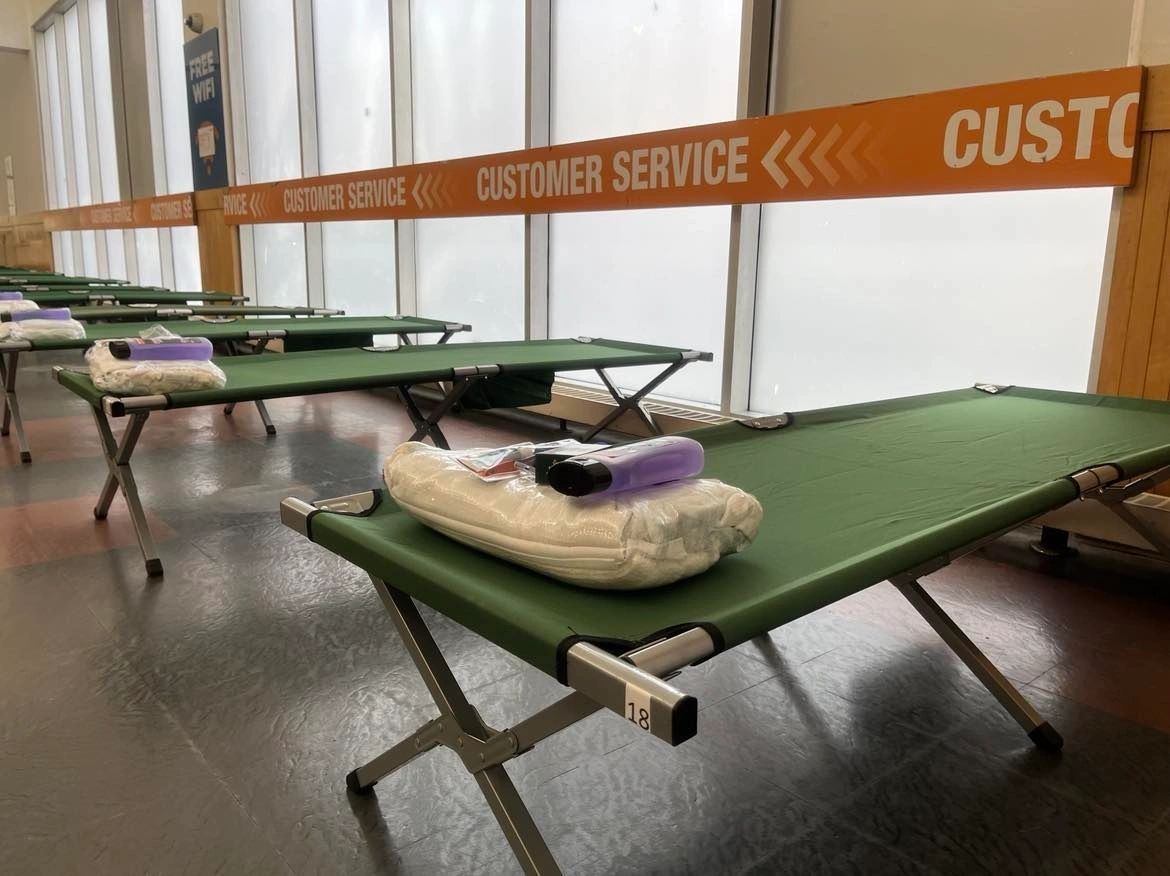
WORCESTER—It was a quiet scene outside of the temporary emergency shelter in the former Registry of Motor Vehicles building on Main Street Thursday, marking a contrast from the day before.
On Jan. 9, a group called Project Priceless organized what they called a “politicized encampment” at the shelter, according to posts on Worcester Youth Cooperatives Instagram page, on Jan. 10. The situation culminated with three arrests.
On the Instagram page, Project Priceless, formed in Oct. 2023, is described “as a collective of women and girls in Main South who are in the sex trade. Goals include helping one another survive, supporting one another, and combatting misogynistic violence which includes ending sexual exploitation in all its forms.”
The group set up tents in the parking lot of the RMV and when they refused to leave on Wednesday, two men and one woman were placed under arrest at 5:02 p.m., according to Worcester Police Lt. Sean Murtha. They were all charged with trespassing, one of the men was charged with resisting arrest, and the other man was charged with assault and battery of a police officer.
“The assault and battery on a PO is for a headbutt against an officer after the male was in handcuffs,” Murtha said in a statement. “None of the three people arrested are homeless.”
The Worcester Telegram & Gazette reported that the group was protesting the lack of available space for the unhoused population in the city and said that transgender people have been turned away from the shelter. While the shelter was at capacity, the newspaper reported that Tania Diduca, chief of staff of the South Middlesex Opportunity Council, increased capacity and offered the protestors space inside, which they denied.
Protestor Amanda Pelley told the Telegram & Gazette they felt unsafe in the shelter.
In a statement posted to City Manager Eric Batista’s X page, he confirmed that when the city learned of the encampment, he, along with SMOC officials, spoke with state officials and received emergency approval to increase capacity from 60 to 82 beds at the shelter so each person in the encampment could be offered a bed.
At 2 p.m. on Wednesday, Batista said the protestors were offered beds that they would have access to until the shelter closes at the end of April and given until 4 p.m. to vacate the lot. The arrests occurred around 5 p.m. after officials attempted to get the group services and shelter, according to Batista.
By 7:30 p.m. eight of the additional beds that had been set up were taken, three of which by people who had been staying in the encampment.
“I am disappointed in the events that unfolded yesterday as occurrences such as these make the existing obstacles around emergency housing even more challenging,” Batista wrote in the statement. “The City of Worcester, SMOC, and partner agencies place a high priority on the safety, security, and quality of life of those experiencing homelessness and remain committed to finding viable solutions that meet everyone’s needs. “
The shelter is staffed with a Worcester Police detail and security at all times. The city manager’s office requested the Worcester Police Department “help ensure a peaceful evacuation of the parking lot” Wednesday, according to a spokesperson from his office.
The Worcester Guardian spoke to five women outside of the RMV shelter on Thursday. The women confirmed that additional beds were set up inside the shelter Wednesday to create space for the people in the encampment, but the protestors didn’t come inside. When the protestors were being told to leave by police, one woman said the protestors were able to get into cars and drive away.
Four of the five women said they feel safe in the shelter and that they feel there are men in the unhoused community who will stand up for them if needed. They also identified themselves as strong women who can stand up for themselves. None of the women wanted to give their names to the media, citing potential repercussions.
The one woman who said she felt unsafe said she moved to the shelter to get away from a domestic violence situation, and while she felt safer than she did in her previous situation, she still did not feel completely safe at the shelter.
The women and a group of men smoking outside the shelter doors Thursday said they were not familiar with the people who were protesting and had not seen them stay in the shelter before.
“I’ve never seen them before. Homeless people don’t have tents like that…Who are they fighting for?” One 50-year-old woman, who only identified herself only as Anne, questioned. “They’re not fighting for me.”
She said the protest only made things harder for them because they weren’t allowed outside during it which interfered with their ability to smoke and it caused the shelter to put up more beds in a space that was already crowded.
“[SMOC] is trying to do the best they can for people,” Anne said. “They don’t want to turn away anybody.”
While the people the Worcester Guardian spoke to largely said they felt safe in the shelter, many said they had issues with the availability of bathrooms, with only one stall and one urinal for men and two stalls for women.
They also said the three showers available had long waits and they didn’t always get enough food.
Anne said she recognized the RMV shelter isn’t an ideal place for a shelter, but the city and SMOC were trying to keep people out of the cold. She said she was grateful to have a place to live and believed that the majority of the staff truly cared about them and spent more time at the shelter than with their own families.
Anne and the people with her are calling for more funding for the shelter to aid in the creation of more bathrooms.
Anne also added that a more effective way to address homelessness in the city is to tackle skyrocketing rents.
On Dec. 28, Diduca told the Worcester Guardian that the shelter, which opened Dec. 12, was averaging from 50 to 60 guests since opening and had not gone over its 60-bed capacity. When the shelter opened, SMOC said 15 of the beds were reserved for women and 45 were reserved for men, which Diduca said lined up with what they saw in demand.
The shelter has separate sections for male and female beds which is done specifically to ensure safety, according to a statement from SMOC Friday.
SMOC said it makes efforts to accommodate everyone, including requests based on gender identification.
“Living in an emergency shelter can be challenging at times,” SMOC’s statement read. “SMOC staff and management are available to listen to and speak with any shelter guest that is not comfortable, and they will work with the guest (s) to come to a resolution.”
If the shelter reached capacity, Diduca said they would send people over to the Queen Street shelter which SMOC also runs. The shelter has 50 beds but had been averaging 110 clients in December. When the beds are all occupied, Queen Street offers people mats with built-in pillows.
City Manager Eric Batista has confirmed in the past that the city has a shortage of shelter beds. The opening of the 60-bed shelter cut the city’s shortage from 197 to 137, according to his office.
“The municipality acknowledges there is still a great need for emergency housing, housing in general, and has been up front about the complexities of opening of the emergency shelter this winter as detailed extensively in this blog post: https://cmbatista.substack.com/p/restore-motivate-validate,” Batista said in his statement Thursday.
The Worcester Guardian has reached out to Worcester Youth Cooperatives for comment. Refresh this article for updates.
Kiernan Dunlop is an award-winning journalist who has spent the past five years reporting in Worcester, New Bedford, and Antigua and Barbuda. Her work has been published in Bloomberg, USA Today, Canary Media, MassLive, and the New Bedford Standard Times, among other outlets. She can be contacted at kdunlop@theworcesterguardian.org