
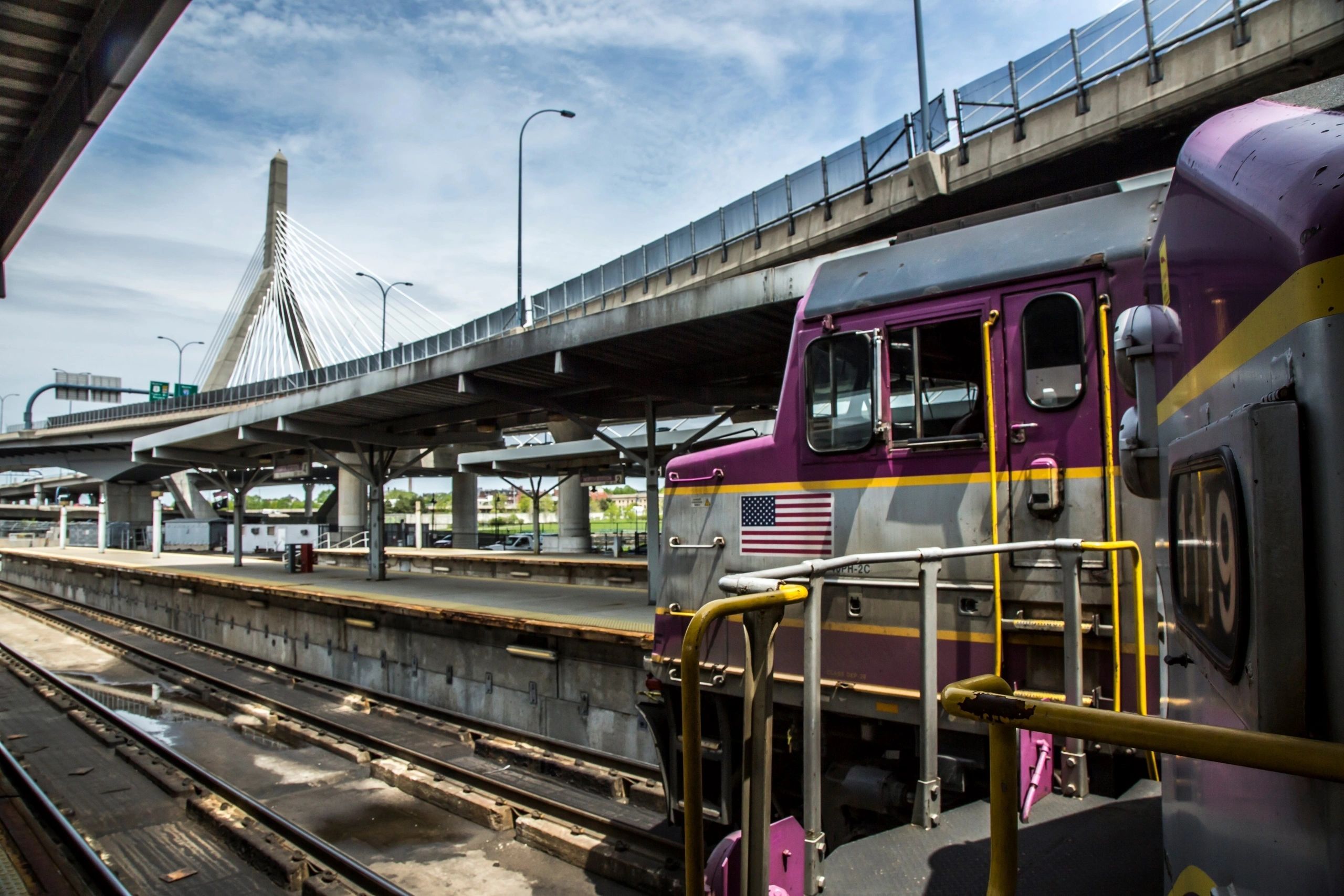
Using data from Decennial Census and five-year American Community Surveys, the report notes Worcester’s population has grown 37.2 percent from 1990 to 2021. There are 211,000 residents and 13,000 jobs within walking distance of Union Station
WORCESTER—Faster, more frequent trips, high platforms for universal access, and high-performing electric trains are among the components of an effective rail system.
That combination, along with infrastructure to relieve bottlenecks and free transfers between regional trains, buses and subways would be challenging to fund but feasible for the Framingham/Worcester commuter rail line, according to a report released by TransitMatters, a Boston-based technical, advocacy nonprofit.
In January, TransitMatters released the 26-page report, “Modernizing the Framingham/Worcester Line,” recommending improvements to increase ridership and convenience while moving closer to the 2050 net zero emissions goal.
“Massachusetts deserves better transit and we can do this here.” said Jackson Moore-Otto, regional rail project manager at TransitMatters. “It is entirely possible. We’re more in the weeds, crunching numbers to find what’s reasonable and most cost-effective to get people where they need to go.”
Under the proposal, rail trips from Boston to Worcester would be reduced to 43-50 minutes depending on the stopping pattern. The current trip takes one hour and 38 minutes, or one hour and 25 minutes for express.
“The municipality, along with partners and local riders have been and continue to advocate for the return of the one-hour express train to Boston and the implementation of additional rides,” according to Worcester City Manager Eric Batista.
According to the suggestions, trains could run every 15 or 30 minutes between Boston and Worcester. Improvements would allow for more East-West travel, with full electrification enabling 90-minute trips to Springfield, according to TransitMatters.
Using data from Decennial Census and five-year American Community Surveys, the report notes Worcester’s population grew 37.2 percent between 1990 and 2021. There are 211,000 residents and 13,000 jobs within walking distance of Union Station.
According to Moore-Otto, those numbers are expected to rise with recent city developments as well as the passage of the MBTA Communities Act, requiring municipalities served by MBTA or close to a line to have at least one zoning district permitting dense, multi-family housing.
The report notes the Framingham/Worcester line directly serves nine communities outside Boston and 18 others that nearly fall within the adjacency threshold. Estimates show 32,971 potential new housing units along the F/W commuter rail line by deadlines in 2023-2025.
Other impacts on potential ridership include the presence of Polar Park, several colleges, universities, and medical and biomedical facilities.
Batista said he is pleased that commuter rail service demand is rising and he appreciates efforts made to accommodate that growth as well as fight climate change and increase access to jobs, housing, and other resources.
A surge in Mass Pike traffic exceeds pre-pandemic levels. Commuters could seek alternatives.
According to TransitMatters, current projects, which include the completion of a new island platform at Union Station and associated interlocking improvements in design, enable a higher frequency of trips.
TransitMatters suggests changes to track structure, allowing for higher top speeds of 90 mph or more and grade separation to remove roadway and railway conflicts.
Electrical multiple unit trains, along with other improvements, come at a price. Using statistics from Amtrak’s Northeast Corridor electrification project of the 1990s, it would cost $6.6 million per mile in 2023 dollars. To electrify the 44-mile Framingham/Worcester line would have a $290 million price tag including catenary and other infrastructure.
But Moore-Otto noted the cost could be driven down to $200 million if best practices from countries such as Germany, Austria, Italy, Finland, and others are applied. Further, he said, electric multiple unit (EMU) trains in Asian and European countries are largely accessible in the United States.
The key, he said, is to take advantage of federal funding from agencies such as The National Infrastructure Assistance Grant Program ($1.8 billion) and Consolidated Rail Infrastructure Safety Improvements Program ($1.4 billion). The latter committed funds to expand East-West transit travel centered around Springfield with plans for service west to Albany and south to Connecticut.
To obtain federal funding, the state must display the capacity to provide matching funds for the construction and design, and deliver on infrastructure projects.
“Part of the challenge for Massachusetts is we must pitch ourselves as trustworthy but also ambitious,” Moore-Otto said. “These are multi-generational investments in mobility, de-carbonization, access and equity on an appropriate scale.”
He added, “Massachusetts needs to step it up and commit its own money,” to garner federal grants.
Any decision related to the Framingham/Worcester Commuter Rail Line would be made by the Massachusetts Bay Transportation Authority, Batista said.
Although the commuter rail is funded by the state, the city’s Department of Transportation and Mobility (DTM) is working toward improved infrastructure to support a range of alternate modes of transportation, Batista said.
The city is working closely with MBTA leadership and MassDOT to improve the ridership experience on the Worcester line
Moore-Otto said the state must remember it is competing with U.S. states and counties that “plow tens of billions of dollars in transit projects over decades.” He cited Los Angeles, “a car-oriented city” that is federally rewarded for demonstrating its credibility through state ballot initiatives.
Meanwhile, TransitMatters anticipates funding will not be as forthcoming until the Allston I-90 project is finished. Short-and-medium-term investments to mitigate disruptions that work will cause cost an estimated $21 million. Measures include installing temporary platforms at existing stations on the F/W line for all stations west of Framingham, Moore-Otto said.
TransitMatters also recommends:
- Re-visiting a possible station in Millbury near Route 20. Park and ride would be encouraged with Framingham/Worcester line to reach downtown Worcester without driving
- A station located near the intersection of Shrewsbury Street, Plantation Street and Route 9, estimated to serve 4,100 jobs. It would connect to existing WRTA bus routes
- Optimizing bus routes whenever possible to achieve better rail connections
- Re-locating the Westborough station closer to downtown
- Moore-Otto said the organization’s next study will examine connectivity between regional rail and bus services
Better synchronization between buses and rail is something that could be explored by the WRTA, the city manager said. He added that while the municipality does not oversee WRTA operations, DTM’s commissioner is in regular communication with them regarding “efficiency, accessibility, and overall operations relative to the city’s infrastructure, demographics and trends.”
Attempts by the Worcester Guardian to reach a representative from the MBTA were unsuccessful at press time. Visit this page for any updates to this story.
Susan Gonsalves is currently editor-in-chief of a mental health trade journal and a freelance writer/editor specializing in education, medical/health and business. She previously worked at the University of Massachusetts Dartmouth and has contributed to publications at Worcester Polytechnic Institute and College of the Holy Cross. At the Worcester Telegram, she covered the town of Leicester and wrote for Business Matters. She can be reached at smgedit@comcast.net
