
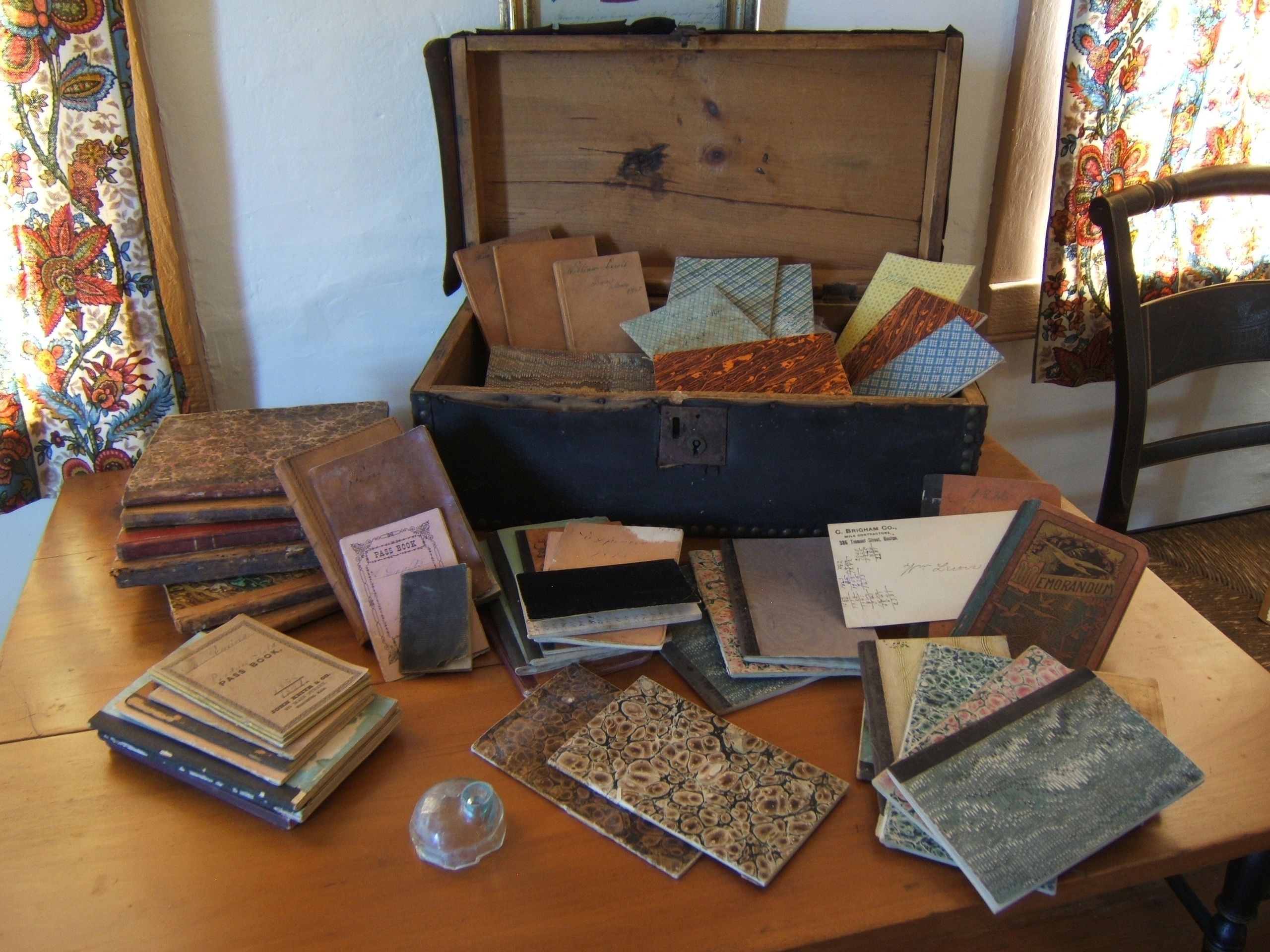
If you lived in the vicinity of Barre, Massachusetts in the mid-1800s, you might have encountered an odd sight on the town roads: a farmer by the name of William Lewis pushing a wheelbarrow heavy with cans of milk. Lewis, who once had a traumatic accident with a horse and had resolved never to use the animals again, delivered fresh milk by wheelbarrow twice a day to his customers along a five-mile route. He did it for more than forty years, in all kinds of weather and rarely missing a day.
Described in his Barre Gazette obituary as having “peculiar traits of character,” Lewis (1819–1897) had another unusual habit, one that will benefit generations of historians and people curious about the past. He kept a daily diary and detailed records for fifty-nine of his seventy-eight years, leaving behind a remarkably accurate and comprehensive picture of rural life in central Massachusetts over most of the nineteenth century.
Lewis’s journals were forgotten in an attic for more than a hundred years until Christie Higginbottom and Bruce Craven of Leicester discovered them in a wooden box at the 2012 Tolland Antiques Show. The couple, longtime historical interpreters at Old Sturbridge Village, recognized what a treasure they had found and purchased the lot. Later that year, they also acquired Lewis’s account books and records.
In 2024, Higginbottom and Craven published a book, Finding William Lewis (1819–1897): The Every-day Life of this Singular Man, and last fall they donated the full collection of Lewis’s manuscripts—one hundred and forty-three journals and more than two hundred record books—to the American Antiquarian Society (AAS).
It is now the society’s most complete collection of nineteenth-century diaries and is preserved and available for researchers, genealogists, and anyone seeking to understand more fully how New Englanders lived in the 1800s.
Born in Vermont on Valentine’s Day in 1819, Lewis was orphaned at age thirteen and by seventeen was living on his own, working in tanneries throughout southern Vermont, New
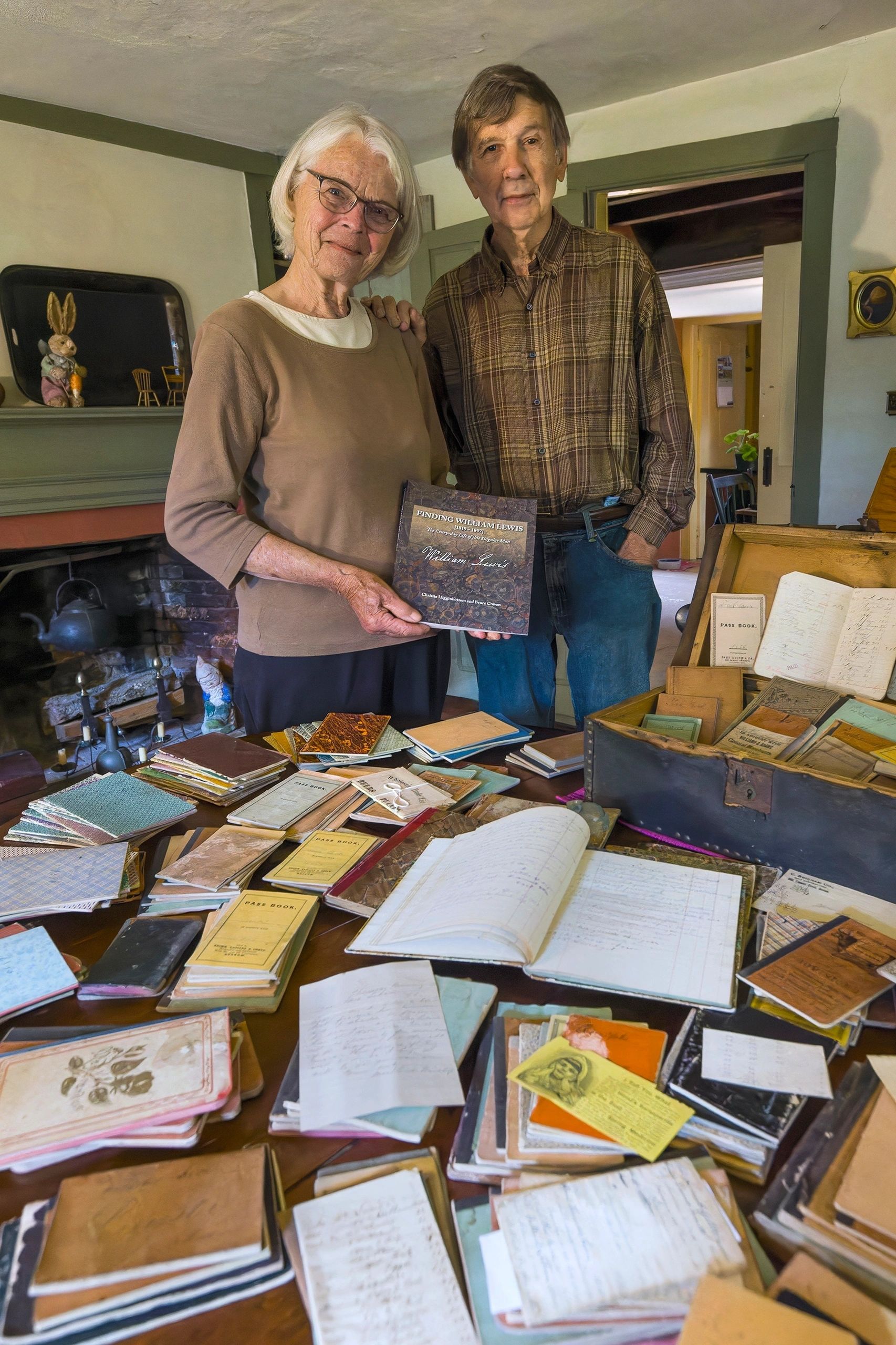
Hampshire, and central Massachusetts. Over the course of his life, he was also a bookseller, a peddler of small household goods, a successful farmer, and an ardent Methodist. Meticulous in his recordkeeping, Lewis wrote about everything from his early work in tanning and years as a traveling bookseller and lender to becoming a self-taught farmer with abundant pear and apple orchards, greenhouses, poultry, and a thriving dairy business.
He began writing his first journal—a small handmade booklet held together with a pin—when he was seventeen. He continued the practice of chronicling his daily activities for the next six decades, leaving behind a trove of information about the economics of rural life in his diaries and account books, with such titles as “Egg Book,” “Milk Book,” “Produce Sold,” “Provisions,” “Cash Received,” and “Cash Paid Out.”
“Through his diaries, we follow William Lewis from when he was a young man all alone finding his way in the world, experimenting with different ways to earn a living, and searching for a community to put down roots, to getting married, buying a small farm, and building it from scratch to provide a livelihood for his family and many of his neighbors,” said Ashley Cataldo, AAS curator of manuscripts.
The scope of what can be learned from Lewis’s writings goes beyond what people were doing from day to day, according to Higginbottom. “For example, Lewis peddled and loaned books in the western part of Worcester County from 1851 until 1857,” she said. “From his book-lending records, we can learn who borrowed books, where they lived, what titles people read, and which were most popular with his customers—the majority of whom were women. I’m interested in seeing what historians learn about mid-nineteenth-century book culture from these records.”
The journals reveal how important women and children were to a family’s financial sustainability. “Many families couldn’t rely on one occupation to support the household, and ‘putting-out work’ was a welcome source of extra income,” Higginbottom said. In the “putting-out system”—an early form of remote work—manufacturers and merchants paid people to perform tasks at home to support the production of a variety of goods.
For example, Lewis’s records show that his wife, Abby, contributed significantly to the family’s income by braiding palm leaf bonnets and sewing mattress ticking. “A woman like Abby couldn’t take a job outside the home—she would have been too busy with farm and household chores—but she could take in work to do in the evening. And she could teach her children to do the work for pay, too,” Higginbottom explained.
Although Lewis did not live in Worcester during his lifetime, the city was integral to his life in many ways. Before he married Abby Kemp of Grafton in 1845 and the couple settled in Barre, Lewis lived in several small towns throughout the county. A prodigious walker, he regularly went to Worcester on foot, seeking work, attending church services, and purchasing supplies. On
Thursday, April 9, 1840, while traveling from Vermont in search of a job, he wrote in his journal: Went from Leominster through Sterling, West Boylston, Worcester, South Shrewsbury, and New England village in Grafton to Westboro and then by railroad to Worcester and to Holden in the evening. A year later, when working in Leicester, he often attended Methodist services in Worcester.
On Sunday, May 30, 1841, he wrote: My time has been pretty much all occupied in walking to and from meetings [religious services] this day…I have been to four meetings today, in three different towns and have walked 21 miles in all. In the 1850s, when working in Barre as a peddler, Lewis bought his stock of books, valentines, and Yankee notions from Worcester suppliers.
Everyday history like that recorded so thoroughly by Lewis is prized today by researchers, genealogists, and anyone pursuing a deeper understanding of life in the United States during a time of significant social, political, and economic change.
“The lives of famous people are often well documented, while details about ordinary people and the lives they led are often lost forever once the last friend or loved one passes away,” said Higginbottom. “Thanks to William Lewis we can preserve stories of average people and how they supported their families, interacted with their neighbors, improved their lives, and thrived in the nineteenth century.”
Related event: On Tuesday, July 15, from 5-6:30 p.m., the American Antiquarian Society, located at 185 Salisbury St. in Worcester, holds one of its popular Chat with a Curator programs, inviting the public to get to know William Lewis through his diaries and record books. Christie Higginbottom, Bruce Craven, and Ashley Cataldo answer questions and give deeper insights into Lewis’s life. The event is free and open to the public. Details are available at americanantiquarian.org.
This article is part of an ongoing, monthly series supplied by the American Antiquarian Society that focuses on the society’s collections and how they deepen the community’s understanding of Worcester’s–and the American–past. Through wide-ranging programs, community engagement, and research support for scholars and students, the AAS works to cultivate a broad community of inquiry―locally and nationally.
- The Worcester Guardian is an independent nonprofit news organization. Support local journalism by making a DONATION today.