
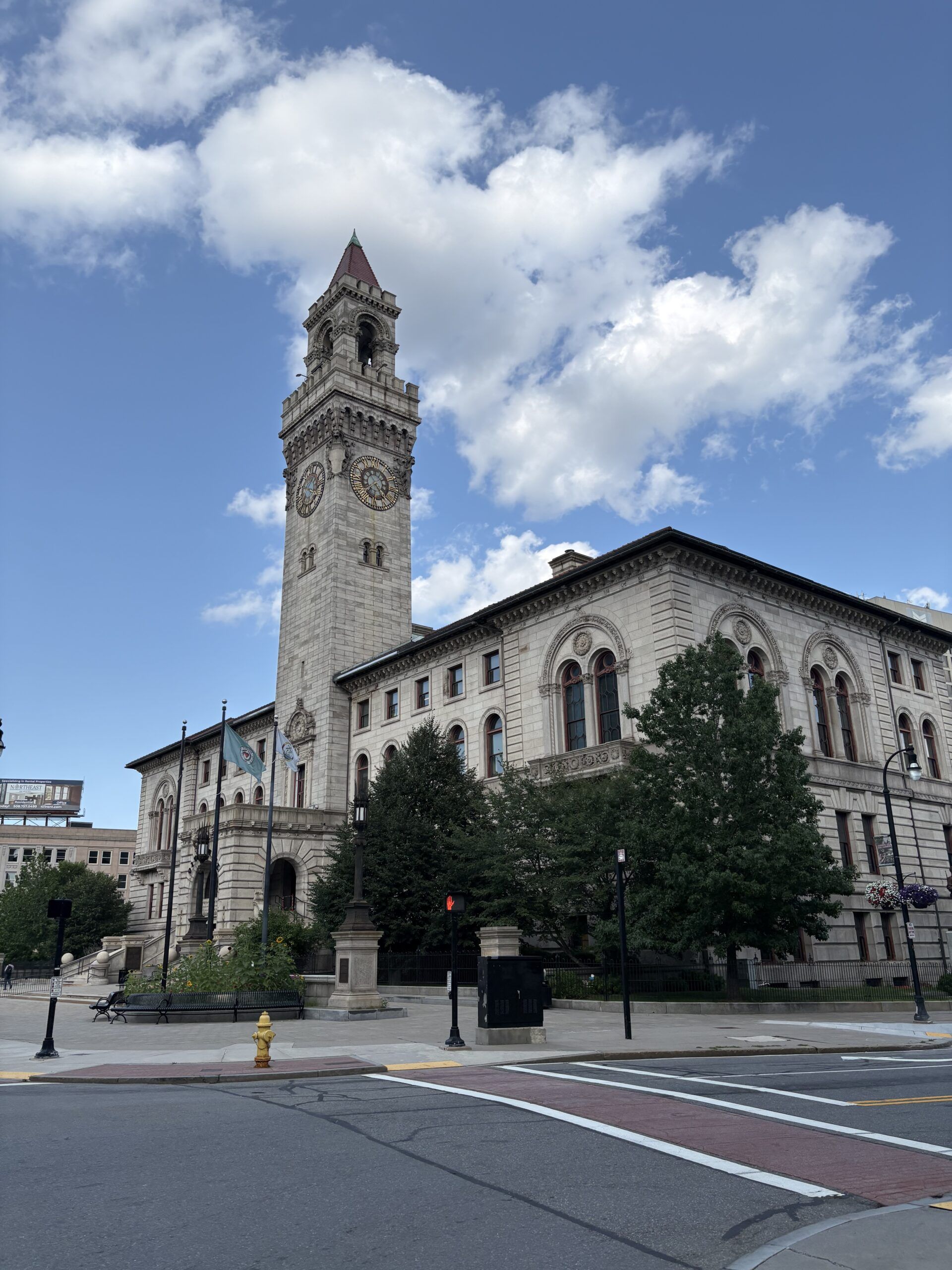
A proposal to restrict the use of city property for civil immigration enforcement will return to the Worcester City Council on Tuesday, three weeks after it fell one vote short, while councilors also turn their attention to violence downtown, homelessness, deteriorating streets and the city’s increasingly expensive housing market.
Council Vice Chairman Khrystian King is seeking reconsideration of two Aug. 18 votes involving signs on appropriate city properties stating that the sites may not be used for civil immigration enforcement. One order also asks the administration to draft an ordinance addressing enforcement of the signs; a companion measure calls for any required signage to appear in all appropriate languages. King’s original proposal failed on a 5-5 vote last month, with Councilor Tony Economou absent.
Police accountability also returns to the council after being postponed at its Aug. 18 meeting. Councilor Kathleen Toomey is seeking a public discussion in the Public Safety Committee about the U.S. Department of Justice’s decision to close its investigation into the Worcester Police Department, while councilors again take up the administration’s recommendation against creating a civilian review board. City Manager Eric Batista has argued that Worcester should instead strengthen its existing police oversight system, saying reforms already put in place are working. The two issues have become closely intertwined as the city and advocates continue to debate what the end of the federal investigation means for police accountability — and whether Worcester needs independent civilian oversight.
The issue returns amid an agenda weighted with quality-of-life concerns. Economou is asking Batista for an immediate action plan addressing violent incidents in and around Worcester Common and the downtown business district over the past several months. Toomey, meanwhile, wants the Public Safety Committee to bring social service agencies that work with people experiencing homelessness and addiction to the table for a discussion about their role in addressing recent public safety problems.
Councilor Gary Rosen is approaching homelessness from a wider policy perspective. He is asking the administration to examine response plans used in Seattle, Portland, Sacramento and Spokane and consider whether Worcester could adopt a more formal strategy of its own. His proposal calls for coordinating existing shelters, medical care, food assistance and employment services and exploring agreements with surrounding communities to share the cost and operation of a regional response.
Street conditions also get a close look. Councilor Satya Mitra wants the city to determine what responsibility it has for keeping private streets passable for fire trucks, ambulances and other public safety vehicles and whether municipal money could be used to maintain a minimum standard. He is separately requesting estimates for resurfacing each major artery identified as needing work under Worcester’s pavement management program. Economou has another order targeting specific street and sidewalk work that he says was completed below acceptable standards, including sections of Florida Avenue, Park Avenue, Germain Street and Burncoat Street.
Councilors also get a snapshot of a city continuing to build despite persistent affordability pressures. Worcester has more than 1,800 housing units under construction, according to the administration, with more than 500 considered affordable. The city’s Affordable Housing Trust Fund has committed nearly $21 million toward developments totaling 999 units, including 454 affordable apartments or homes, while 89 accessory dwelling unit permits have been issued since Worcester began allowing ADUs by right. At the same time, the median sale price of a single-family home reached $462,000 during the first half of 2026, up 4.3% from a year earlier.
A companion economic-development report details changes likely to shape what gets built next. State zoning changes that took effect July 1 lowered the traditional threshold for property owners seeking variances and, for the first time, allow residential “use variances” that could permit housing in districts where it otherwise is not allowed. Worcester officials expect the changes to result in more variance requests — and potentially more legal appeals — and plan to bring zoning amendments to the council before the end of the year. The report also updates redevelopment efforts involving the Denholm Building, Memorial Auditorium, the former Registry of Motor Vehicles property at 611 Main St., GreenTech Park, Union Station and several housing projects across the city.
The council also receives a financial update on the special tax district that supports the DCU Center. Treasurer and Collector Francisco Hernandez reports that revenues collected through the district are sufficient to cover debt service on $30 million in bonds issued under the district’s original 2006 authorization, about $23.6 million issued under a 2014 amendment and another $574,308 in bonds now being issued. State legislation creating the district requires the treasurer and city manager to report to the council that revenues are sufficient to cover the proposed debt service.
Other highlights on the agenda

- What’s bugging Worcester? Councilor Jose Rivera wants the administration to tell residents how they should report and respond to the spotted lanternfly, an invasive insect that has spread into Massachusetts. His order asks for best practices rather than a new city program, but it could give residents clearer guidance on what to do when they encounter the insect. The request puts a decidedly different kind of public-safety issue before the council: protecting trees and plants from an invasive pest before its presence becomes more widespread.
- Winter is coming — and so are the plows: Economou is asking the Department of Public Works to report on its preparations for the coming snow and ice season. He wants details on staffing, equipment and any improvements planned for winter operations. It is an early-September request, but one with obvious consequences once the first major storm arrives: snow removal remains one of the most visible services city government provides, and problems become apparent very quickly when roads and sidewalks are not cleared.
- Where does Worcester’s tobacco money go? A Public Health and Human Services Committee order asks the administration to account for money Worcester receives through tobacco and nicotine sales or settlements and to show how much is spent on cessation and prevention. The request follows a summer in which youth vaping and tobacco regulation have already drawn scrutiny at City Hall. The report could give councilors a clearer picture of whether money connected to tobacco is being directed back toward efforts to reduce nicotine use and addiction.
- Throwing shade at the library: A trio of items would refer a request for a shade tree outside the Worcester Public Library’s Frances Perkins Branch on West Boylston Street to the Parks, Recreation and Cemetery Department. The tree would go into an existing tree pit near the branch at 470 West Boylston St. It is a small agenda item compared with housing or public safety, but one that touches the city’s larger efforts to expand tree canopy and improve shade along streets and public spaces.
- Nearly $2 million for Grafton Street repaving: The council will be asked to accept nearly $1.924 million from the Massachusetts Department of Transportation for the Route 122/Grafton Street Repaving Project. The state money will cover one portion of the work, while Worcester will contribute about $720,143 toward a second portion, bringing the total project cost to approximately $2.64 million. The administration says the project will not require additional city staff. Councilors will also consider a separate $200,000 state and federal infrastructure grant, $60,000 from UMass Memorial Medical Center’s Community Benefits Department and several smaller donations to city programs.
- New faces in city roles: Batista is notifying the council of the appointments of Daniel Padilla and Angel Rosario as constables for civil and criminal business, with three-year terms running through December 2028. He is also seeking council confirmation of Lauren Tiberio and Jennifer Maddox as full members of the Accessibility Advisory Commission and the reappointment of John Finn as an associate member. The constable appointments come with state reporting requirements involving fees collected through civil process work, while the accessibility panel advises the city on issues affecting residents with disabilities.
- A closer look at how City Hall changes its own rules: Several committee orders ask the clerk and city solicitor to spell out what role the council has in changing ordinances and which changes to Worcester’s charter could be made without convening a Charter Review Commission. Another asks for the process required to place a nonbinding question on a future local ballot. The largely procedural requests could become important if councilors pursue broader changes to Worcester’s governing structure or seek to put advisory questions directly before voters.
- A month for service dogs: Councilor Robert Bilotta is offering a resolution recognizing September as National Service Dog Month in Worcester. The measure does not change city policy but formally recognizes animals trained to assist people with disabilities and the role they play in independence and daily life. If adopted, September would receive the council’s official recognition as Service Dog Month.
Worcester City Council meets Tuesday, Sept. 8, at 6:30 p.m. at City Hall in the Esther Howland Chamber. The meeting is also livestreamed on the city’s website.
Have news, tips, or a story worth telling? Reach Editor Charlene Arsenault at carsenault@theworcesterguardian.org — because good stories (and great scoops) deserve to be shared.
