
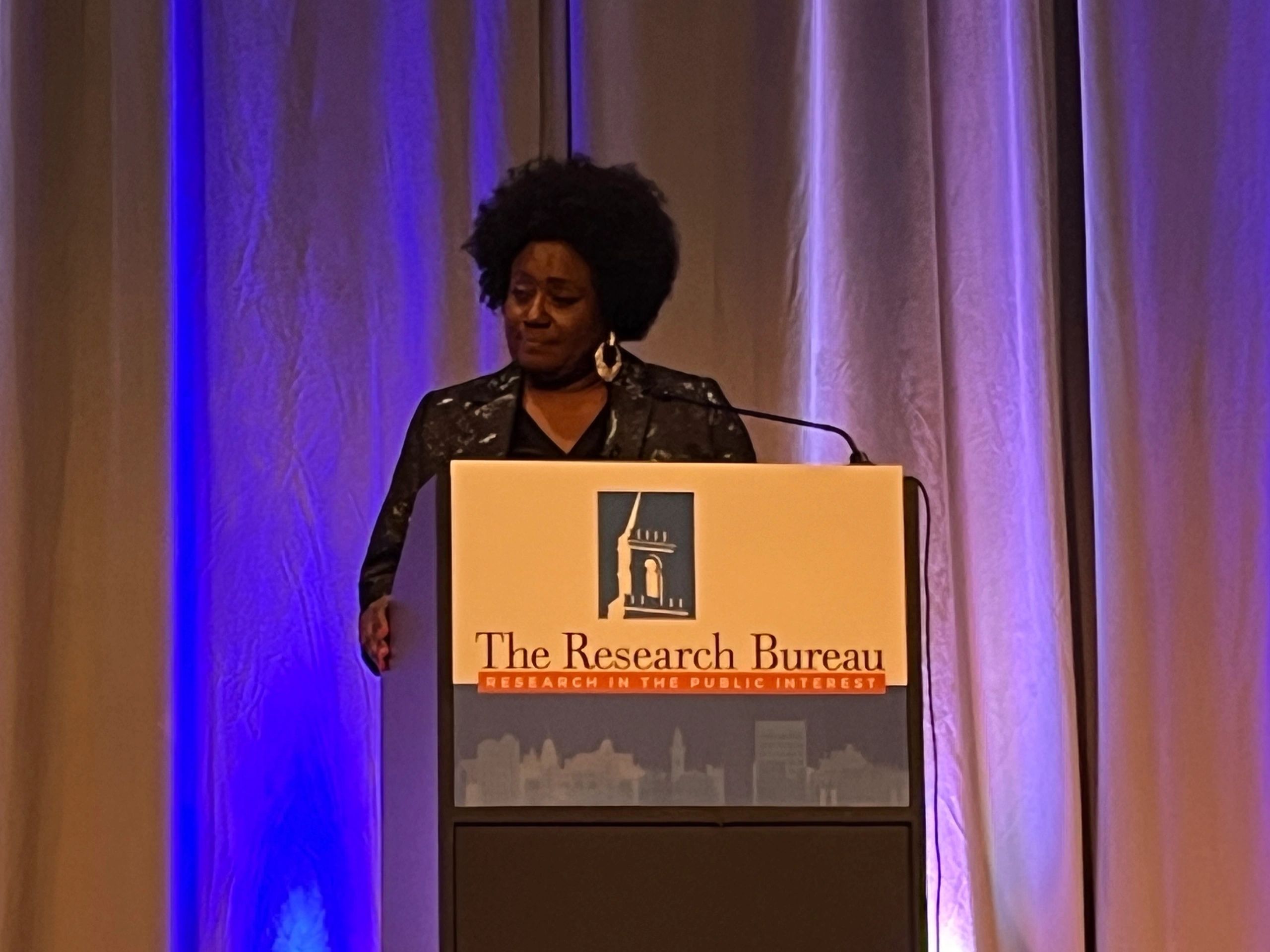
WORCESTER – Data is the lifeblood of Artificial Intelligence, Professor Renée Cummings told the crowd gathered for the Worcester Regional Research Bureau’s annual meeting Monday.
Cummings, an AI expert and Data Activist-in-Residence at the University of Virginia, was the keynote speaker at the meeting at the DCU Center for the nonprofit that seeks to “serve the community by providing… data-driven objective analysis and research on a tremendous range of issues,” according to its annual report.
Paul Matthews, the CEO and executive director of the WRRB, told the Worcester Guardian that while the bureau does not currently use AI, he said one of the reasons they chose to host Cummings was to learn about it.
He said there’s some potential for the bureau to use AI when it looks at very large data sets that are hard to analyze with typical human interaction, and the bureau is grappling with a way to use AI for that moving forward.
Cummings is optimistic about AI, saying she understands the technology can solve some of the challenges that the human race has thought about for decades, but those working with it also have to understand the risks.
“There are many risks because AI is built with data and many of the datasets that are being used to build this absolutely brilliant technology are compromised. Some of them are fragile. Some of them have been traumatized. Many of them carry a memory of past decisions made, some of those decisions not decisions we have been really proud of,” Cummings explained.
AI needs public oversight to take into consideration questions around accountability, transparency, discrimination, bias, and systemic racism, according to Cummings.
A member of the audience, Vanessa Joga, expressed how data’s limitations can have a negative impact during a question-and-answer portion of the speech.
“I was misdiagnosed once because I checked the box Hispanic, but in Latin America, there’s more to just Hispanic in our DNA, so because of that checkbox…the data is corrupted,” Joga, executive director of Guardians of Tradition said.
Without oversight, algorithms have the ability to deny agency because in the blink of an eye an algorithm can make a decision about a person without them participating in the decision, Cummings explained, giving algorithms the ability to undermine questions around democracy, human rights and civil rights.
The oversight to prevent that should include creating very diverse, inclusive, and equitable teams to ensure that the policies are justice-oriented.
“I love the fact that you’re committed to research in the public interest,” Cummings told the bureau, saying AI will require an extraordinary amount of public engagement and public education.
While the bureau has yet to use AI, the majority of its work involves data.
“When I think about data availability and the modern age, one of the consequences of the internet is there’s a ton of data but you don’t know the quality of the data and you don’t know whether or not it’s subjective and should be really be utilized,” Matthews told the Guardian after Cummings’s speech. “As a result one of the things the bureau is unflinching about is ensuring that we use credible objective data, particularly from the American Community Survey in the census.”
When the bureau does specialty projects, it also scrutinizes the data source to make sure it’s objective and appropriate, according to Matthews. That has resulted in the bureau rejecting potential data because they felt it didn’t accurately reflect in an equitable fashion an urban environment like Worcester, Matthews said.
The bureau also makes sure to be transparent about its data sources by citing them in all of its reports, according to Matthews.
Some of the work the bureau has done in the past year includes performing a detailed analysis of the Worcester Regional Transit Authority’s finances and ridership and creating an interactive dashboard; providing insight on Worcester County’s food insecurity; explaining the Worcester Public Schools revenue picture and its dependency on the state level; examining the municipal budget and the priorities of Worcester’s city manager and city council; and creating a series of resources for voters surrounding the municipal election, Matthews told the crowd gathered for the annual meeting.
Going into the new year, Matthews said the bureau is working on identifying Worcester Public Schools catchment zones, with Worcester Education Collaborative to provide an objective look at what the facility needs are for WPS, and with Kelleher & Sadowsky to determine the best way to examine the city’s commercial real estate market.
Kiernan Dunlop is an award-winning journalist who has spent the past five years reporting in Worcester, New Bedford, and Antigua and Barbuda. Her work has been published in Bloomberg, USA Today, Canary Media, MassLive, and the New Bedford Standard Times, among other outlets. She can be contacted at kdunlop@theworcesterguardian.org
