
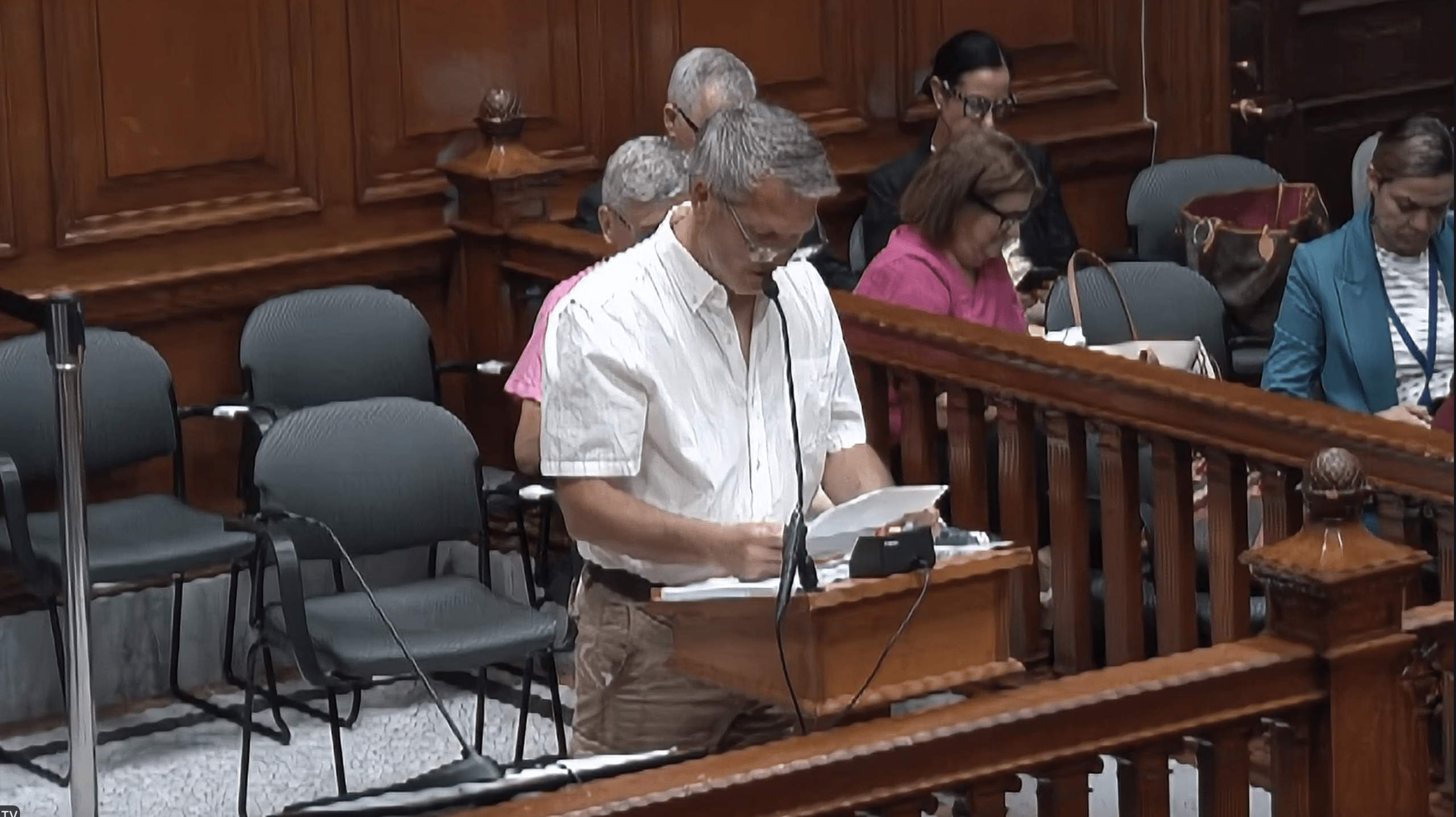
The Worcester School Committee rejected a resident’s proposal Thursday night that sought to limit the types of flags displayed in Worcester Public Schools, following public testimony centered on LGBTQ+ student representation, student mental health and the district’s academic priorities.
The committee also approved annual recognition of Pride in June and September, several state grants supporting preschool access, literacy and computer science, and a new policy governing interactions between schools and civil law enforcement officers.
The flag proposal was submitted by Worcester resident Michael Douglas, a parent of two Worcester Public Schools students. The petition asked the committee to establish a districtwide policy restricting flags on school grounds and inside school buildings primarily to the U.S., Massachusetts, Worcester and POW/MIA flags.
The proposal included exceptions for flags temporarily used for classroom instruction, school sports and spirit banners and recognized U.S. military branch flags.
The agenda initially recommended referring the petition to the Operations and Governance Standing Committee, but the full School Committee instead voted on the proposal Thursday and rejected it.
Douglas told the committee his proposal was intended to establish consistency across the district rather than target a particular group or message.
“This petition includes practical exceptions. It does not apply to flags used temporarily inside classrooms for direct instructional purposes such as history, geography, or foreign language lessons,” Douglas said. “It also does not impact recognized branch flags in the United States military or official school sports and spirit banners. My request is rooted in three primary principles: civic unity, educational focus, and clear administrative guidelines.”
Douglas argued that restricting flags could keep schools focused on academics while eliminating the need for administrators to determine which flags and banners are appropriate.
“This policy ensures our school infrastructure remains focused on its primary mission: academic excellence,” he said. “When public school property becomes a venue for displaying various social, political, and cultural banners, it inadvertently introduces outside debates into the learning environment. A clear, objective policy protects our school leaders. Without a formal rule, our principals and administrators are forced to make subjective, case-by-case decisions about which flags to allow.”
“To be clear, neutrality ensures integrity,” Douglas added. “By limiting flags of national, state, and city banners, you will send the definitive message to your students that there is strength in unity, power in common purpose, and bonding in fellow citizenship.”
The proposal drew opposition from several speakers who said symbols of inclusion, particularly LGBTQ+ Pride flags, can send an important message to students who may be struggling with their identities or mental health.
Andrew Willis, a teacher at Burncoat High School, urged committee members not to simply send the proposal to a standing committee.
“The scariest thing for me as an educator isn’t dealing with violence in the classroom, it’s not dealing with violence outside the classroom,” Willis said.
“Students dying by suicide is the scariest thing for me,” he continued. “The things that most teachers don’t realize is that we’ve had a number of students attempt suicide at Burncoat High. There are very few people that know this due to privacy concerns.”
Willis said the committee needed to take a clear position on the petition.
“We can’t just refer this to the committee and hope it doesn’t go anywhere,” he said. “We have to vote this down and give the kids a chance to live.”
Joshua Croke, a Worcester resident and founder and president of Love Your Labels, similarly argued that representation can have significant consequences for young people.
“Representation in our classrooms, our schools and our city and city hall is life saving,” Croke said. “Queer students, students with different cultural, ethnic and identity backgrounds.”
“It’s our responsibility as public educators, public administration and city residents to say that we care about the lives of every one of our students, LGBTQ+ and otherwise,” Croke added.
Other residents questioned whether the debate was distracting the School Committee from academic performance and special education services.
Joey Ford, an Attleboro resident who is active around SPED issues, pointed specifically to individualized education programs for students receiving special education services.
“Right now you have how many SPED kids and you have how many of them that are actually getting their IEPS fulfilled to their fullest,” Ford said.
“This is a waste of our time,” Ford added. “You guys currently have a proficiency rating between 24% to 27% for both math and reading. This is not what we should be focusing on, we should be focusing on the SPED kids.”
Pride recognition approved
The discussion over flags came as the committee also considered a measure introduced by School Committee member Molly McCullough establishing annual recognition of June and September as Pride months in Worcester Public Schools.
The measure describes Pride as a time for “visibility, celebration, education, and advocacy” and encourages appropriate recognition and acknowledgment.
The committee approved the item.
McCullough said the recognition was not new for the district and addressed some of the criticism surrounding it.
“I just want to point out that this is an item that we have approved many times before,” she said. “It is nothing new. There seems to be a lot of confusion in the community and a lot of backlash online.”
“Our LGBTQ+ students attend our schools; they are part of the Worcester Public Schools community, and acknowledging that they belong does not take anything away from any other student, staff member, or family,” McCullough said. “There has also been a question as to why Worcester recognizes Pride in June and September. June is nationally recognized as Pride Month. Worcester has also historically celebrated Pride because of Worcester’s returning college students, so they can participate in community Pride events.”
McCullough also rejected the argument that recognizing Pride necessarily comes at the expense of academics.
“I absolutely agree that academics must remain at the center of what we do, but I don’t think there’s an either-or situation here,” she said.
Committee approves grants
The School Committee also approved state grants supporting early education, literacy and computer science initiatives.
The largest fixed award is a $521,064 Commonwealth Preschool Partnership Initiative grant from the Massachusetts Department of Early Education and Care. Worcester Public Schools plans to use the funding to continue partnerships with private preschool providers, with an emphasis on reducing financial barriers and making special education services available to young children with individualized education programs.
A $236,835 Partnership for Reading Success Massachusetts grant from the state Department of Elementary and Secondary Education will support secondary English language arts instruction, including professional development and the creation of a district literacy council.
The district also received a $27,831 Computer Science Engage grant for curriculum materials and professional development.
Together, the three fixed awards total $785,730.
A fourth award, the High Dosage Tutoring Grant from DESE, will support literacy tutoring for elementary students who are below or well below reading benchmarks, with first-graders receiving priority. The grant does not have a fixed award amount and instead reimburses Worcester based on eligible costs, primarily tutoring staff stipends.
Law enforcement policy approved
The committee also approved a new district policy governing interactions with civil law enforcement officers.
The policy was developed in response to the Massachusetts PROTECT Act, which Gov. Maura Healey signed Aug. 5.
State guidance released later that month says civil arrests, including those connected to federal immigration enforcement, generally cannot take place in nonpublic areas of school grounds during operating hours without a judicial warrant or judicial order.
DESE’s model resources also establish procedures for schools when civil law enforcement officers seek access to students, records or school grounds, including identifying points of contact, consulting legal counsel, reviewing warrants and orders and notifying parents or guardians when agents request access to students or their information.
The committee’s vote puts Worcester’s policy in place as school districts across Massachusetts implement the requirements of the new law.
