
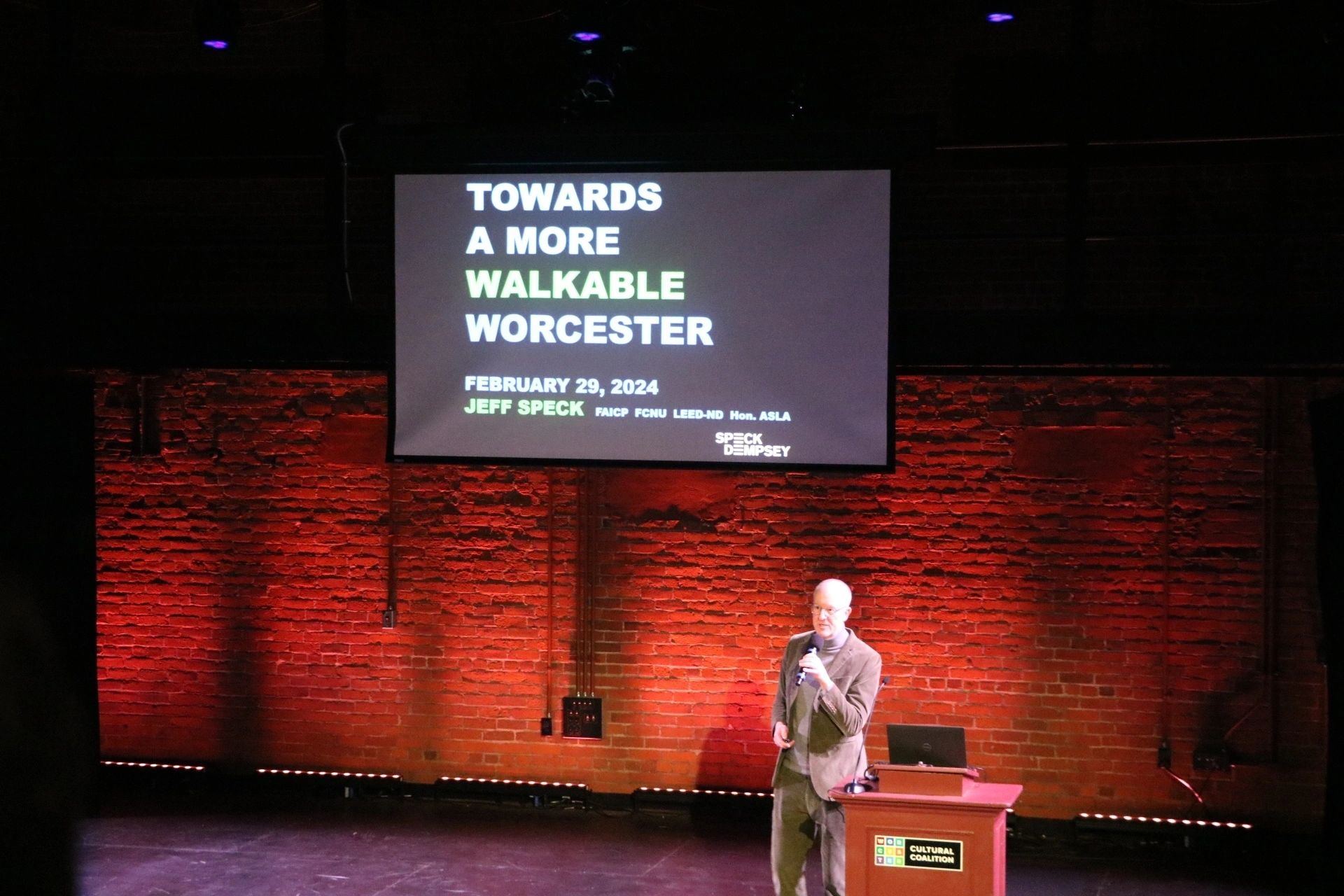
WORCESTER—That nationwide Vision Zero initiative toward safe streets may be a challenging goal, but advocates maintain it’s realistic and doable, and can be done in Worcester.
The “State of Our Streets” forum held recently marked a significant stride toward ensuring the safety of Worcester’s streets, roads, and avenues, while spotlighting Worcester’s effort to eliminate traffic-related fatalities and severe injuries. Held at the Jean McDonough Arts Center, this event drew community members, city officials, and experts in urban design/planning.
Jeff Speck, a prominent figure in advocating for walkable, safe cities and the author of “Walkable City,” served as the keynote speaker.
At this forum, city officials announced its commitment to the Vision Zero initiative, a multi-national movement that seeks to eradicate all traffic fatalities and severe injuries while promoting safe, healthy, and equitable mobility for everyone. According to the Vision Zero Network, there are currently more than 45 communities across the United States officially signed on to achieve the goal.
This discussion set the groundwork for Worcester’s ambitious plans to foster a safer city for walking, biking, and driving.
Chris Dempsey, Jeff Speck’s business partner at Speck Dempsey, kicked off the night with an encouraging message, and request, to the public to stay engaged and remain hopeful, noting that Vision Zero, while challenging, is an achievable, realistic goal.
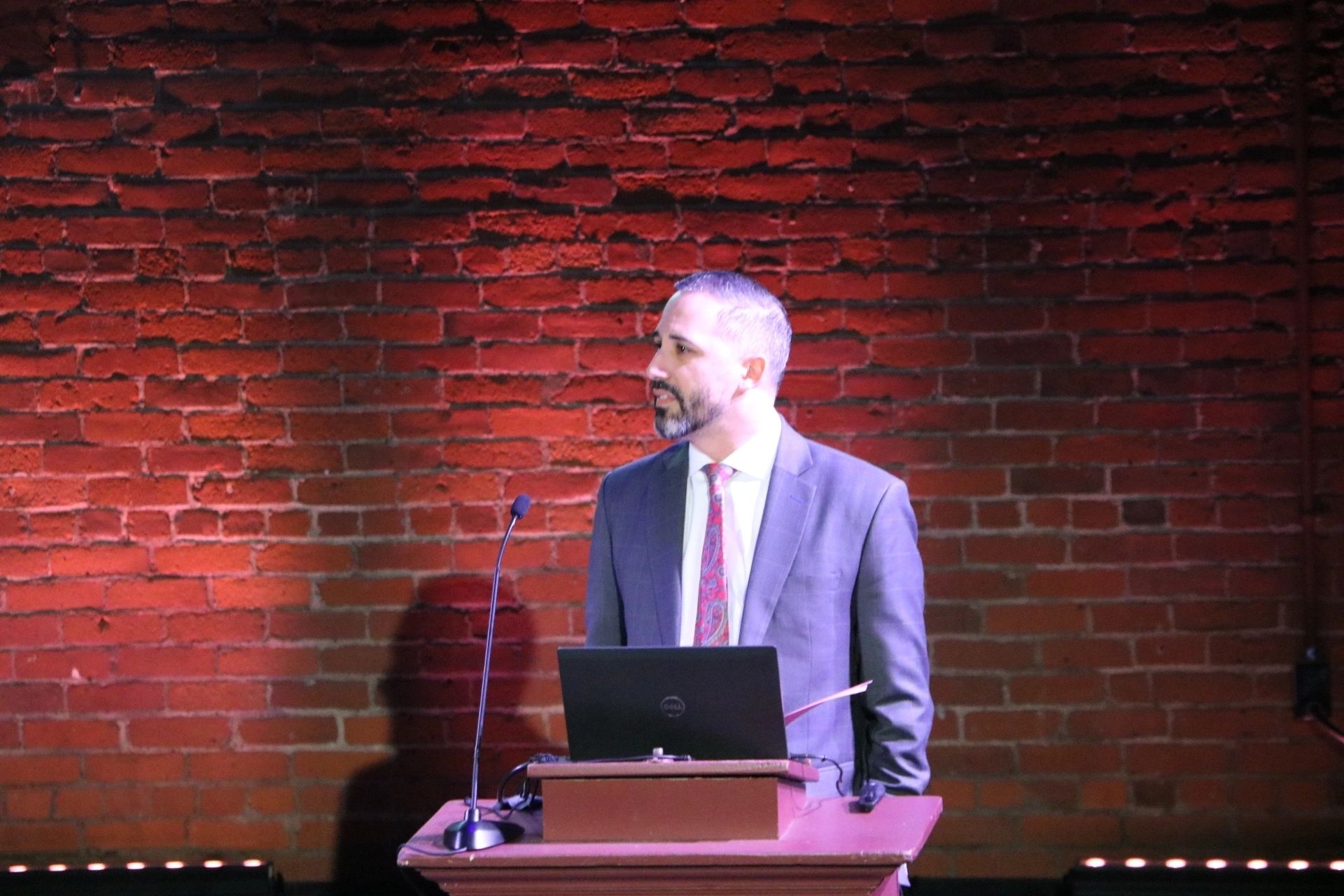
Eric Batista, Worcester’s city manager, discussed how Worcester can transform into a better city through this plan of action. “A more walkable Worcester is a stronger, more equitable Worcester,” he said. “Our streets need to be engineered safely and effectively,”
Batista also emphasized that this approach is multi-pronged, focusing on data and public insight. “It will be a data driven approach that involves the community, especially our residents,” said Batista. “We hear you. We see you and we want to make things better. Thank you for raising our collective beliefs about what Worcester can be.”
Speck led a majority of the forum with an engaging presentation about how this approach to ensuring road safety seems counterintuitive in many ways, but is effective. He touched on how increasing traffic lanes and widening lanes increases the likelihood of drivers speeding, with no positive impact on traffic congestion. He also emphasized that getting people to walk must be done in several ways: they must have a reason to walk, it must be safe to walk, comfortable to walk, and it must be “interesting.” The top priority to focus on, Speck said, is safety.
“The most important thing to keep in mind is the speed of the vehicle,” said Speck. “A car going 35 mph an hour is about seven times as likely to kill you as a car going 25 mph.” When considering cost effective ways to ensure public safety on roads, Speck noted that a lot of streets can have safe bike lanes added to them without reconstruction. “I always say, don’t necessarily rebuild, just re-stripe,” he said “You can re-stripe a whole downtown for the cost of rebuilding a street. The typical effort that we and Stantec put forth is proposing new paint, not normally new construction.”
Speck also noted that a lot of road layouts are extremely dangerous and inefficient. “This is a very specific, bad type of street,” he continued. “It’s the four-lane road. These aren’t just dangerous; they’re incredibly inefficient. The turn lane is the speeding lane, and the speeding lane is also the turning lane.” Speck talked about a safer and more effective alternative that would protect drivers, bikers and pedestrians.
“It takes a four-lane street and makes it a three-lane street by consolidating the turn lanes in the middle,” he said. “It’s a win-win-win. You get about 12 more feet to use in the form of bike lanes, and you increase safety dramatically. The number of potential crashes goes from 6 to 3 after making this change.”
He showcased the success of this street layout in Oakland, CA. “When this was done in Oakland and a four-lane street turned into a three-lane street, biking went up 78 percent, walking doubled, crashes dropped by 40 percent, and retail sales went up 12 percent,” he added. “You have a lot of these, and I was pleased to learn that Chandler Street is being engineered to go from a four-lane street to a three-lane street.”
Speck noted that another factor that needs to be considered is the wideness of the lanes: “A 12-foot lane, a highway-width lane, is going to have ten times the severity of impacts on it compared to a 10-foot lane which is a standard urban lane.”
This Vision Zero initiative was further supported by the insights of Stephen Rolle, commissioner of Transportation & Mobility, who emphasized the potential to significantly reduce crashes, particularly those leading to severe injuries or fatalities.
In an interview with The Worcester Guardian, Rolle highlighted, “The whole idea of this initiative is to see a reduction in crashes, but particularly those that result in serious outcomes like severe injuries or fatalities. A lot of people doubt that this can happen, but it definitely can be achieved.”
Rolle also drew parallels to the improvements in construction worker safety over the years, suggesting a similar approach could enhance road safety. “A while ago, the occupational risk for construction workers was much worse than it is today,” he said. “Now, after concerted efforts to address those safety concerns, construction workers are a lot safer. We can do the same thing for drivers, pedestrians, and bikers.”
In a visual presentation with picture evidence, Speck showed the cities of Somerville, Cambridge, and Seattle demonstrating the “gold standard” for safe bike lanes. He believes Worcester can do the same. Using the width of streets for safe bike lanes will be a noticeable step in the right direction. At the end of his talk, Speck noted, “Re-striping is the most efficient and comprehensive way to solve your problems.” He also emphasized that depending on the situation, “There may be opportunities to rebuild streets, and the investment can pay off.”
Rolle also further elaborated on the strategic focus areas of the initiative, aiming to improve the safety of Worcester’s street and transportation networks in a variety of ways. “This effort will really focus on the safety of our street network and the transportation network,” he said. ”It will look at the High Injury Network and locations where, historically, crashes resulting in severe outcomes have occurred more frequently. It will also look at it in a predictive way by analyzing the geometry of the roadway and the traffic characteristics to identify possible risks of severe crashes.”.
Chris Dempsey mentioned the crucial role of community engagement in realizing the goals of the Vision Zero initiative. “Engagement is absolutely essential,” he said. “The people that know Worcester streets the best are those that live on those streets, work on those streets, or travel on those streets. We can only make things better when we’re hearing from members of the public about what they want to see changed.”
Vision Zero has gained momentum across the globe as cities adopt its principles to combat road traffic deaths and injuries. Worcester’s initiative to embrace these principles signals a significant step towards reimagining its urban landscape. By focusing on systematic safety improvements, enforcement, education, and community engagement, the city aims to create a transportation system that cares for the lives of all its residents.
Anyone having feedback or suggestions related to the Vision Zero initiative are encouraged to take this survey.
Speck will be holding a two-day class at Harvard from May 30-31, available to anyone interested in learning more about how to make streets safer.
“I would encourage you, or perhaps to send some city officials, to come to that event this year,” said Speck.
Matt Olszewski is a freelance content and news writer based in Boston, MA. In his free time, Matt enjoys running, hiking or skiing. Matt is currently finishing up the MPH degree program at Tufts University. He can be reached at mattoskier@gmail.com