
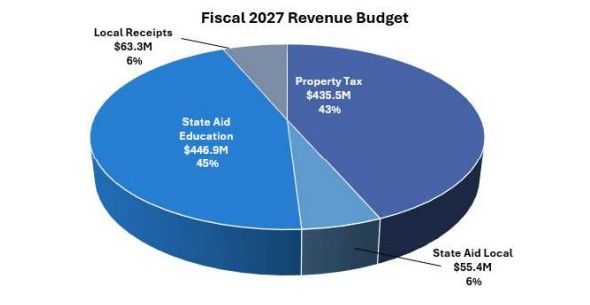
WORCESTER—The Worcester City Council gets its first formal look Tuesday at a budget that crosses a line the city has never crossed before: $1 billion.
The proposed fiscal 2027 operating budget comes with the usual budget-season gravity, but this year’s package also lands with several issues residents can feel directly—school spending, potholes, snow cleanup, public safety buildings, sewer bills and the cost of keeping basic city services running in a year when municipal budgets across Massachusetts are under pressure.
City Manager Eric D. Batista’s proposed billion dollar operating budget is up $43.6 million, or 4.7%, from the final fiscal 2026 budget. The increase is driven largely by education aid through the Student Opportunity Act, rising property values and new private investment, according to the administration.
The council also reviews a proposed capital budget that includes $159.4 million in fiscal 2027 borrowing, including major investments in roads, sidewalks, sewer and water infrastructure, school building projects, the new South Division Fire Station and upgrades to Worcester Police headquarters.
The budget arrives under the theme “Funding the Future: Smart Spending, Stronger Outcomes,” with the administration arguing that Worcester remains financially stable even as costs rise.
Batista wrote that the city has avoided the need for a Proposition 2½ override and has built unused tax levy capacity to $25.8 million, while still facing pressure from education, pensions, health insurance, debt service, snow removal, road conditions and public safety needs.
The council can reduce the proposed budget, but cannot increase it without the city manager’s recommendation.
Much of the proposed spending is already spoken for. Education accounts for $612.4 million, or 61% of the operating budget. That includes Worcester Public Schools, charter schools, school choice and special education assessments. The total education budget is up $34.8 million from the fiscal 2026 final budget, with $31.7 million of that increase dedicated to Worcester Public Schools.
The city’s local direct contribution to education would rise by $7.9 million, bringing it to $165.5 million. Batista’s budget message notes that the local increase alone is larger than the total budget of all but five municipal departments.
Fixed costs, including pensions, health insurance and debt service, total roughly $172.5 million. Health insurance is projected to rise by $2.8 million, while pension obligations are also increasing.
Public safety is the second-largest operational category, at $126.5 million. The budget includes funding to account for the end of the federal SAFER grant that had helped support expanded Worcester Fire Department academy classes. The capital plan also includes $25 million for the new South Division Fire Station and $5 million for Worcester Police headquarters roof replacement.
The budget also reflects the city’s recent winter hangover. After Worcester recorded its eighth-snowiest winter, the administration is proposing an $11 million, or 66%, increase in DPW borrowing over fiscal 2026. The money would support streets and sidewalks, snow equipment and building improvements.
The proposed budget also calls for expanded hours at the Millbury Street Drop-Off Center through schedule restructuring, with a full plan expected later.
Residents would also see a water and sewer decision. The administration is recommending keeping the water rate flat at $3.85 per hundred cubic feet while raising the sewer rate from $9.49 to $10.22 per hundred cubic feet, a 73-cent increase. For the average single-family home, the combined water and sewer bill would go up by $36.21 per year, or $9.05 per quarter.
The city says the increase is needed because of higher ordinary maintenance, sewage treatment, salary and fringe costs, and anticipated debt service on capital improvements. The water rate would remain flat because the city plans to use an estimated $381,468 in water reserves.
The sewer budget is also facing pressure from Worcester’s $35.5 million settlement with the Town of Holden. Worcester paid the first $10 million installment from sewer reserves April 1. The next $10.5 million payment is due July 1 and is expected to be paid through debt, creating new sewer fund debt service obligations beginning in fiscal 2028.
The settlement is split into five payments through 2029. Batista wrote that the administration continues to look for ways to limit the impact on Worcester ratepayers.
The council revisits questions and votes on how Worcester responds to mental health-related emergency calls, following multiple orders adopted last week. Councilors are seeking detailed data on the Crisis Response Team and Worcester Police Department’s co-response model, including how often individuals avoided arrest or hospitalization after contact with the program. Additional requests call for recommendations on expanding clinician involvement, improving dispatch triage and strengthening partnerships with outside providers. The discussion comes as the city faces a federal lawsuit alleging its current system relies too heavily on police rather than trained mental health professionals.
An update from the Department of Health and Human Services outlines early steps toward recognizing Worcester residents who died during World War II but were excluded from the city’s existing memorial due to non-combat classifications. The Veterans’ Services Division is recommending a new standalone memorial, citing space limitations at the current site. The effort, brought to the council floor by Morris Bergman, is still in the research and verification phase, with officials working to confirm eligibility, explore design options and develop a funding strategy that may include public and private contributions.
Other items on the agenda
- Anna Maria site floated as potential salt shed: Councilor Luis Ojeda is asking the city to examine whether the Anna Maria College property in Paxton could be used as a salt storage location for winter operations. The proposal is tied to the site’s proximity to Worcester Regional Airport and aims to reduce travel time for salt supply pickups during storms. The idea comes as the city looks for ways to improve efficiency after a costly snow season.
- Pothole costs under the microscope: Councilor Morris Bergman is requesting a report comparing Worcester’s pothole repair costs per centerline mile with other cities of similar size, including Boston, Springfield and Manchester, NH. The request follows a winter that left road conditions deteriorated across the city and is expected to factor into upcoming budget discussions around DPW funding and infrastructure investment.
- Questions raised over police cruiser crashes: Councilor Khrystian King is seeking details on no-fault motor vehicle accidents involving Worcester police vehicles. The request stems from a recent city manager communication and passed on a divided 7-4 vote, signaling some disagreement among councilors on the issue.
- Housing Authority seat status requested: King also filed an order seeking clarification on the designated “state representative” seat on the Worcester Housing Authority board. The item was ultimately placed on file on a 7-3 vote, meaning no further action will be taken at this time.
- Appointments to Board of Health and Election Commission: The agenda includes the appointment of Joseph Kahora to the Board of Health and Susan Ledoux to the Election Commission. Ledoux’s appointment requires council confirmation.
Worcester City Council meets Tuesday, May 5, at City Hall in the Esther Howland (south) at 6:30 p.m. It is also livestreamed on the city’swebsite.
Have news, tips, or a story worth telling? Reach Editor Charlene Arsenault at carsenault@theworcesterguardian.org—because good stories (and great scoops) deserve to be shared.