
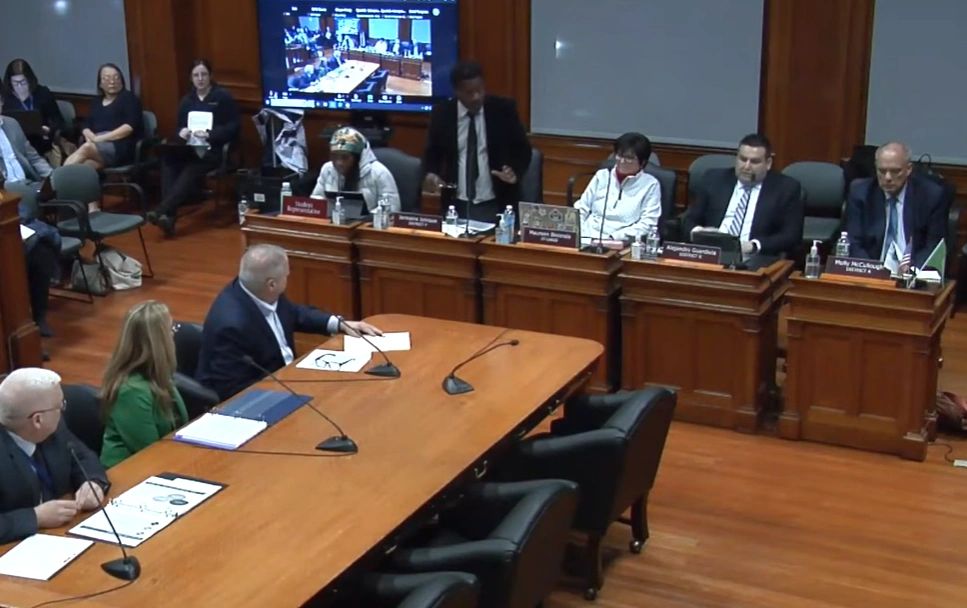
WORCESTER—Worcester Public Schools officials provided an update on school security and student safety during the Worcester School Committee meeting on Jan. 22, outlining recent investments in building security and ongoing efforts to address traffic and pedestrian safety near school campuses.
The update focused on both physical security improvements inside school buildings and operational changes aimed at keeping students safe as they travel to and from school, including walking routes and vehicle drop-off and pick-up areas.
One of the most prominent topics was student safety around school traffic patterns, particularly congestion near certain buildings. Earlier this week, the city council approved a 90-day parking ban on Grafton Street near Roosevelt Elementary School to help ease traffic concerns that have affected both student safety and nearby businesses. The issue persists despite the district adding 40 parking spaces at the school last year.
While the Grafton Street situation drew additional comments from committee members later in the meeting, Matthew Morse, the district’s director of school safety, said during his presentation that officials are reviewing drop-off and pick-up procedures across the district to improve safety in high-traffic areas.
The district is working with the Worcester Department of Transportation & Mobility, the Massachusetts Department of Transportation’s Safe Routes to School Program and the Worcester Police Department’s Traffic Division to develop long-term solutions addressing congestion and pedestrian safety near schools.
“The ultimate goal is to keep our students safe on their walk to and from their school or bus drop-off point,” Morse said. “Our collaboration with Worcester Department of Transportation & Mobility and the Mass Department of Transportation Safe Routes to School Program involves us in opportunities to improve our infrastructure, to educate, and to engage our school communities in the work of promoting safe walking, biking, or rolling to our schools.”
Morse highlighted the installation of rectangular rapid-flashing beacons and pedestrian crossing improvements at five high-priority locations across the district, pointing to the Belmont Street Community School as a priority site.
Inside school buildings, district leaders reported continued investment in security infrastructure and emergency preparedness. Data presented to the school committee showed safety initiative funding increased from $125,000 in fiscal year 2023 to $1.42 million in fiscal year 2026, an increase of more than 1,000% over four years.
Morse cited upgrades including additional cameras, improved locking systems and enhanced intercoms, along with expanded training for school staff. Administrators, principals, assistant principals and deans have participated in training using the Standard Response Protocol and Standard Reunification Method, as well as tabletop exercises conducted with Worcester police to prepare for emergency scenarios.
The district is also implementing a new communication system designed to improve coordination with emergency responders.
“Worcester Schools Net, a grant-funded collaboration between the Worcester Public Schools and Worcester Emergency Management Communications, is providing all of our schools with a desktop radio and an active and passive radio connection directly to emergency communications dispatchers,” Morse said. “This system is being rolled out and radios are being installed in schools at this time.”
As part of the rollout, the district is introducing a new protocol to standardize the information schools provide to 911, whether a call is made using the radio system or a telephone, Morse said.
Additional safety measures include ongoing reviews of crisis and communication response protocols and a pilot program exploring a school-based emergency notification system. The system could allow emergency messages to be displayed on devices throughout school buildings, including hallways and classrooms.
Jason Bleau, a seasoned reporter from Connecticut’s Quiet Corner, has more than 11 years of news media experience. He has worked as a news anchor for WINY 1350 AM, contributed to Stonebridge Press publications, and covered racing as a Press Box coordinator at Thompson Speedway. Outside journalism, he is a movie enthusiast, freelance film reviewer, banker and solo musician. He can be reached at bleau.jason@yahoo.com