
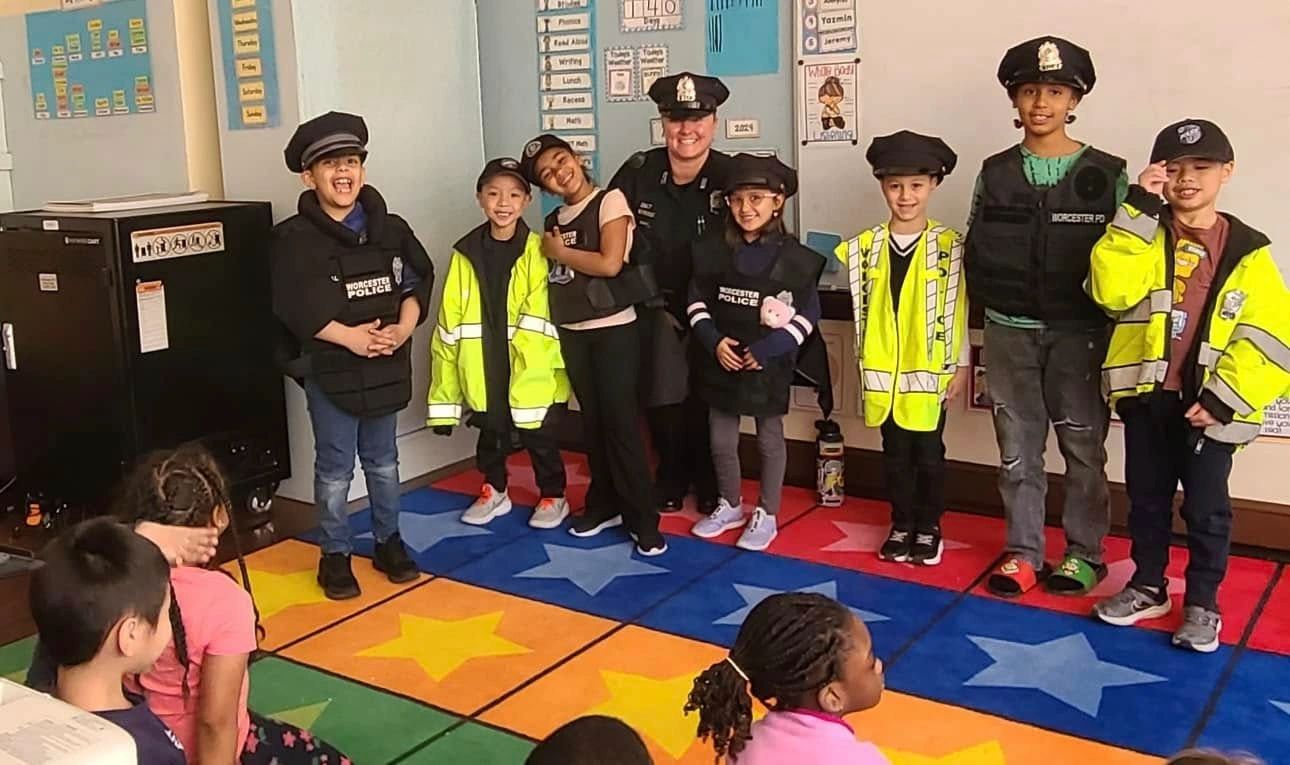
WORCESTER – Over the past five years the relationship between Worcester Public Schools and the Worcester Police Department has evolved to include more educational initiatives to help build better relationships between the police department and the schools.
A recent meeting of the district’s Standing Committee on Teaching, Learning and Student Success (TLSS) further solidified this partnership by approving a memorandum of understanding (MOU) that affirms the department’s role in education as well as its limited capacity in school discipline.
The discussion stemmed from a request from Subcommittee Chair Alejandro Guardiola to receive an update from the school administration on the status of the school liaison officer (SLO) partnership between the district and city police. The school liaison officer program was put in place after the school resource officer program ended in 2021 and over time has put more of a focus on police officers as education support systems.
A written response from the administration issued to the TLSS on Dec. 11 explained that Worcester police officers continue to have an important limited presence in the schools, serving as a non-disciplinary, relationship-building resource for students and families.
“Under this agreement, WPD officers are not stationed in schools or assigned to quadrants,” the administration’s report reads. “They do not engage in school discipline or non-criminal incidents, and participate only in scheduled educational and community-focused activities—such as safety presentations and mentorship initiatives. The report further stressed that the partnership would continue to embrace transparency and prioritize youth-development-focused initiatives.
District Administrative Director of Positive Youth Development Thomas Toney elaborated to the TLSS on some of the programs provided through the partnership, specifically the fifth-grade Talk to a Cop and sixth-grade Scholar Engagement Program in which officers educate students on different topics such as the dangers of misusing social media or the importance of identifying trusted adults they can turn too when they need help.
Members of the subcommittee praised the partnership and the MOU for its continued focus on police officers’ roles in educational rather than enforcement figures in the schools.
Member Alex Guardiola said he was pleased with the report and the continued partnership believing that police do have an important role to play in the community striving for the betterment of students.
“We need to see our Worcester police officers as community members and partners,” said Guardiola. “This is an opportunity for [students] to see that they’re an organization that’s really trying to encourage them to be successful in life.”
Subcommittee Member Sue Mailman said she supported the continuation of the partnership but stressed that she wants to keep police intervention out of the schools. Member Maureen Binienda added that while police may need to be called in for some incidents, such as those involving dangerous weapons on school property, she agreed with the MOU setting boundaries where police are more of a support system for student learning while the principals maintain responsibility for school discipline.
Jason Bleau, a seasoned reporter from Connecticut’s Quiet Corner, has more than 11 years of news media experience. He has worked as a news anchor for WINY 1350 AM, contributed to Stonebridge Press publications, and covered racing as a Press Box coordinator at Thompson Speedway. Outside journalism, he is a movie enthusiast, freelance film reviewer, banker and solo musician. He can be reached at bleau.jason@yahoo.com
