
WORCESTER—Fenway Park’s left field wall is the most distinctive architectural item in Major League Baseball. It has not always been green but it has always been a monster.
When Fenway Park opened in 1912, the wall was so high, so far from home plate that in the bunts-and-triples baseball world of those days it was thought that no ball might ever be hit over it.
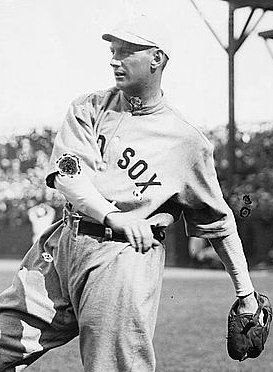
It took five games to shatter that myth. In the bottom of the seventh inning on April 26, with future Hall of Fame outfielders Harry Hooper and Tris Speaker on base for the Red Sox, 26-year-old Hugh Bradley — most recently residing at 33 Pleasant St., Worcester, MA — became the first man to clear the future Green Monster.
The three-run bomb, off Philadelphia Athletics starter Lefty Russell, brought the Red Sox from a 6-4 deficit to a 7-6 lead that wound up being the final score.
Local newspapers were delirious in their praise of Bradley’s blast.
Those who saw the home run reacted with amazement. Bradley’s teammates left the dugout and greeted him at the plate as today’s players might celebrate a game-ending homer. The Boston Advertiser’s account of the game mentioned that old Fenway friend, the prevailing wind, was blowing out from home plate and noted the ball, “started somewhere for downtown and may be going yet.”
The Boston Globe’s report was:
“The scene that followed was indescribable. The spectators jumped onto their seats and threw their hats in the air until Bradley had dropped out of sight and with the Boston players offering congratulations.”
The Boston Post said the home run was “a feat that may never be duplicated.”
The homer was the second, and last, of Bradley’s Red Sox career. He had previously hit an inside-the-park home run for Boston when the team was playing its final season in the spacious Huntington Avenue Grounds, located on what is now the campus of Northeastern University.
Lots of players have subsequently hit balls over Fenway’s left field wall. Carlton Fisk in 1975, Jim Rice from 1974 through ’89, Bucky Dent in…well, you know when…Ted Williams on rare occasions and, like Bradley, Henry Aaron did it one time.
Those are familiar names, but who was Hugh Bradley?
Bradley grew up on Millbury Street in Grafton. He was one of the area’s best athletes as an amateur and even coached Grafton High football. When Jesse Burkett brought New England League baseball to Worcester in 1906, Bradley became one of the best players on a team that won four straight pennants.
This is when he moved to Worcester.
Bradley was signed by Boston in 1910 and spent three seasons there. Despite his memorable home run early in 1912, Bradley was mostly in the wrong place at the wrong time. The man ahead of him on the first base depth chart was Jake Stahl.
Stahl was the Red Sox’ regular first baseman, the team manager and one of the owners. Three strikes, and Bradley was out.
He was back in the minors in 1913, played in the outlaw Federal League in ’14 and ’15 and continued in the minors until 1923. In all Bradley had a 17-year career.
He kept Worcester as his home base throughout his adult life. In 1914 he married Rita Kenney. The couple had one daughter, Doris. She married Edward Salmon and they raised four daughters in the Greendale section of Worcester. Two of those daughters, Ann Robb and Clare Salmon, are living.
Bradley died of a heart attack in January, 1949, at age 63.
Ann Robb lives in Greenwich, Conn. and was very young when her history-making grandfather died.
“I remember a picture of him pushing me in a baby carriage when I must have been about two years old,” she said in a phone interview. “Our family did not have a lot of oral history about him, but I knew about his home run, and I knew about the Red Sox in the World Series in 1912. And I know he had an autographed baseball from Babe Ruth.
“And I know that when he died, he had a beautiful display of red roses at his services, sent by the Red Sox.”
Robb added that for many years the family had a medallion from her grandfather’s playing days, but that has disappeared. It is very likely, although not certain, that the medallion had something to do with Boston’s World Series triumph in 1912.
There were never any chance of retaining the baseball from his historic home run. In those days, fans were not allowed to keep foul balls or home runs, at least ones that stayed in the ballpark. Bradley’s hit landed on Lansdowne Street and was probably picked up by some stunned pedestrian who figured it must be a meteorite, or possible a leftover hailstone from one of those fierce Kansas thunderstorms.
Baseball was not Bradley’s only pastime.
“From everything I’ve heard,” Robb recalled, “he had a wonderful singing voice and that he sang with many groups, with barbershop quartets, throughout his life.”
In fact, Bradley sang professionally during the winters with a group called the Red Sox Quartette. According to a biography by noted Red Sox historian Bill Nowlin, three of the singers — Bradley, Larry Gardner and Marty McHale — reunited for one last time and performed at the Boston Baseball Writers dinner in 1947.
Clare Salmon lives in Florida and was born just after her grandfather died.
From what she knew, “He was a very, very nice man.”
While she never met him, Salmon remembers her father relaying a conversation he had with Bradley.
“I think dad was a little starstruck,” she said, “and he told my grandad how exciting it must have been, how thrilling, to play major league baseball and have all the fans jumping up and down in their seats cheering for you.”
Bradley agreed, adding, “It is very exciting, something to remember, but the owners expect you to do that every time, and you can’t do it. After a while you get tired of it. You can’t do it any more and time runs out.”
Fenway Park has been remodeled since Bradley’s home run.
According to author Philip J. Lowry in his landmark book, “Green Cathedrals,” the fence that Bradley cleared in 1912 was 31 feet high and stood 324 feet from home plate down the foul line. It had a six-foot high earthen incline at the bottom, then 25 feet of wooden boards above and was covered with advertisements.
So it was not as high as today’s Green Monster, but was further from home plate.
After his playing career ended Bradley worked as an umpire and had several different jobs in the city. He was living at 43 Austin St. when he died.
Robb has moved but remains a dedicated Red Sox fan and has visited the Hall of Fame in Cooperstown. She is, however, living in foreign territory now.
“This is the heart of Yankees country,” she said, “and whenever I’m with a group of people, I’m the most hated one there.”
And while Bradley is the only ex-Red Sox player on the family tree, one of the branches extends into pro football. Robb’s late sister, Mary, married Tom Hennessey. He is in the Holy Cross athletics Hall of Fame and played defensive back for the Patriots in 1965 and 1966.
Big league rookies are advised to swing at the first pitch they see in the majors because, well, there can only be one first pitch. Everything has a first, and Hugh Bradley will own his one forever.
Bill Ballou covered the Red Sox for the Worcester Telegram from 1997 through 2018. He has covered pro hockey in Worcester since 1994 and currently does a weekly column for the Worcester Red Sox. Ballou can be reached at vetgoalie@aol.com
As the Worcester Guardian marks nearly a year of delivering free, independent digital news to our city, our dedication to this mission strengthens. Please consider a tax-deductible donation to support our ongoing commitment to providing hyperlocal news coverage to Worcester. Scroll to the bottom of our home page to sign up for our daily newsletter
