
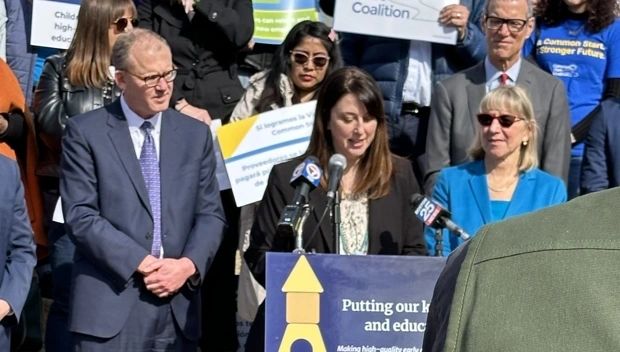
Massachusetts consistently ranks among the highest in early childcare and education expenses, according to various reports. A recent study from Care.com reaffirms this trend, revealing that the Bay State holds the top spot for nanny expenses, averaging $899 per week. Additionally, Massachusetts ranks third for both babysitter costs, averaging $195 weekly, and daycare expenses, averaging $372 per week.
The state senate earlier this month unanimously passed the EARLY ED Act, which aims to address the issue by enhancing the affordability and accessibility of childcare support programs across the Commonwealth.
According to State Senator Jason Lewis, senate chair of the Joint Committee on Education, “This is a very comprehensive bill that overall seeks to ensure that high quality, affordable early education and care is available to all families in Massachusetts who need it.”
Senator Rebecca Rausch added, “There’s so much good in this bill. One of the best parts of this bill is that it increases the financial eligibility cutoff marker for families to access childcare. Middle-class and lower-class families are being crushed by the cost of quality early education and after-school care, but they’ll see help from this bill.”
The legislation strives to make childcare more affordable for families through various measures, including permanently establishing the Commonwealth Cares for Children (C3) operational grant program, broadening the eligibility for state childcare subsidies, and improving compensation for educators with the development of a career ladder, scholarships, and loan forgiveness programs.
Senator Robyn Kennedy, who represents the first Worcester district, emphasized that investing in quality early education is vital. “The youth are our future right now,” she told the Worcester Guardian. “They are our leaders. When you’re listening to these young people, they’re constantly thinking of ways to make their space and their community better. I’m so excited to continue to foster this engagement and leadership that our young people are showing.”
According to Kennedy, Worcester, at any given time, has an average of 12 classrooms that are either closed, darkened completely, or dimmed at reduced capacity because providers struggle to hire and retain educators. She believes that the bill will go a long way to help Worcester address that gap by helping providers.
“It starts with educators being compensated not just for the work they’re doing, but also to allow them to increase their compensation accordingly, like in other industries,” Kennedy said. “In Worcester, there’s a long, exhaustive list for care, especially those waiting for subsidies. There’s a long list to be able to access those slots. And part of it is because we don’t have enough capacity in Worcester to meet the needs.”
This bill is multi-pronged and effectively addresses many of the problems that families and early educators are facing currently, according to Kennedy.
The legislation targets extending high-quality education and care to more families, particularly those unable to access such services due to financial constraints or lack of availability. “This bill also helps the providers of early education and care,” said Lewis, “so that they have stable operations, can improve program quality, and can expand capacity so that more children can be served.”
The bill seeks to expand childcare subsidy eligibility to families earning up to 85 percent of the state median income (SMI), and outlines potential expansions based on future funding availability. Lewis also pointed out the need for educator support, stating, “Early educators also lack the ability to move up in a career ladder, so this bill proposes that the Department of Early Education and Care develop that ladder.”
This approach is intended to enhance educator qualifications and program quality. “Many of our educators are leaving the field of early education to make more money elsewhere,” Rausch added, “so this bill will boost this sector for not only families but also educators. Early education and care is infrastructure.”
Lewis added, “The fact that the Senate is taking up this bill here in early March should help encourage the House to take up this bill.”
The legislation also introduces initiatives to encourage employer investment in early education and care slots.
Matt Olszewski is a freelance content and news writer based in Boston, MA. In his free time, Matt enjoys running, hiking or skiing. Matt is currently finishing up the MPH degree program at Tufts University. He can be reached at mattoskier@gmail.com