
WORCESTER—The city’s deputy fire chief Adam Roche watched as the Christmas trees burned. Flames shot ten feet into the air and he didn’t move. Roche joined two others from the Worcester Fire Department to observe the Society of Fire Protection Engineers at Worcester Polytechnic Institute conduct their annual Christmas Tree Burn. It’s all in the name of educating the public about the fire hazards around dry and misplaced Christmas trees.
These burns have been happening annually for the past 15 years at WPI’s fire lab, located just off I-290 in a modern brick building that would appear to a passerby to be a standard office or campus structure. Inside, however, is a sophisticated lab that enables students and professors to study combustion, explosions and fire safety. There are approximately 50 students in the program, and 30 to 40 graduate each year.
Last Wednesday evening, the students ignited two trees; one had been well-watered and the other was dried out, although it still held its needles. The fire started slowly and within seconds the dry tree was fully engulfed in flames. The well-watered one didn’t take long to catch up and was soon shooting flames as well. No more than two minutes later both were merely charred skeletons of evergreen trees.
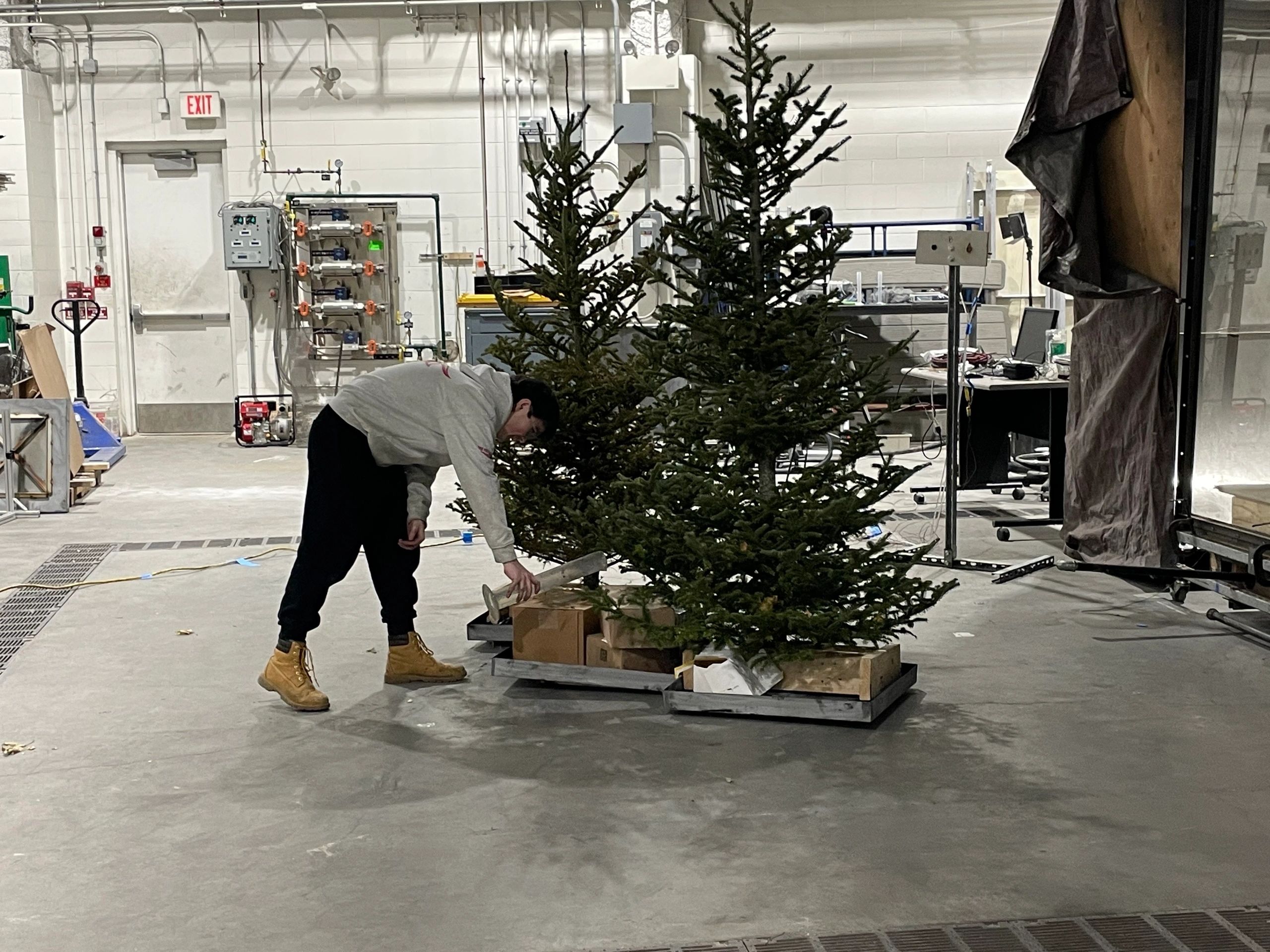
“The danger begins the second the trees are cut,” said Kyle Shriberg, a student and vice president of the WPI chapter of the society. Shriberg said 160 home fires between 2016 and 2020 were due to Christmas trees igniting. He also said that 41 percent of home structure fires in December involve Christmas trees. And 33 percent of those home fires that occur in January involve Christmas trees as well. The threat is a real one. Shriberg advised a fresh cut from the base of a Christmas tree just before it is put into water as well as daily watering. Both help reduce the flammability of the tree.
“Keep them watered and away from emissions,” said Roche, adding that it’s important not to have trees up for too long. Roche said each year the city’s fire department gets at least one call, and sometimes more, because of a Christmas tree fire. Roche also said it’s important to remember to get old, dried-out trees away from the house. Don’t leave it on your porch, he said. An errant cigarette or other spark that it comes in contact with a tree, even outside, could cause a major problem to nearby structures.
Shriberg noted that most fires involving Christmas trees originate from an electrical issue. It might be a frayed wire or broken bulb, or batteries from a train or toy under the tree. Having trees too close to a heat source is another cause. Roche advises placing a Christmas tree at least three feet from any heat or electrical source.
“There’s nothing much left of either tree,” said Shriberg, at the end of the burn, looking at the charred remains. “But the dry one caught fire much more quickly.” Before the demonstration, Shirberg had warned that “flashover” (when an area becomes so hot that nearly everything nearby will be on fire) can occur merely a minute after a Christmas tree catches on fire.
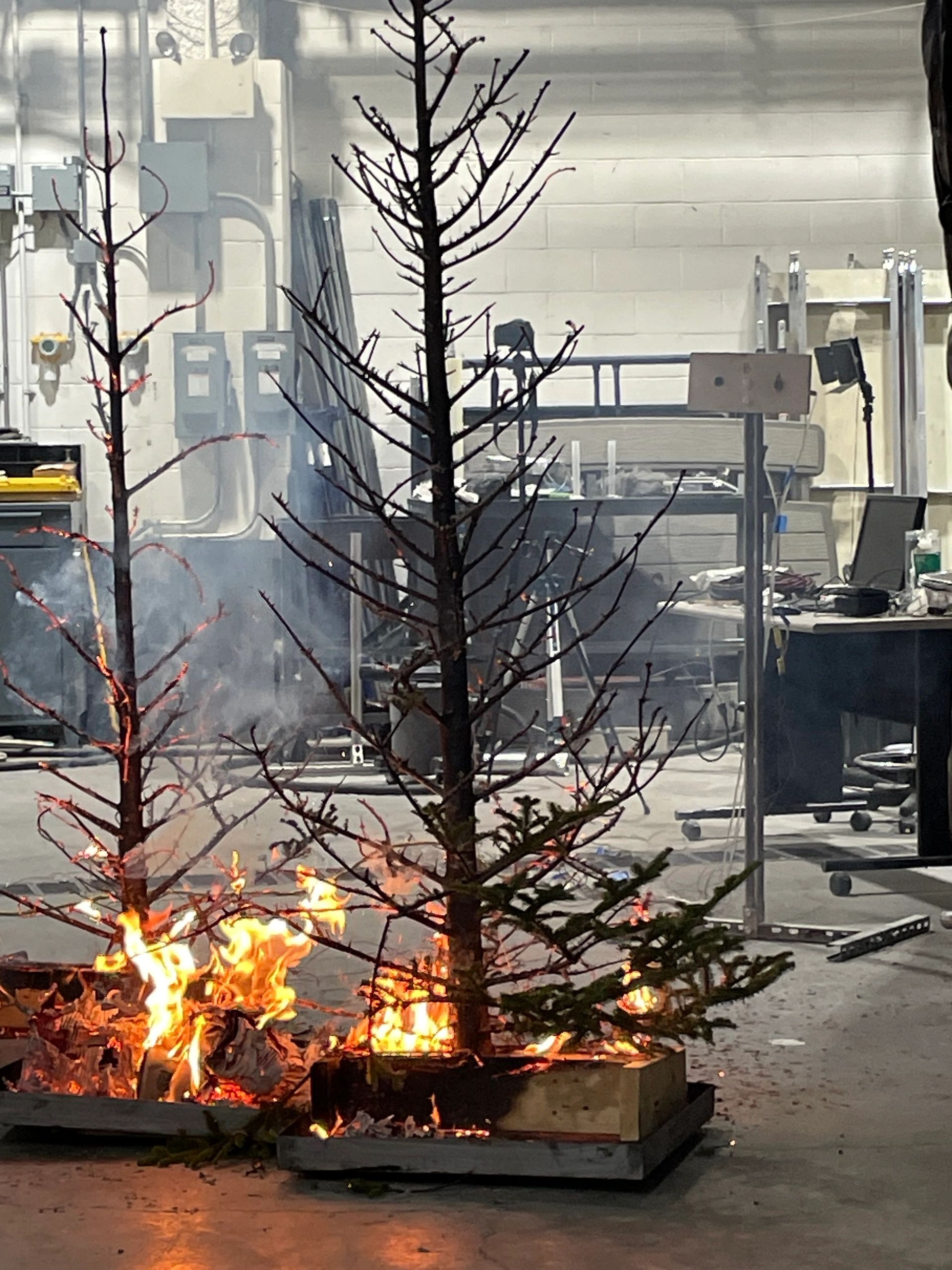
Although less common, Shirberg also warned that artificial trees can still catch fire. At the end of the burn, the society calculated that the watered tree reached 1,755 degrees Fahrenheit and the dried-out tree got to 1,902 degrees Fahrenheit.
“People think the probability is very low and that it will not happen to them,” said Albert Simeoni, chair of the Fire Protection Engineering Department. Keeping trees well-watered, away from heat sources, and decorated with lights that are in working order will get you on your way to a safe holiday season.
Bridget Samburg is a freelance editor, reporter and ghostwriter. She has written for Boston Magazine, The Boston Globe and Yankee Magazine, among other outlets. She can be reached at bsamburg@comcast.net
