

WORCESTER—Tuesday’s Worcester City Council meeting is dominated by one of the most closely watched hearings of the year: the annual tax classification vote, the process that sets Worcester’s property tax rates and shapes the city’s fiscal outlook for the coming year.
The hearing has become a kind of civic ritual—part budget reality check, part barometer of Worcester’s economic mood. This year’s package comes with fresh revisions after a ninth inning update from the administration, as well as a long list of numbers that residents and business owners inevitably sift through, including the annual ranking of the city’s largest taxpayers.
According to materials submitted to councilors, Worcester’s total taxable valuation climbed to $25.332 billion for FY26, a 4.12% increase over last year. The combined single tax rate remains $16.67 per $1,000, a figure recently reconfirmed after two personal property accounts — roughly $7.3 million in value — were mistakenly omitted and then reinstated.
City Manager Eric Batista introduced the revised packet by noting that the update “does not change the overall tax burden or the single rate,” but does slightly shift how the burden is distributed within the commercial, industrial and personal property classes.
CFO Timothy McGourthy added that the correction “allows for the inclusion of one additional tax-table line,” which adjusts the lowest possible residential factor to 79.8778 and nudges the highest possible commercial rate to $29.16.
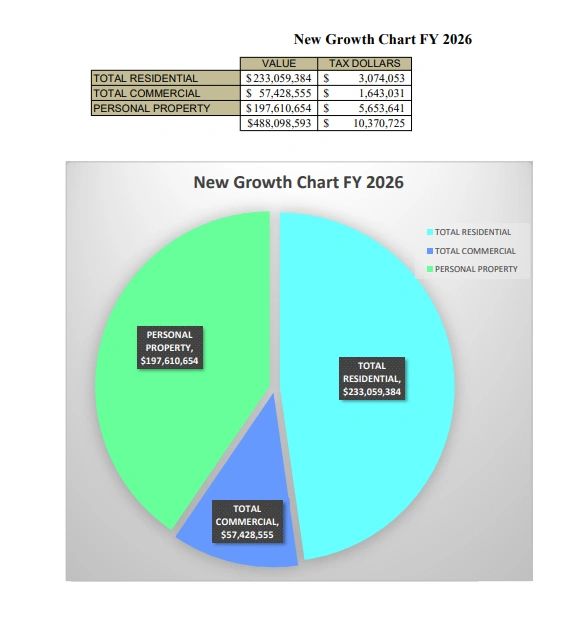
New growth remains one of the year’s standout metrics: $10.37 million, far above the $7 million assumed in the FY26 budget, with another $1.52 million carried forward from last year.
Growth appeared across all property classes, driven by large new residential projects and ongoing utility investment—two trends that continue to reshape the city’s tax base.
Even with the added revenue, officials are signaling caution. The FY26 levy recommendation is $422.4 million, preserving roughly $25.8 million in excess levy capacity, a buffer Worcester has kept intentionally. In Batista’s words, the city is attempting to maintain “stability in the face of state aid volatility and mounting school-year obligations.”
So what is the CIP shift — and why max it out?
The Commercial–Industrial–Personal (CIP) shift is the mechanism that allows Worcester to distribute a larger share of the overall tax burden onto commercial, industrial and personal-property taxpayers in order to reduce the amount paid by residential homeowners.
State law permits communities to “shift” up to 175% of the tax burden onto the CIP classes and Worcester consistently adopts the maximum shift to help moderate residential tax increases. In practice, the shift functions like a lever: the higher the percentage applied to CIP properties, the lower the residential tax rate falls, and vice versa. This year’s recommended shift once again lands at the 175% ceiling, which produces a minimum residential factor of 79.8778 and allows the city to keep roughly $25.8 million in excess levy capacity while maintaining a proposed single tax rate of $16.67 per $1,000 in value.
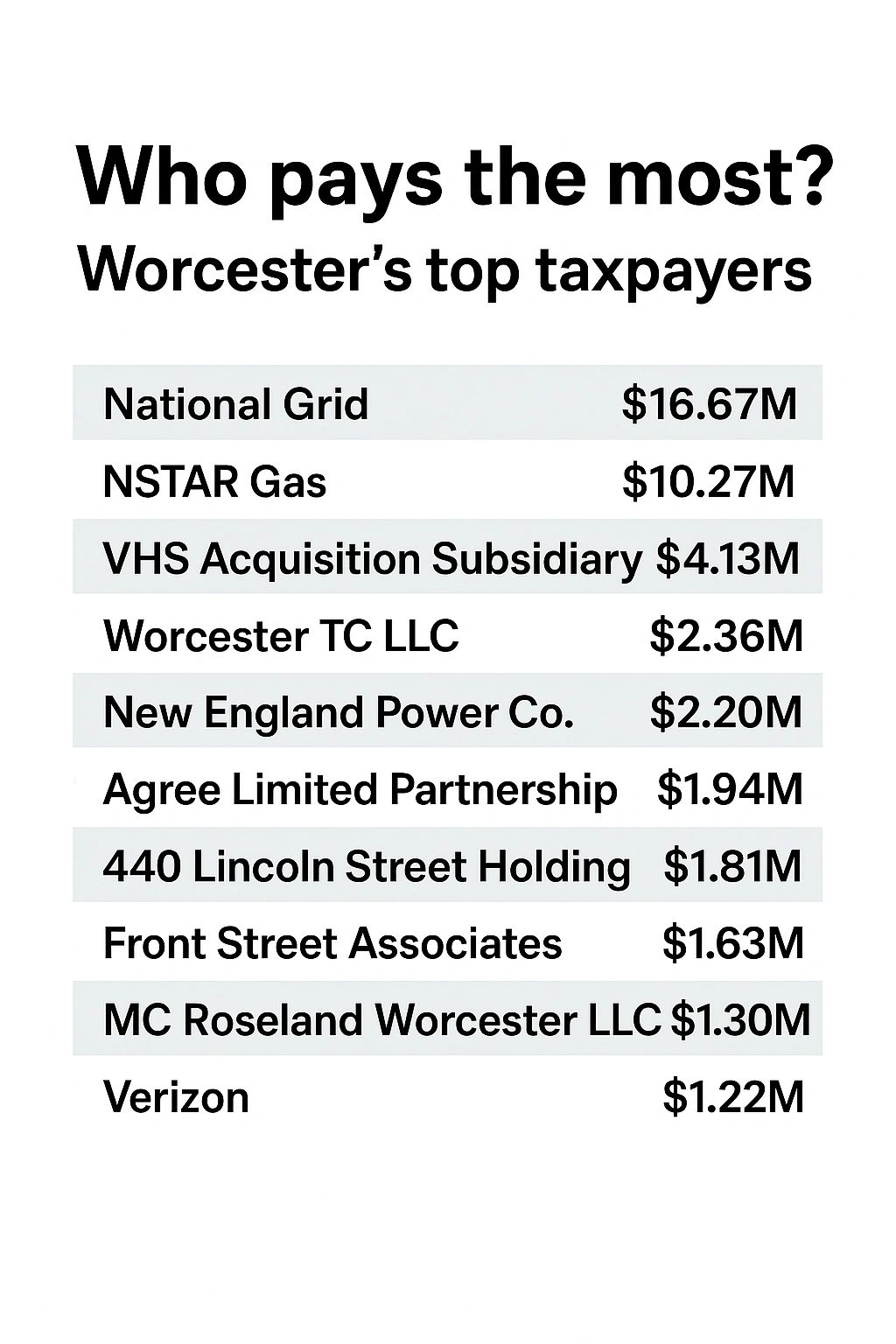
Who pays the most? Worcester’s top taxpayers
Another perennial favorite buried in the tax-classification material is Worcester’s list of top taxpayers — and once again, it’s the utilities carrying the heavy load.
National Grid leads the pack by a wide margin, contributing roughly $16.67 million in property taxes. NSTAR Gas follows at $10.27 million and the third-largest contributor is the hospital entity VHS Acquisition Subsidiary at about $4.13 million.
From there, the list shifts to major commercial and industrial players: biotech firm Worcester TC LLC at $2.36 million, New England Power Co. at $2.20 million and a series of commercial real-estate ownership groups — Agree Limited Partnership, 440 Lincoln Street Holding, Front Street Associates, and MC Roseland Worcester LLC — along with Verizon rounding out the top tier.
Taken together, Worcester’s ten largest taxpayers account for more than 11% of the city’s entire tax levy, a reminder that Worcester continues to lean heavily on major utility companies and large-scale commercial property owners to support the municipal budget.
Police overtime, body camera reviews on hold
Two oversight reports—one on Worcester police overtime and detail operations, the other on the department’s body-worn camera program — remain listed as held under privilege by Vice Chair councilor Khrystian King from the Nov. 18 meeting.
Because the items are still marked as held on the Nov. 25 agenda, they will not be taken up Tuesday unless King releases them. The reports include findings from CliftonLarsonAllen LLP’s follow-up forensic review of overtime procedures. CLA found no material instances of fraud or misappropriation but noted ongoing inconsistencies, continued reliance on paper slips, and incomplete implementation of past recommendations. Some reforms — such as centralized detail scheduling and new internal controls — are in place, but others remain only partially adopted.
Other highlights on the agenda:
- National Grid seeks multiple conduit and pole approvals: The utility (along with Verizon on two petitions) is before the council for a cluster of conduit and pole location requests on Grove Street, Lovell Street, Mill Street, Salisbury Street, Webster Street, Bridle Path and Lincoln Street. These are standard infrastructure hearings but represent a sizable slate for a single meeting.
Editor’s note: This story will be updated as agenda items are added or revised. Refresh this page for the latest developments.
Worcester City Council meets Tuesday, Nov. 25, at City Hall in the Esther Howland (south) at 6:30 p.m. It is also live streamed on the city’s website.
Have news, tips, or a story worth telling? Reach Editor Charlene Arsenault at carsenault@theworcesterguardian.org—because good stories (and great scoops) deserve to be shared.
The Worcester Guardian is an independent nonprofit news organization. Support local journalism by making a DONATION today.