
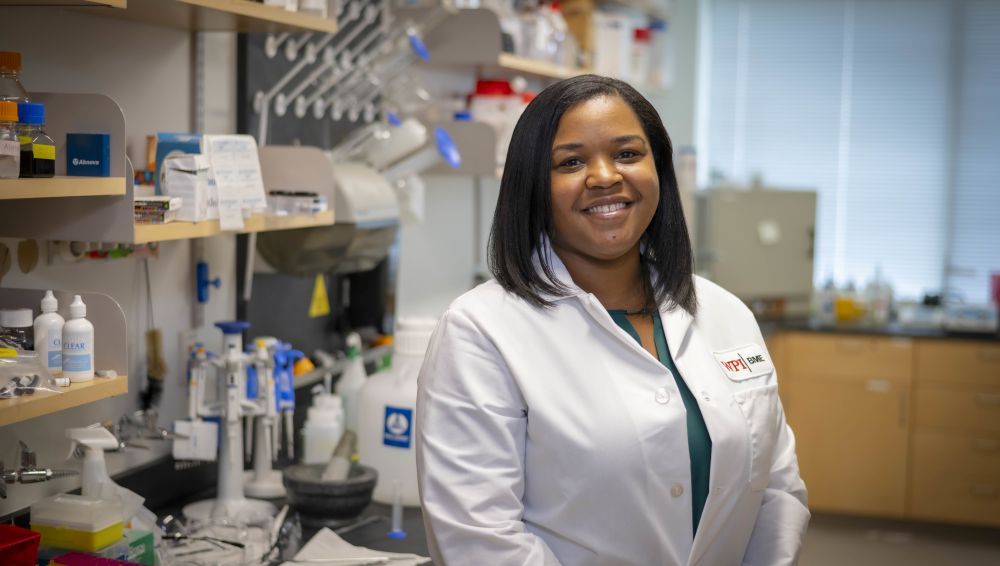
A research project at Worcester Polytechnic Institute that began in the hands of students — including one who was still in high school — is growing into a three-year, federally funded effort to better understand uterine fibroids and potentially improve the way treatments for the condition are studied.
Associate Professor Catherine Whittington, of WPI’s Department of Biomedical Engineering, has received a $555,371 grant from the National Institutes of Health to develop two laboratory models designed to give researchers a closer look at how fibroids behave within the complex environment of uterine tissue.
But the foundation for the work was already being built before the grant arrived.
Previous student projects in Whittington’s laboratory produced findings that are expanded through the NIH-funded research, according to WPI’s announcement. The project also brings additional undergraduate and graduate students into the lab over the next three years.
“The framework for this project was established by students who conducted studies, replicated their results, and did statistical analysis, all of which goes into rigorous scientific research,” Whittington said in the announcement. “We have an opportunity to advance and expand their pioneering work.”
The research targets a remarkably common but still incompletely understood health condition. Uterine fibroids are benign tumors that develop within the muscular walls of the uterus. An estimated 70% to 80% of women develop them by age 50, according to WPI. While some cause no symptoms, others can cause pain and affect fertility.
Researchers still do not know why fibroids form or why they can return following treatment. The only cure is a hysterectomy, according to WPI.
“There is much we do not know about fibroids,” Whittington said in the announcement. “We don’t know why they form. We don’t know why they recur after treatment. Models could help by giving researchers a rapid way to study fibroids and tissues under many different scenarios.”
Whittington’s grant comes from the NIH’s Eunice Kennedy Shriver National Institute of Child Health and Human Development through a program that emphasizes extending research opportunities to undergraduate students.
The project develops two three-dimensional laboratory models intended to recreate aspects of the environment surrounding fibroid cells. Researchers will use them to investigate how cellular signals travel through tissue that has become stiff or inflamed — conditions that may influence both the progression of fibroids and the effectiveness of potential treatments.
One model places a tiny sphere of fibroid cells inside a gel engineered to mimic the stiffness and structure of uterine tissue. Researchers will study how molecules of different sizes move through the material, with particular attention to larger molecules comparable in size to therapeutic drugs.
That work grew out of a 2024-25 undergraduate capstone project.
The second model has an even earlier student origin. Researchers will create small rings of uterine muscle tissue, seed them with tiny fibroid spheroids and expose them to hormones, molecules produced by fat-derived cells and therapeutic compounds.
The approach is based on a two-year project conducted by Isabella Palit, who graduated from the Massachusetts Academy of Math and Science at WPI in 2024, along with work by a team of undergraduates who completed a capstone project in 2025. WPI doctoral student Kiran Tremblay has worked on the research since 2025.
The models could help scientists investigate several factors thought to play a role in fibroids. The tumors respond to hormonal changes and have also been associated with obesity and inflammation. Previous research has suggested that stiffening of the tissue surrounding fibroids could interfere with cellular signals, potentially including those delivered by drug treatments.
Rather than removing students from the equation as the research moves into its federally funded phase, the project will bring more of them in.
Whittington expects to sponsor additional undergraduate capstone teams focused on the models and plans to hire undergraduate and graduate students to assist with their development during the three-year project.
The work is part of Whittington’s broader research into three-dimensional, tissue-engineered biomaterials used to study diseases involving fibrosis — the scarring and thickening of tissue. In 2025, she received a National Science Foundation CAREER Award to develop models for studying fibrosis in the pancreas, skin and uterine fibroids. Her research has also received support from the National Cancer Institute, Genentech and the Pancreatic Cancer Action Network.
For Whittington, the latest grant advances the science while also illustrating the role students can play in creating it.
“This new project addresses a significant health problem, but it also highlights the importance of integrating undergraduate and graduate students into research at WPI,” Whittington said in the announcement. “None of the research in my lab, including this project, could happen without the work and contributions of student researchers.”