
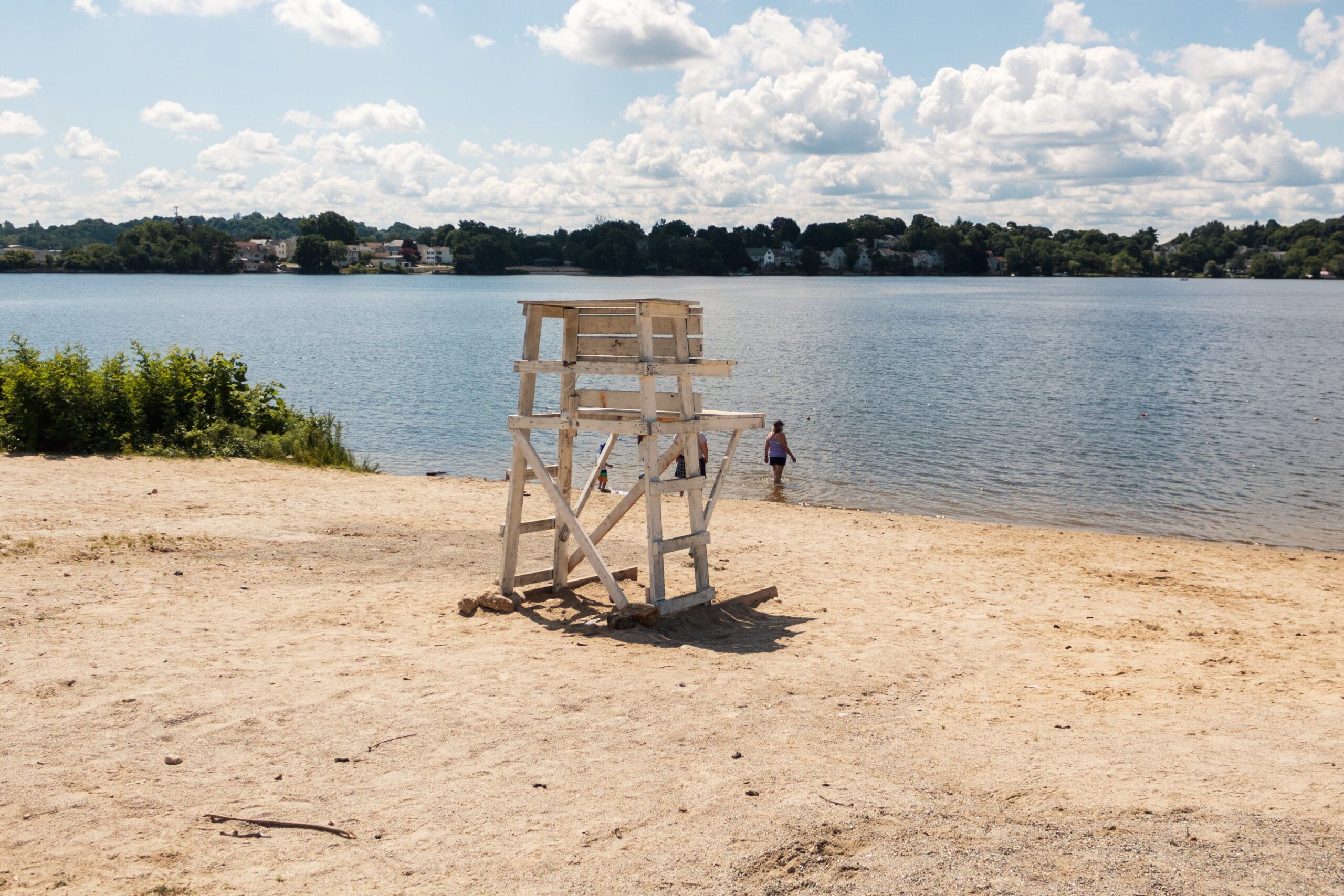
WORCESTER — After a summer of repeated water-quality advisories and beach closures, a Worcester city councilor wants officials to look beyond short-term treatments and determine what can be done to prevent the problem in future years.
Councilor-at-Large Gary Rosen filed an order at the Aug. 18 City Council meeting requesting that City Manager Eric Batista provide councilors with recommendations for long-term steps the city can take to prevent frequent summer closures at Coes Reservoir and Indian Lake.
The order, which passed the council, cited repeated closures that have restricted swimming, boating, fishing and other contact with the water because of cyanobacteria and other water-quality concerns.
“There must be some way we can get these beaches under control so we don’t have to close them down during the months of July and August when they see the most use during summer vacation,” Rosen said during the meeting.
The request comes after a difficult stretch for several Worcester waterways. Coes Reservoir and Indian Lake have both been subject to public health advisories because of cyanobacteria this summer, while Smith Pond Beach temporarily closed because of elevated E. coli. A sanitary sewer overflow also prompted temporary swimming and fishing restrictions along part of Lake Quinsigamond.
The incidents have not all shared the same cause, but the repeated restrictions have drawn attention to the challenges Worcester faces in maintaining water quality at its urban lakes during the summer.
Rosen suggested the city could potentially look to Worcester Polytechnic Institute for help exploring longer-term solutions.

“It would be good if we can take some steps, and we have WPI always looking for projects,” Rosen said. “There’s two locations for them, I would think these would be good projects for the students over there.”
The city already partners with local schools and universities on educational programs related to its lakes and ponds, according to Worcester’s Department of Sustainability and Resilience. The city’s Lakes and Ponds Program also monitors water quality and undertakes projects intended to reduce nutrient pollution before it reaches waterways.
Coes Reservoir sees repeat closures
Coes Reservoir has experienced multiple cyanobacteria closures this summer after avoiding them entirely in 2025.
The city first closed the reservoir July 22 after testing found cyanobacteria densities above the state’s recreational public health threshold. The dominant cyanobacteria identified were Aphanizomenon and Woronichinia, both of which have the capacity to produce toxins.
Coes reopened July 31 after follow-up testing found safe cyanobacteria densities, but the respite was short-lived.
The reservoir temporarily closed Aug. 3 for a preventive treatment and was placed under another public health closure Aug. 7 after testing again found cyanobacteria above the state threshold. Indian Lake was already under its own cyanobacteria advisory at the time.
The closures came despite preventive measures earlier in the summer. Contractors hired by the city applied copper sulfate to both Coes Reservoir and Indian Lake July 6 in an effort to control harmful algae growth. At the time, the city said the treatment was preventive and there was no threat of harmful algae exposure.
The situation at Coes contrasts with last summer. The city’s 2025 water-quality report found that cyanobacteria concentrations began increasing in July, but a preventive treatment was conducted after testing recorded 42,400 cells per milliliter. Concentrations subsequently remained low, and Coes did not close because of a cyanobacteria bloom at any point during the season.
The reservoir has experienced more severe problems in other years. In 2022, Coes was closed for 78 days because of cyanobacteria blooms, including five days during a heat wave.
Why some lakes are more susceptible
Pamela Weathers, a biology and biotechnology professor at Worcester Polytechnic Institute, said several factors can influence cyanobacteria growth, including the amount of nitrogen and phosphorus entering individual waterways.
“Cyanobacteria respond to the N and P levels in particular so there could be different levels of fertilizer runoff from one neighborhood [in Worcester] vs. another,” Weathers said. “For example, if there are many lawns in one neighborhood but few in the other then the amount of N and P coming from the lawned neighborhood may feed into a lake that will then have more cyanobacteria.”
That can help explain why water bodies located within the same city do not necessarily experience the same conditions at the same time.
Worcester’s Lakes and Ponds Program says phosphorus pollution can contribute to cyanobacteria growth. The city manages cyanobacteria first by attempting to reduce nutrient availability and, when necessary, through algaecides intended to prevent potentially toxic blooms.
“Fertilizer runoff from lawns is especially rich in nitrogen (N) and phosphorous (P) nutrients,” Weathers said. “Cyanobacteria love that and along with heat and the water in which they live, it stimulates their growth and reproduction.”
Heavy rain can also affect how those nutrients reach waterways, Weathers said.
“If we get a deluge as has occurred occasionally, city stormwater drains cannot handle the rapid increase in volume and the resulting influx of nutrients like N and P also spurs growth,” she said.
Coes Reservoir and Indian Lake receive extensive recreational use, including public swimming, and have water-quality conditions that can make them susceptible to cyanobacteria blooms.
Samples from both lakes are sent to an outside laboratory that counts the number of cyanobacteria cells in a known volume of water. One threshold used by the Massachusetts Department of Public Health for recommending a public health advisory is more than 70,000 cells per milliliter.
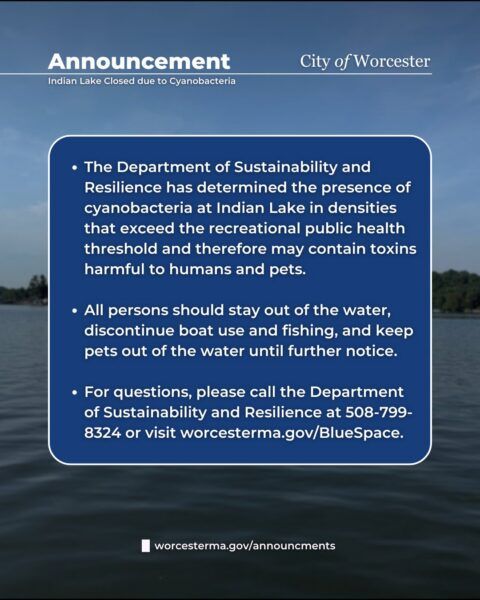
Indian Lake exceeded the recreational threshold in early August. The city closed the lake Aug. 4 after testing identified Microcystis, Planktolyngbya and Aphanocapsa as the dominant cyanobacteria, all of which have the capacity to produce toxins.
Volunteer monitoring provides broader look
The Worcester Cyanobacteria Monitoring Collaborative provides another layer of monitoring across Worcester and surrounding communities.
The collaborative consists of volunteer community scientists who collect samples from participating waterways and use relatively fast, low-cost methods to track cyanobacteria and estimate potential cyanotoxin exposure risk.
The collaborative’s Aug. 3 results rated Indian Lake at Clason Beach as having a “High” potential cyanotoxin exposure risk, while Coes Reservoir and Salisbury Pond were rated “Elevated.” Cooks Pond and Green Hill Park Pond received “Low” ratings.
Katie Liming, Worcester Lakes and Ponds coordinator, cautioned that those results should not be treated as official public health determinations.
“The WCMC’s results are intended as additional context for residents to inform their recreational decisions,” Liming said. “Because cyanobacteria do not always produce toxins and there are many different types of possible toxins, results do not represent authoritative health advice.”
WCMC monitoring uses methods that serve as proxies for cyanobacteria presence rather than the laboratory cell counts used for official health advisories. Worcester does not issue health advisories based on the collaborative’s monitoring results.
“Cyanobacteria cell counts collected at Indian Lake and Coes Reservoir are much more robust measures of cyanotoxin exposure risk than WCMC results,” Liming added. “When the municipality issues an official cyanobacteria health advisory, residents should adhere to guidance and avoid swimming, boating, and fishing in the impacted areas.”
Liming said the data remains useful for tracking how conditions change throughout a season and helping residents make informed decisions about recreation. She also cautioned that some measurements can be affected by sediment or harmless organic material, including at Salisbury Pond.
Weather and development play a role
Liming said there is no single factor responsible for cyanobacteria conditions.
“While there are many factors that impact cyanobacteria, changing temperature and precipitation patterns and increasing urban development can increase the amount of nutrients entering waterbodies,” she said. “Long periods of drought followed by intense downpours can increase erosion and runoff, carrying excessive nutrients into waterbodies.”
She also said increased monitoring and improved detection capabilities can influence what is known about cyanotoxin exposure risk, making comparisons between different periods more complicated.
Weathers similarly cautioned that conditions can vary substantially from year to year.
“Each summer has different weather,” she said. “Summer temperatures on average, however, are rising, and that trend will induce more cyanobacterial growth when provided with nutrients.”
Limiting nutrient runoff is one way to reduce conditions favorable to cyanobacteria, Weathers said.
“Reducing inorganic fertilizer application should reduce bloom incidence. Examples of inorganic fertilizers are nitrates and phosphates,” she said.
Different problems across city waterways
Not all of Worcester’s water-quality issues this summer have involved cyanobacteria.
Smith Pond Beach temporarily closed after testing found elevated E. coli concentrations. The beach later reopened after subsequent samples returned to acceptable levels.
The Worcester Cyanobacteria Monitoring Collaborative’s Aug. 3 sampling rated Cooks Pond, where Smith Pond Beach is located, as having a low potential cyanotoxin exposure risk. The findings are not contradictory: the collaborative was assessing potential cyanotoxin exposure, while the subsequent beach closure involved E. coli rather than cyanobacteria.
Lake Quinsigamond faced a separate problem in July when a sanitary sewer overflow prompted temporary swimming and fishing restrictions in part of the lake. The restrictions were lifted July 28 following additional testing.
Taken together, the incidents show the range of water-quality challenges Worcester has faced this summer.
The City Council’s latest request shifts the focus toward longer-term prevention at Indian Lake and Coes Reservoir.
Worcester is already developing Project Blue Worcester, an initiative intended to establish water-quality goals for phosphorus, bacteria and dissolved oxygen and identify pollution-reduction measures, including potential stormwater infrastructure improvements.
Rosen’s order asks the city administration to outline long-range recommendations specifically aimed at reducing the summer closures that have periodically put two of Worcester’s major recreational waterways off limits.
Matt Olszewski is a freelance content and news writer who graduated with his MPH from Tufts University. In his free time, Matt enjoys running, hiking or skiing. He can be reached at mattoskier@gmail.com
