
The Worcester City Council rejected a proposal to establish a civilian review board for the police department late Tuesday, after residents packed a five-hour meeting to demand greater independence, transparency and accountability in police oversight.
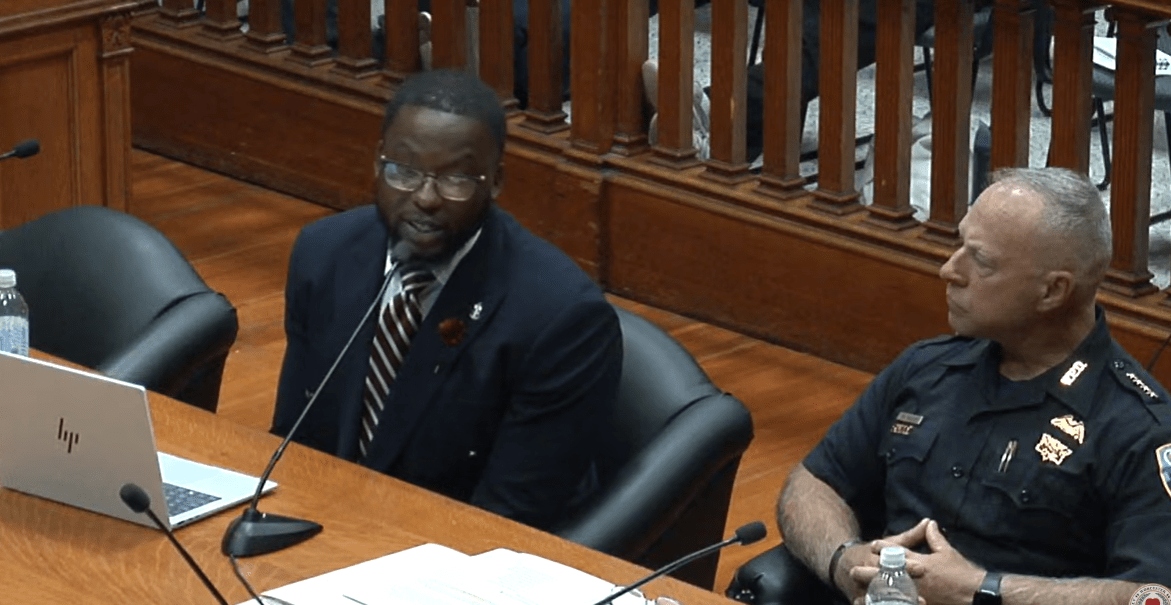
The council voted 8-3 to file the matter, with Councilors Khrystian King, Luis Ojeda and Robert Bilotta opposed. The vote followed extensive public comment and a presentation from Worcester Chief Equity Officer Kevin Lovaincy, who outlined the city’s existing oversight system and the administration’s recommendation that Worcester strengthen that framework rather than create a separate civilian board.
Lovaincy said the current structure includes five civilian investigators who report to him rather than to the Worcester Police Department or its command structure.
He said investigations of municipal employees start with a determination of whether a city policy has been broken, followed by an assessment in which more weight is given to cases involving a protected class.
When an investigation by the Executive Office of Diversity, Equity and Inclusion finds wrongdoing, Lovaincy said, his office discusses the findings with the police chief and seeks a resolution.
“We engage in a discussion where we go over what the facts of the case were, evidence, and what we recommend,” he said. “But at the end of the day, the Chief of Police is the sole authority figure to ensure that discipline is handled.”
Violations of police standards are also sent to the Worcester Police Department’s Bureau of Professional Standards and the state Peace Officer Standards and Training Commission. The city separately maintains a process for complaints of discrimination, bias, harassment or excessive force through the Executive Office of Diversity, Equity and Inclusion.
Lovaincy pointed to data showing an 81% decline in excessive-use-of-force complaints since 2018 and said most cases resulted in the officer being exonerated.
A review of cases that came through the city’s hotline showed that 140 calls were received between December 2024 and July 2026. Thirteen were referred to the Bureau of Professional Standards, and seven were investigated by Lovaincy’s department.
The presentation also outlined challenges the administration says would come with establishing a civilian review board, including the potential need to restructure provisions of the police department’s collective bargaining agreement, which could take years to renegotiate. A review board would also require support staff and ongoing training for members on police procedures, laws and operational practices.
King sought to pause the presentation, saying councilors had received the 55-page report only that day, shortly before the meeting. He argued the information should have been included with City Manager Eric Batista’s earlier report recommending against establishing a civilian review board and asked for more time so councilors and the public could review it.
Mayor Joseph Petty denied the request, saying the presentation was an explanation of Batista’s report.
Councilor Kathleen Toomey said she appreciated the presentation and argued that adding a civilian review board would complicate the oversight system already in place.
“The question isn’t whether we want police accountability. We absolutely do,” she said. “The question is whether creating another civilian review board is the best way to achieve it I believe Worcester should focus on an oversight system that’s independent, transparent, timely, and grounded in professional expertise, while preserving due process for our officers and protecting the public.”
Councilor Morris Bergman said he opposed a civilian review board for several reasons, including the low number of substantiated excessive-force complaints. He also argued that a civilian review system could become biased and create additional complications.
“It’s an unfair system,” Bergman said. “I don’t know of any other profession that are judged by people who aren’t in the profession…I don’t think it’s necessary…I think it’s subject to becoming highly political, and not accomplish what the ultimate goal is.”
Councilor Satya Mitra countered that the extraordinary authority granted to police is precisely why civilians should have a role in oversight.
“This particular department has been given an extraordinary power,” Mitra said. “The police department has the power to detain you, the power to arrest you, the power to shoot you. That’s why probably every resident is asking ‘can we have a civilian review board to make sure they are not abusing or over-using that power?’”
King said the issue is complicated and argued that the information presented to the council remained incomplete.
“We do not have significant oversight. That’s why we have a research bureau report,” King said. “It came because of the people. It came because we had a number of concerns about needing more oversight.”
King said that while the existing system accomplishes some oversight functions, adding a civilian review board would better address concerns raised by residents.
Many residents who spoke cited previous complaints against police, the Department of Justice investigation into the Worcester Police Department and their own experiences with police. The DOJ closed its investigation in August.
Idella Hazard argued that closing the federal investigation did not amount to a finding that no wrongdoing had occurred.
“They did not find anyone innocent,” she said. “The case was closed because Trump closed all of the Homeland Security cases across the country.”
“I’ve lived in this city for 60 years. I’ve seen a lot of racism here,” resident Gordon Davis said. “Recently I talked to Chief Saucier, and he said they’re doing nothing—there’s nothing he can do—about the systemic racism found in the CNA report on it. He said there’s nothing he can do. He says it’s out of his hands…For anyone who says we don’t need a civilian review board, that’s a crock of s$#t. We do need it. We don’t want people investigating themselves.”
Worcester police disputed Davis’ characterization of his conversation with Saucier. Department spokesperson Sgt. Elise Miranda said Saucier had been referring to a software program the department has been awaiting and had told Davis that there was nothing WPD could do to speed up that process. Saucier “was not talking about the subject of racism,” Miranda said, and denies saying that addressing racism was something the department could do nothing about or that it was out of his hands.
While much of the public testimony favored creating a civilian review board, some residents spoke against it. Donald Borek, a lifelong Worcester resident, said he believed such a board would be biased against police officers and could make their jobs more difficult.
“I’ve been here all my life—69 years,” he said. “I’m definitely opposed to this thing because all I feel is that when the civilian review board will be there, it will be completely biased. I don’t see anyone on there that wouldn’t be biased against the police department.”
Borek, who was booed by audience members several times while talking, said he believed existing state oversight was sufficient and that another layer of review would not improve public safety.
“These guys have a tough enough time doing what they’re doing, as opposed to having a harder time because they already got a state review board-it’s just totally crazy for to have a civilian review board,” Borek said. “It’s not going to help the city at all. It’s only going to make the city more unsafe.”
Robert Rizzuti, a pastor who said he was tased and arrested and later acquitted, argued that residents need an avenue for recourse over police conduct.
“They have Mass. domestic immunity and qualified immunity. Both protect the government. We need protection for the people for the misconduct,” Rizzuti said. “Without a civilian review board, these men continue on believing they will never be held accountable because they have qualified immunity.”
Fred Taylor, president of the Worcester branch of the NAACP, said a civilian review board would benefit the city as a whole.
“We’re advocating for a civilian review board because we believe the city will benefit from greater transparency, accountability and public trust in policing,” Taylor said.
The Civilian Review Board Coalition, which has advocated for independent civilian oversight of the Police Department, criticized the council’s decision in a statement sent to the Worcester Guardian on Wednesday and signaled that the issue would carry into the coming municipal election.
“Police are entrusted with extraordinary governmental authority,” said Giselle Rivera-Flores, spokesperson for the coalition, in a statement . “Systems of accountability should not depend upon who occupies the Chief of Worcester Police Department’s office, whether elected officials personally trust that individual, or whether a new administration has been given enough time to demonstrate results. Good leadership and independent oversight can—and should—exist at the same time.”
Rivera-Flores said community members and organizations had spent months researching civilian oversight, organizing and testifying before city officials, and argued that Tuesday’s vote should make police accountability an issue for voters. “Last night was a vote on a Civilian Review Board,” the statement concluded. “The next vote belongs to the people of Worcester.”
The council ultimately voted 8-3 to file the civilian review board report, with King, Ojeda and Bilotta voting against doing so.
UPDATE: This story was updated Sept. 9 to include a response from the Worcester Police Department disputing a resident’s characterization of a conversation with Police Chief Paul Saucier.
Steve Smith, a veteran reporter with 17 years at The Hartford Courant, now brings his passion for photojournalism to Worcester. An award-winning photographer, he has covered major events like U.S. soccer, pro football, and UConn basketball. He is also the official photographer for the Miss Massachusetts competition and works as a realtor. Contact him at steve@stevephotographysmith.com
