
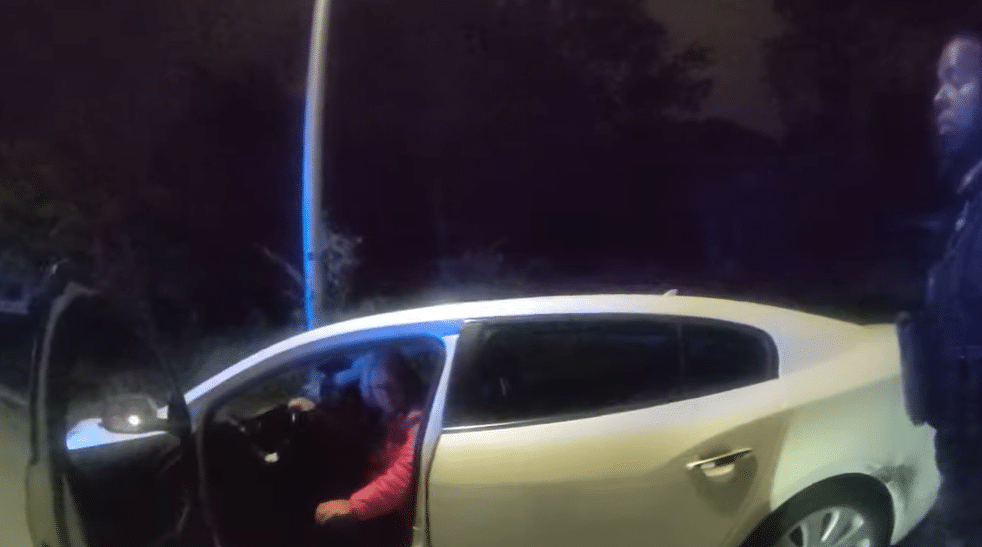
An internal Worcester Police Department investigation found no evidence that officers gave City Councilor Kathleen Toomey preferential treatment after her late-night car crash in September, but sustained a policy violation against an officer who muted his body camera for much of the encounter.
The investigation also acknowledged that responding officers did not direct their questioning toward determining whether Toomey was impaired, despite the circumstances of the crash and a 911 caller’s concerns that the councilor was intoxicated.
Those findings are detailed in an Oct. 16 review by Capt. Sean Murtha, commander of the department’s Bureau of Professional Standards. The review concluded that officers lacked probable cause to arrest Toomey for operating under the influence and that her position as a longtime city councilor and former chair of the Public Safety Committee did not affect their response.
But Murtha acknowledged that the extensive muting of police body-camera audio left some uncertainty about what officers discussed during the encounter.
“The investigation did not uncover evidence of preferential treatment,” Murtha wrote. “While the excessive muting of the body-worn camera audio introduces some uncertainty about the content of the officers’ conversations, we believe that a fair-minded observer, after seeing all the evidence, would conclude that a similar call involving an elderly, disabled person who was not a city councilor would have been handled in a similar manner by these officers.”
Police Chief Paul Saucier sustained a body-camera policy violation against Officer Joseph Fitton, who was supervising a rookie officer during the response, but did not sustain an allegation that Fitton violated the department’s operating-under-the-influence policy.
The department has also amended its procedures to require a police supervisor with the rank of sergeant or higher to respond to calls involving elected officials.
The findings have drawn criticism from the Worcester Civilian Review Board Coalition, which argues that the department failed to investigate several key aspects of the encounter and that the internal review demonstrates the need for independent police oversight.
Questions about impairment
The investigation stems from a Sept. 2 crash on Harrington Way, where Toomey’s 2014 Buick struck an unoccupied Volkswagen parked on the sidewalk shortly after midnight. No injuries were reported, and both vehicles were towed. A resident who called 911 after hearing the collision told the dispatcher that she believed Toomey was intoxicated.
According to Murtha’s review, however, the dispatcher did not relay the caller’s suspicion of alcohol involvement to responding officers.
Instead, officers were told that a vehicle had struck a parked car, that something might be wrong with the driver, that she had declined an ambulance and that she might have been attempting to leave.
Four officers responded in two patrol cars. Two were recent police academy graduates working under field training officers.
Murtha acknowledged that the circumstances should have prompted an experienced officer to consider possible impairment.
“Although the officers were not told that this incident involved a suspected OUI when they were dispatched, an officer experienced in OUI detection should have considered the possibility that the driver was impaired given the time of night and the nature of the crash,” he wrote.
The review states that officers checked on Toomey’s well-being, repeatedly asked whether she needed medical attention, gathered information for the crash report and arranged for someone to take her home.
But their questioning did not focus on whether she had been drinking or was otherwise impaired.
“They were not told of a possible alcohol component to the call when they were dispatched,” Murtha wrote. “In their conversation with Mrs. Toomey, they said that they did not observe slurred speech, glassy or bloodshot eyes, or smell the odor of an alcoholic beverage.”
The officers attributed Toomey’s apparent disorientation to the shock of the crash or a possible medical issue, according to the review.
Murtha concluded that the officers’ observations did not establish probable cause for an arrest.
Why officers did not administer sobriety tests
The absence of field sobriety testing became one of the central controversies surrounding the crash.
Murtha’s review offers the department’s explanation: Toomey’s age and apparent physical limitations made the balance-based tests potentially unsafe. The review cites federal training guidance warning that older individuals and people with certain physical conditions may have difficulty performing tests such as walking heel-to-toe or standing on one leg. Murtha said officers observed indications of a disability, including a handicap parking placard.
“Under these circumstances, asking her to attempt two of the tests, the one-leg stand and the walk-and-turn, would have been irresponsible and unsafe,” he wrote.
Worcester officers also do not carry portable breath-testing devices. The department’s breath-testing equipment is located at the police station and is used after an arrest.
That left officers to evaluate Toomey’s condition through observation, conversation and the circumstances of the collision, according to the review.
The department’s operating-under-the-influence policy requires officers to make an arrest when probable cause exists. Saucier concluded that Fitton had not violated that requirement because the responding officers did not establish probable cause.
The review did not determine whether Toomey was impaired. Murtha explicitly described the investigation as an examination of the officers’ response, not a criminal investigation of the councilor.
Toomey has repeatedly denied being impaired.
“I was not in any way impaired and will face no charges,” she said in a Sept. 15 statement previously provided to the Guardian.
Muted cameras and an officer’s policy violation
The investigation found a violation in the handling of body-camera recordings.
The Guardian previously obtained four recordings from the crash through a public records request. Portions of the footage show officers interacting with Toomey without accompanying audio.
Murtha wrote that investigators immediately noticed the extensive muting when reviewing the recordings.
At the time of the crash, the department’s body-camera policy permitted officers to mute audio during sensitive conversations but offered limited guidance about when that was appropriate.
Murtha acknowledged that muting can serve legitimate purposes, including protecting sensitive information or avoiding unlawful recordings of telephone conversations.
But he concluded that the policy did not justify muting most of an ordinary crash response.
“Although the policy’s guidance on muting was limited, no reasonable reading of the term ‘sensitive’ conversations would allow an officer to mute the majority of a call for a motor vehicle crash,” he wrote.
Saucier sustained the violation against Fitton under Policy 403, the department’s body-worn camera policy.
The review does not identify any disciplinary penalty imposed on Fitton. The Worcester Civilian Review Board Coalition said in an Oct. 21 statement that Fitton’s only consequence was retraining, a claim not independently confirmed in the review.
A revised body-camera policy took effect Sept. 11, nine days after the crash. It limits muting to specified circumstances and requires officers to document why they mute their cameras and restore audio once the reason has ended.
Murtha said the department is also undertaking a modernization of its approximately 150 policies, with updates expected by spring 2027 and annual reviews thereafter.
Did Toomey’s position influence the response?
The question of preferential treatment arose in part because Toomey has been a longtime supporter of the police department and chaired the city council’s Public Safety Committee, which considers police-related matters.
During the crash response, Toomey asked officers to contact Saucier and said she was trying to reach Sgt. Anthony Petrone, a Worcester police officer and former police union leader.
As the Guardian previously reported, campaign finance records show Petrone has contributed $425 to Toomey’s campaigns since 2015.
The body-camera footage includes Toomey asking, “Can you call the chief?”
Murtha’s review found that those requests did not change the officers’ behavior.
Fitton and Officer Jonathan Winbush knew Toomey was a city councilor during the response. Officers Colm King and Brendan Charbonneau, both recent academy graduates, did not learn of her position until later in the encounter or afterward.
King, who was handling the call as part of his field training, completed the crash paperwork and spoke with Toomey for much of the response.
According to Murtha, King did not appear to recognize Toomey as a public official and was neither deferential nor influenced by her position.
The review found that officers did not contact Saucier or Petrone on Toomey’s behalf.
Saucier previously told the Guardian that he had no contact with Toomey during or immediately after the crash and, to his knowledge, neither Petrone nor another supervisor had such contact.
Toomey subsequently apologized for invoking the officers’ names, acknowledging that doing so created the appearance that she was seeking special treatment.
Witness accounts remain unresolved
The review also identifies a limitation in the investigation: The residents who reported the crash declined requests for formal interviews. Murtha wrote that the 911 caller had not witnessed Toomey driving before the collision and that the people who gathered outside came out after hearing the crash.
Investigators contacted the household twice in an effort to interview the caller and other residents, but they declined.
As a result, Murtha wrote, the department could not independently examine or verify the basis for the caller’s statements about possible impairment.
The caller’s concerns therefore remained unresolved in the internal review.
Coalition challenges investigation
The Worcester Civilian Review Board Coalition disputed the department’s findings in an Oct. 21 statement, arguing that investigators failed to examine several critical aspects of the crash response.
The coalition said Fitton’s camera was muted for 14 of the 17 minutes of the encounter and criticized what it described as a lack of meaningful consequences for the policy violation.
“Retraining is not discipline; allowing for continued lack of transparency is not a sustainable practice of accountability,” the coalition said in the statement issued by Giselle Rivera-Flores.
The group questioned why investigators did not examine the dispatcher’s failure to relay the caller’s suspicion of intoxication, or obtain testimony from witnesses who declined voluntary interviews.
Murtha’s review acknowledges that the caller’s concerns were not passed along to officers, but does not identify a separate investigation or disciplinary finding involving the dispatcher.
The coalition also raised questions about Toomey’s attempts to contact Saucier and Petrone, arguing that her actions warranted examination under Massachusetts conflict-of-interest law. The group cited a provision of state law restricting public officials from using their positions to secure unwarranted privileges. The coalition contends that Toomey’s conduct may have raised ethics concerns independent of whether responding officers actually gave her preferential treatment.
Murtha’s review, however, explicitly limited the investigation to the officers’ conduct, rather than potential violations by Toomey.
The coalition also said it had petitioned the city council to release unredacted body-camera footage, 911 calls and dispatch communications, but that its request was never placed on the council’s agenda.
“This is why the city council must reconsider its rejection of civilian review,” the coalition said. “An independent review board with subpoena power would have examined the dispatcher’s actions, investigated the councilor’s attempt to influence the police response, compelled witness testimony, and had the authority to impose real consequences.”
The coalition’s criticisms come amid a debate over civilian police oversight in Worcester.
On Sept. 8, Toomey joined an 8-3 City Council majority in rejecting a proposal to create an independent civilian review board.
Following criticism over the crash, Toomey announced Sept. 15 that she would temporarily step down from the Public Safety Committee and recuse herself from police-related matters until the investigation was completed.
New policy for elected officials
Although investigators concluded that officers had not favored Toomey, the department determined that similar incidents would benefit from greater supervisory oversight.
Worcester police already required a supervisor to respond to calls involving off-duty police officers. The department has now amended Policy 444, response to calls for service, to extend that requirement to incidents involving elected officials.
Under the change, a supervisor with the rank of sergeant or higher must respond to such calls.
The findings close the department’s internal review of the officers’ response, but leave unresolved the conflicting accounts of Toomey’s condition, the conversations missing from body-camera audio and questions raised by the coalition about the investigation’s scope.
The Worcester Police Department declined to comment further on the completed investigation, according to Sgt. Elise Miranda, the department’s chief of staff and public information officer.
Have news, tips, or a story worth telling? Feedback to this story? A good recipe, a funny joke or a suggestion? Reach Editor Charlene Arsenault at carsenault@theworcesterguardian.org—because good stories (and great scoops) deserve to be shared.
- The Worcester Guardian is an independent nonprofit news organization. Support local journalism by making a DONATION today.