
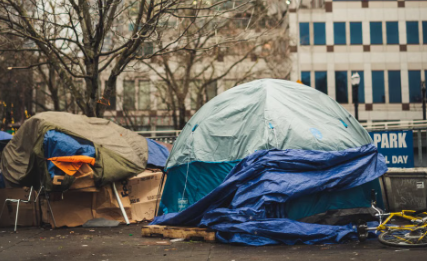
Worcester would prohibit camping on public property and give city officials new authority to clear encampments under a sweeping homelessness strategy headed to the City Council Tuesday, one that pairs enforcement with plans to expand shelter capacity, create a real-time system for finding available beds and better coordinate the patchwork of agencies serving unhoused residents.
The proposed ordinance is the most immediate—and potentially contentious—piece of City Manager Eric Batista’s new “Disrupting the Cycle” framework. It would prohibit camping, sleeping or lying on streets, sidewalks, bike paths and other public property, as well as using cars, campers or recreational vehicles for living purposes on public ways or in public parking lots for more than 24 consecutive hours. The city would conduct outreach before enforcement and generally post notice up to 72 hours before clearing an encampment, offering shelter, treatment and supportive services first. People who remain after a notice to vacate could face a $25 fine for each day of violation.
Batista is asking councilors to adopt the ordinance as part of a much larger effort to rethink Worcester’s response to homelessness. In his communication to the council, Batista acknowledged that previous approaches have fallen short, writing that despite years of work around Housing First, seasonal shelters and other programs, “government has ultimately failed.” The 2026 Point in Time count identified 1,187 unhoused people in Worcester County, down sharply from the previous year but still leaving what the administration describes as a substantial population not being reached by existing services.
The broader plan would expand shelter capacity and create a coordinated access system so people seeking a bed would no longer have to navigate individual providers largely on their own. Worcester currently has four permanent year-round shelters with a combined 197 beds; another 136 temporary beds were added last winter as permanent shelters reached capacity. The city wants a live dashboard showing available beds and eligibility requirements, centralized access by phone, online and in person, and stronger partnerships among shelters, hospitals, outreach workers, police and other agencies. The framework also calls for expanding transitional housing and single-room occupancy units and using the planned Day Resource Center as a hub for case management, housing navigation, behavioral health services, showers, laundry and other support.
The homelessness strategy arrives alongside a detailed accounting of Worcester’s opioid settlement money, another source of funding that the administration says could support some homelessness-related services when they are tied to opioid abatement. Worcester expects to receive about $14.3 million through 2039, with money already supporting treatment, harm reduction, housing stabilization, shelters, hygiene services, naloxone access and outreach. The city reports that opioid-related overdose deaths in Worcester fell about 65% from their 2022 peak to 2025, although fentanyl was present in 96% of opioid-related deaths in 2024 and the share involving xylazine increased from 26% to 44%.
Councilor Gary Rosen’s proposal to look beyond Worcester for models of responding to homelessness also returns after being held last week. Rosen wants the administration to examine plans in Seattle, Portland, Sacramento and Spokane and consider a formal Worcester strategy built around existing shelters, social and employment services, food assistance and medical care. His order also raises the possibility of agreements with surrounding cities and towns to share the financial and operational burden of a regional homelessness response.
The opioid report also provides a fuller accounting of where settlement money has gone and acknowledges criticism of how the funding process has worked. Nine nonprofits received $50,000 each through one initiative, while other allocations included about $697,000 for a Community Healthlink crisis-response model, $500,000 for a treatment and recovery center at Meryl’s Safe Haven, $200,001 for shower access and supportive services and nearly $132,000 for an emergency shelter program for women. In a city survey of 194 people with lived experience, more than 80% identified treatment and support for people in treatment as a funding priority, while 72% identified equitable housing. Community members have also called for greater transparency, more consistent participation and more predictable funding cycles; Health and Human Services says it plans quarterly stakeholder meetings, stronger public reporting and a more structured process for future awards.
Transportation’s another piece of Tuesday’s agenda as Worcester aims to put more structure around a speed-hump program that has grown rapidly since its 2021 launch. By the end of 2026, the city expects to have more than 160 traffic-calming humps, tables and other raised elements, while councilors have received 167 petitions for additional installations over the past 18 months. Beginning in 2027, requests would be screened and ranked using speeding data, crash history, pedestrian activity, roadway characteristics, neighborhood context, equity and emergency-response considerations. Resident applications would require five co-signers, neighbors along proposed treatment areas would have an opportunity to object, and the city would publish a ranked list of active applications.
That proposed policy comes with an August construction report on Worcester’s streets and sidewalks. The city’s pavement-management system, introduced in 2025, now organizes work into six categories ranging from local road resurfacing and major corridor reconstruction to pavement preservation, standalone sidewalks, safety projects and routine maintenance. The program is intended to make roadwork decisions more data-driven while giving residents an online map showing active projects, pavement-condition scores, treatment types and project contacts. Several councilors also have related orders pending Tuesday seeking costs for repairing major arteries, improvements to how local street and sidewalk projects are selected and corrections to work they contend was completed below acceptable standards.
Councilors also get their first look at Worcester’s finances for fiscal 2027, and the early picture is generally stable — with one notable reduction. The city now expects about $1.2 million less in state aid than it budgeted, including approximately $1.1 million less for Worcester Public Schools and $100,000 less for general government. Property-tax collections stood at 20% of the annual budget through July 31, while overall revenues were at 13% and expenditures at 14%; Chief Financial Officer Timothy McGourthy said the slightly faster pace of spending largely reflects the timing of interfund credits and fixed costs paid early in the year. Local receipts were at $2 million, or 3% of budget, slightly below the same point last year, while water, sewer and Green Hill Golf Course finances were described as generally stable.
Councilors are also being asked to revive a hotel project at Washington Square that was first approved before the pandemic. First Bristol Corporation now plans a five-story, 105-room Hampton Inn, an estimated $28.7 million investment on the long-vacant development site near Union Station. The project was originally approved in 2019 as a Home2 Suites with a $21.78 million investment but stalled as COVID-19 battered the hospitality industry. The developer received Planning Board approval in July and expects to break ground this fall; the council is being asked to amend the existing 10-year tax increment financing agreement to reflect the new project, ownership, valuation and timeline.
Other highlights on the agenda
- Downtown safety and homelessness return: Two orders held from last week would bring the recent debate over downtown conditions back before councilors. Councilor Tony Economou wants Batista to develop an immediate action plan addressing violent incidents in and around Worcester Common and the Downtown Central Business District over the past several months. Councilor Kathleen Toomey separately wants the Public Safety Committee to invite social-service agencies working with homeless residents and addiction-treatment programs to discuss what they are doing to help address recent public-safety concerns. The orders overlap with Tuesday’s much broader homelessness proposal but focus specifically on conditions that have generated concern downtown.
- Private streets, public problems: Councilor Satya Mitra has several held orders seeking a deeper accounting of Worcester’s private streets and deteriorating major roads. He wants to know how many miles of private streets remain, how residents can convert them to public streets, what it would cost—and whether it would be legal—for the city to pay for all such conversions, and how other municipalities handle the issue. A companion order asks what responsibility Worcester has to ensure private streets remain passable for police, fire and other emergency vehicles and whether municipal money could be used to maintain a minimum standard. Mitra is also seeking the estimated cost of resurfacing each major artery identified by the city as needing repairs.
- When new pavement isn’t good enough: Economou is asking the administration to revisit a list of street and sidewalk projects he says were completed below acceptable standards. His order identifies work along Florida and Park avenues, Germain Street and Burncoat Street, calling for measures ranging from better loam and hydroseeding to replacement of cracked or heaved sidewalks and changes to driveway and sidewalk installations. Councilor John Fresolo has a related request for a Public Works Committee discussion on how the city and district councilors select local rehabilitation projects and how the process could be improved to get work finished sooner. Together, the orders put not only the quantity of Worcester’s roadwork but the quality and selection of that work before the council.
- Fixing the math on DCU district debt: City Treasurer and Collector Francisco Hernandez is correcting a report submitted to the council last week on the special taxing district surrounding the DCU Center. The earlier memo omitted one bond issuance, according to the updated report. City finance officials now say district revenues are sufficient to cover debt service on $30 million in bonds issued under the original 2006 law, another $24.07 million issued under a 2014 amendment and $574,308 in bond anticipation notes now being issued. The special district law requires the treasurer and city manager to certify that available revenues can support the debt.
- Who makes sure developers follow the rules? A petition from Keith Boucher seeks a public accounting of what happens between approval of a development and construction—particularly how Worcester makes sure zoning conditions, permit requirements and approved plans are actually followed. Boucher wants the city to explain how departments coordinate when several approvals apply to the same project, how unresolved requirements are tracked and how stop-work orders are followed through to resolution. He is also asking how complaints from residents about possible violations are documented and investigated. The petition is slated for referral to the Economic Development Committee.
- Please don’t put the dog poop down the drain: Worcester’s Department of Public Works is responding to a council request for more public education about something officials would very much like residents to stop doing: dumping dog waste into storm drains. DPW says pet waste can clog drainage systems and is ultimately carried into lakes, rivers, brooks and ponds, where it can contribute to contamination and water-quality problems. The city has mailed disposal information to licensed dog owners, installed warning placards and worked with the Chamber of Commerce on colorful murals around 30 catch basins. Since 2025, new cast-iron catch-basin grates have also carried a considerably less subtle reminder: “Dump No Waste – Drains to Waterways.”
- A new four-legged officer: The Worcester Police Department could soon add another dog to its K-9 unit with help from a $7,500 grant from Massachusetts Vest-A-Dog. The grant would cover 80% of the purchase price, with Worcester contributing the remaining $1,875 from a law-enforcement trust account; no additional staffing would be required. Police Chief Paul Saucier told the administration that the department does not currently have enough canines to cover every shift, leaving dogs unavailable for some incidents in which they could be useful. In a bit of canine coincidence, a separate resolution from Councilor Robert Bilotta recognizing September as National Service Dog Month also returns from last week’s agenda.
- Winter is coming — and so are the plows: Economou’s request for an accounting of Worcester’s snow-fighting readiness returns after being held last week. He wants the Department of Public Works to report on available personnel and equipment before winter and identify any improvements planned for snow and ice removal. The request comes months before the first major storm but would give councilors a chance to examine the city’s capacity before plows are actually needed. It is among several items held from the Sept. 8 meeting.
- Spotted lanternflies are back on the agenda: Councilor Jose Rivera’s request for guidance on dealing with the invasive spotted lanternfly is another held item returning Tuesday. Rivera wants the administration to provide residents with best practices for reporting the insect and taking action when they encounter it. The order does not propose a new enforcement program or eradication effort; it asks the city to clarify what residents themselves should do.
- Economic development and housing reports get another turn: Three substantial administration reports held from last week are also back before councilors: updates on economic-development initiatives, housing and neighborhood development, and the city’s semiannual tax-incentive agreements. The material covers a wide range of ongoing projects and housing activity rather than a single proposal requiring council action. Their return gives councilors another opportunity to question the administration about development, affordable housing and the performance of projects receiving tax incentives. The Washington Square hotel amendment, which does require action Tuesday, is addressed separately in the main story.
Worcester City Council meets Tuesday, Sept. 15, at 6:30 p.m. at City Hall in the Esther Howland Chamber. The meeting is also livestreamed on the city’s website.
Have news, tips, or a story worth telling? Reach Editor Charlene Arsenault at carsenault@theworcesterguardian.org — because good stories (and great scoops) deserve to be shared.
Worcester City Council meets Tuesday, Sept. 15, at 6:30 p.m. at City Hall in the Esther Howland Chamber. The meeting is also livestreamed on the city’s website.
Have news, tips, or a story worth telling? Reach Editor Charlene Arsenault at carsenault@theworcesterguardian.org—because good stories (and great scoops) deserve to be shared.
