
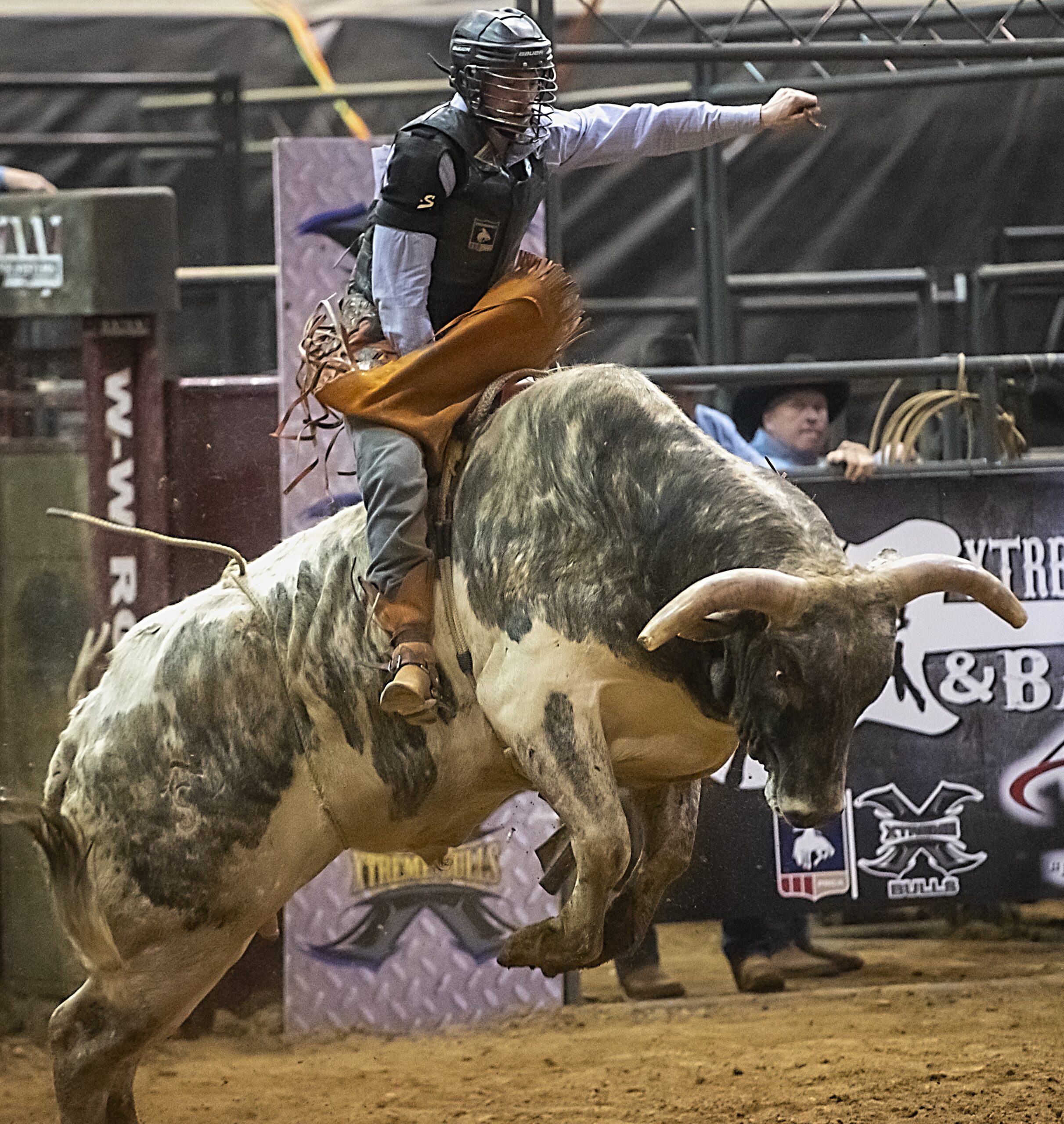
WORCESTER—A proposed ordinance intended to protect animals at rodeos is headed to the Worcester City Council on Tuesday, setting up a debate over whether the city can restrict equipment used in bull riding without effectively driving the popular events out of the DCU Center.
The ordinance, drafted by City Solicitor Alexandra Kalkounis at the council’s request, would prohibit flank straps, electric prods, certain spurs and other equipment or practices considered harmful to animals during rodeos on municipal property. Violators could face fines of up to $300 per offense.
City Manager Eric Batista warns that prohibiting flank straps, which are routinely used in professional bull riding, would effectively end rodeos in Worcester and eliminate an attraction that draws thousands of visitors and generates business for local hotels, restaurants and other establishments. But animal advocates who have spent more than a year pressing for the restrictions dispute that conclusion. They argue that rodeos can continue without the prohibited equipment and say the city should establish enforceable standards for events held at publicly owned facilities.
Matthew A. King, president of the Christian Animal Rights Association, said the proposal grew out of concerns raised by Worcester residents about the treatment of animals at rodeos.
“Our ministry, alongside Positive Change for Animals (PCA), was prompted to push for this ordinance after hearing from dozens of Worcester constituents concerned about cruel devices like flank straps and electric prods being used in events on city-owned property,” King told the Worcester Guardian. “Our organizations and local residents share the conviction that using equipment designed to cause pain, discomfort, or electrical shock to force animal performance is entirely unnecessary and out of step with modern community standards.”
The dispute centers on a question that has divided animal advocates and the rodeo industry for years: whether equipment used to encourage bulls to buck causes unnecessary distress or is a harmless component of a sport involving animals bred for their athletic abilities.
What the ordinance would prohibit
The proposed ordinance would amend Worcester’s municipal code to establish animal-welfare standards for rodeos held on city property, including the DCU Center.
It would prohibit electric prods or shocking devices, flank or bucking straps, wire tiedowns and sharpened or fixed spurs. The ordinance also addresses physical and chemical irritants, beating and certain handling techniques, including tail twisting and ear pulling. The restrictions would apply to practices that cause or are likely to cause physical injury, torment or suffering to animals during rodeo events.
The ordinance defines a flank strap as material placed around an animal’s abdomen, just in front of its hind legs. The definition includes padded straps but excludes the rope held by a bull rider and certain saddle components.
Enforcement could involve the city’s commissioner of Inspectional Services, police chief or other officials authorized by the city manager. Each affected animal and each day of a violation could constitute a separate offense. The proposed rules would apply to rodeos on municipal property, rather than all rodeo activities throughout Worcester.
The draft represents the latest step in an effort that began in November 2025, when the council unanimously advanced an order introduced by then-Councilor Khrystian King seeking restrictions on equipment used to induce animal performance. At the time, King said the intention was to protect animals and public safety without necessarily prohibiting rodeos altogether.
“We’re not looking to stop rodeos,” he said during the November 2025 meeting. “This ordinance would allow rodeos here in Worcester, but it would restrict the tools that distress the animals, cause agitation and increase the likelihood of dangerous escapes by regulating these devices.”
The measure remained under development when animal advocacy organizations protested outside the DCU Center during a Bulls, Bands & Barrels event in February.
City manager warns of economic consequences
In a communication accompanying the draft ordinance, Batista argues that rodeos are both a longstanding cultural tradition and a significant source of economic activity for Worcester.
Professional Bull Riders events have visited the DCU Center for more than two decades, drawing an average of 13,500 attendees annually from 2001 through 2025, according to the administration.
Approximately 44% of those attendees came from Massachusetts counties outside Worcester County, while another 16% traveled from out of state.
The venue also hosted the New England debut of Bulls, Bands & Barrels in February, featuring professional bull riding, barrel racing and performances by country artists Jon Pardi and Ashley Cooke.
The sold-out event was the highest-attended western sporting event in the DCU Center’s history, according to Batista’s report.
The city manager contends that losing rodeos would weaken Worcester’s position in the competitive live entertainment market and reduce business for restaurants, hotels and parking facilities.
He also disputes the characterization of flank straps as inherently harmful.
Batista describes the straps as properly fitted, soft cotton ropes intended to cue bulls to display bucking behavior for which they have been selectively bred. He argues that maintaining the animals’ health and physical condition is essential to their competitive success.
His communication also points to existing Massachusetts animal cruelty laws and industry standards governing animal handling and care.
Rather than adopting restrictions that could prevent certain events from operating, Batista recommends greater awareness of animal-welfare practices while preserving the cultural and economic benefits of rodeos.
Advocates challenge claims that rodeos would disappear
Matthew King rejects the suggestion that banning flank straps and electric prods would eliminate all rodeo entertainment in Worcester.
“City Manager Eric Batista’s argument that an equipment regulation would prevent rodeo events from coming to Worcester is completely unfounded,” King said in written responses to the Guardian.
He pointed to several professional organizations involved in barrel racing, breakaway roping and team roping, including the National Barrel Horse Association, International Barrel Racing Association and National Team Roping, whose competitions do not require flank straps.
King argued that those events could provide alternatives to traditional bull-riding competitions at the DCU Center.
“Prohibiting flank straps and prods does not ban rodeo; it just helps events hosted on public property to evolve and align with humane standards,” he said. “Just as other professional sports continuously update safety gear and rules to meet public expectations, rodeo can adapt too.”
The distinction is significant. While barrel racing and roping competitions are part of the broader rodeo tradition, they are not substitutes for bull riding itself. The proposed ordinance could therefore allow some western sporting events to continue while preventing others from operating under their existing rules.
King also disputes the industry’s claims about flank straps, arguing that they create abdominal pressure and discomfort that exaggerate an animal’s bucking response.
He cited studies and statements from rodeo participants that he said support that position, although the Guardian has not independently reviewed the studies or verified the individual statements referenced in his responses.
The Professional Bull Riders organization has previously rejected similar allegations.
In November 2025, Andrew Giangola, PBR’s vice president of strategic communications, told the Guardian that bucking is a natural behavior in animals selectively bred for competition and that the equipment used in the sport does not injure them.
“The bulls are not shocked or prodded or coerced or harmed in any way,” Giangola said at the time. “The bulls love their job the way someone’s dog loves retrieving his ball. That dog isn’t being tortured, and neither are the bucking bulls.”
Giangola described the flank strap as a soft cotton rope used to signal the bull to perform, and said electric prods are prohibited inside bucking chutes and used only in limited situations involving animal handling and safety.
“PBR is committed to the ethical treatment of all animals involved in our events, and the careful, regulated use of tools like electric prods – never used to encourage a bull to compete – reflects that commitment,” Giangola said.
The competing descriptions reflect a fundamental disagreement over whether existing industry safeguards adequately protect animals.
Advocates seek enforceable local standards
King argues that voluntary rules adopted by rodeo organizations are insufficient.
He cited video recordings collected by Showing Animals Respect and Kindness, an animal advocacy organization known as SHARK, that he said document handlers using electric prods in ways that violate industry guidelines.
The Guardian has not independently reviewed the footage or established whether the incidents described resulted in disciplinary action.
“Self-regulation has failed, which is why clear, enforceable municipal standards are necessary,” King said.
The Christian Animal Rights Association and Positive Change for Animals have organized and participated in demonstrations outside Worcester rodeo events, including the Bulls, Bands & Barrels show earlier this year.
Karen Bacon, founder of Positive Change for Animals, previously told the Guardian that the organizations approached Khrystian King’s office in October 2025 with a presentation outlining their concerns about bull riding and other rodeo practices. The groups have maintained that their goal is to restrict equipment they consider harmful, rather than prohibit all western sporting events.
Matthew King said the organizations have also offered a compromise intended to address concerns about the financial effects of the proposed ordinance.
“We have explicitly communicated to City Manager Batista that we are eager to support a smooth transition, including a reasonable phase-in window (such as 12 to 18 months),” King said.
He suggested that the transition period would give the DCU Center time to adjust bookings, bring in rodeo organizations whose events do not require the prohibited equipment or schedule alternative entertainment, including country music concerts.
The draft ordinance before councilors does not include the proposed 12- to 18-month transition period.
A decision with implications beyond the arena
Massachusetts law already prohibits animal cruelty, including torture, torment and unnecessarily cruel treatment. A separate state law that took effect in January 2025 restricts the use of certain wild animals in traveling entertainment acts but does not prohibit bull riding.
The Worcester proposal would establish additional, equipment-specific restrictions for rodeos on municipal property.
City officials and advocates agree that animal welfare should be protected, but disagree sharply over whether the proposed restrictions are necessary and what they would mean for future events.
The ordinance’s scope also differs from what advocates sought earlier this year. In February, Matthew King told the Guardian that the coalition wanted citywide restrictions, rather than rules limited to the DCU Center. The current draft applies only to municipal property.
The proposal now returns to councilors for consideration, with no restrictions adopted yet. For animal advocates, the immediate goal is to move the ordinance toward adoption.
“We hope to see the city council move this ordinance forward,” King said. “It is a narrow, common-sense measure that establishes reasonable standards for events held on municipal, taxpayer-funded property.”
The council’s decision could determine not only which equipment is permitted at future rodeos but also whether Worcester continues to host the same types of bull-riding competitions that have drawn large audiences to the DCU Center for more than two decades.
The Worcester City Council meets Tuesday, Nov. 10, at 6:30 p.m. at City Hall.
Have news, tips, or a story worth telling? Reach Editor Charlene Arsenault at carsenault@theworcesterguardian.org—because good stories (and great scoops) deserve to be shared.
The Worcester Guardian is an independent nonprofit news organization. Support local journalism by making a DONATION today.
