
It all started in the summer of 2005 when new Quinsigamond Community College basketball coach Jon Winer rolled up to the Great Brook Valley public housing complex in a button-down, collared shirt and what Maurice “Mo” Horton could only describe as “church” pants.
Perhaps visually out of place, Winer was physically in the right spot to talk to Horton, a former basketball and football star at Burncoat High School, who lived in his grandmother’s apartment.
Winer introduced himself as the new men’s coach at QCC and asked if Horton would like to come play basketball for him as a student-athlete. Written off by many due to a troubled past, Horton assumed his athletic career was over and that an opportunity to attend college had passed him by.
Although he didn’t exactly know what QCC was at the time, Horton ultimately decided to give it a shot. It wound up being a life-changing decision.
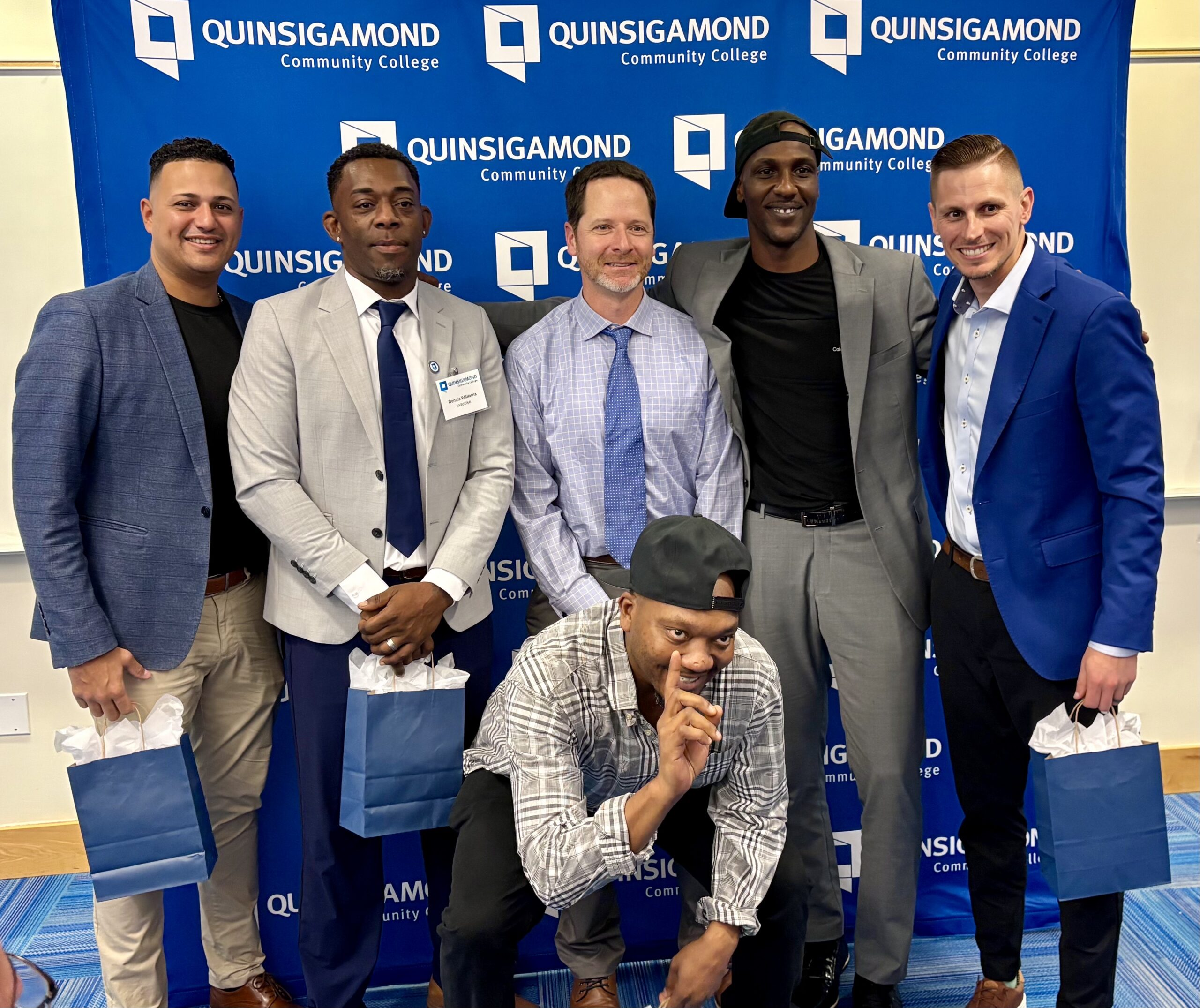
“Your circumstances don’t define your potential and your past doesn’t have to determine your future,” said Horton, who was back on campus with Winer and other members of the historic 2006-07 QCC men’s basketball team on Nov. 7 to be inducted into the school’s inaugural Alumni Athletic Hall of Fame during a ceremony at the Harrington Learning Center.
A record-setting season
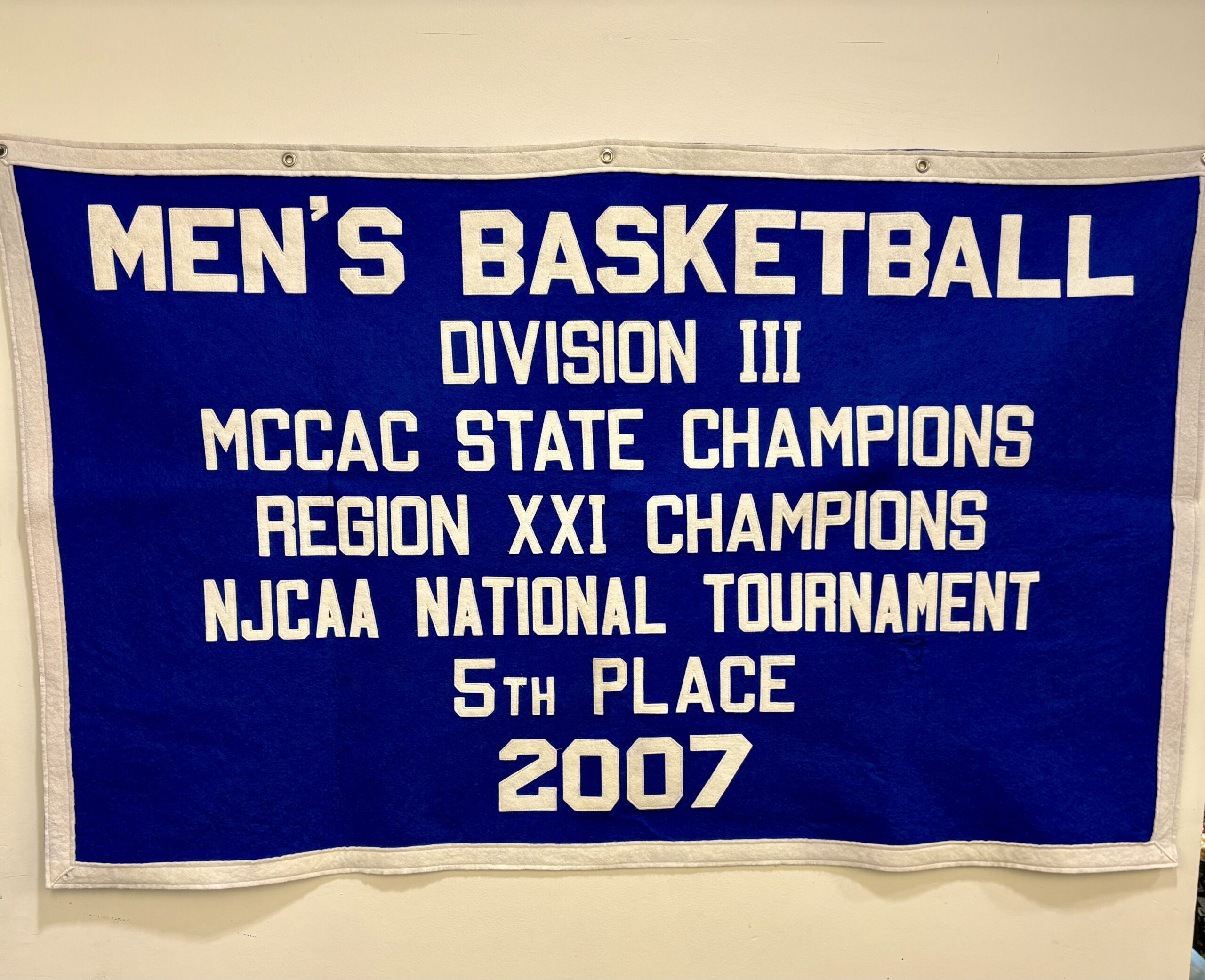
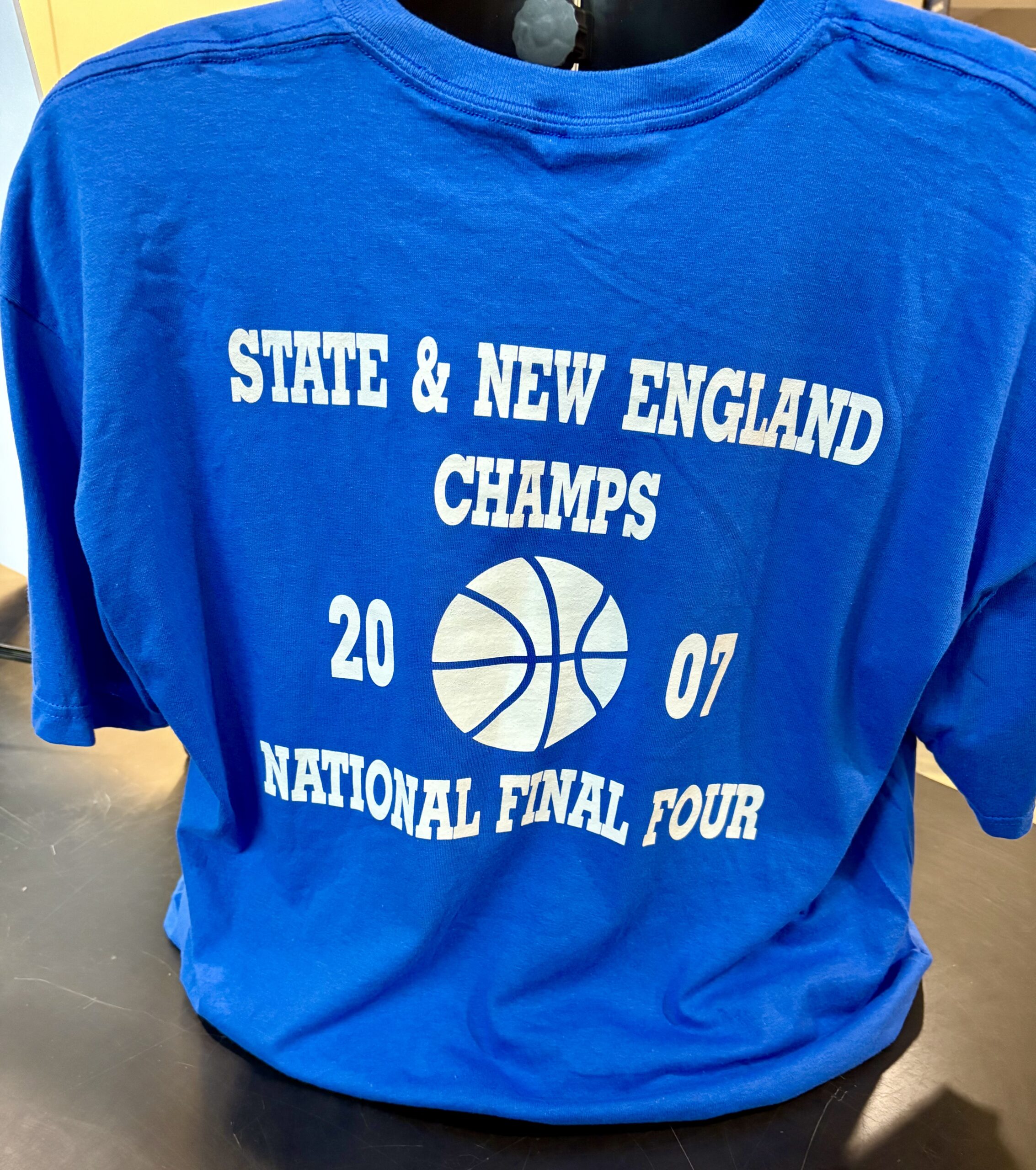
After winning just nine games in Horton’s first season, the revamped Chiefs went 28-7 to set the school record for wins and leave a legacy that is still talked about. QCC captured the NJCAA Division III, District 8, Region 21 championship and advanced to the national tournament in Delhi, New York, for the first time in school history.
The 2006-07 team, previously inducted into the New England Basketball Hall of Fame in 2015, finished fifth in the nation that season among all junior college programs in the fifth division.
In addition to the men’s basketball team and Horton, the event also honored Rich Small, a member of the men’s basketball team in 1980-81 and a current QCC employee, and Trafficia Warburton of the women’s basketball program.
Horton led the nation in scoring with 36.8 points per game during his freshman season and was clearly the centerpiece for the Chiefs heading into 2006-07. But to build a winning team, Winer knew it would take more than just the scoring prowess of one talented player.
“I knew we had the best player in the country, but I also knew that he would have to buy into a new role,” said Winer.
Horton, the school’s all-time leading scorer with 1,406 points, eventually got the message and made the adjustment. He scored half as many points, but the team won nearly 20 more games. The puzzle pieces that had been missing started to emerge.
In the second game of the season, point guard Elijah Sims of Worcester posted a rare quadruple-double with 20 points, 12 rebounds, 13 assists and 11 steals in a win over Roxbury Community College. Sims briefly played at QCC a few years prior, but left the team in frustration after a few games. His cousin, Al Jenkins, an assistant coach to Winer along with Hadley Camilus, ultimately convinced Sims to give QCC a second chance in the fall of 2006.
Charles Horton, another local product of Burncoat and Mo’s cousin, gave QCC a lockdown defender who could score. Undersized but athletic post players Dennis Williams of Notre Dame Prep in Fitchburg and Ramon Llanos of Worcester provided even further balance for the Chiefs on both ends of the floor.
Williams, known to teammates as “Duke,” was the heart and soul of the team. In high school he scored nearly 30 points a game, but like Horton, came to realize that QCC was better as a team when he sacrificed scoring to focus on his greatest strengths.
“I’ve never been more proud to be a role player in my life,” said Williams. “It’s good to be a superstar sometimes, but to understand the hard work that others put in for others to look great, there’s a sense of appreciation for that.”
Other players on the team were Worcester’s Carmelo Perez, Shane Trudell and Michael Pucko, along with Jon Evans of Shrewsbury and Kojo Asenso, a native of Ghana.
The injury
The team was piling up victories before the holiday break when Horton tore a ligament in his thumb and was forced out of action for several games. Other members of the team had to pick up the slack.
“It really threw things into a spiral, but at the same time it gave the opportunity for other guys to step up,” said Winer. “Him getting injured and missing some time was probably, in the long run, helpful for our guys coming together.”
The Chiefs regrouped and turned in a winning record with Horton on the sidelines. Especially notable was the play of Sims at point guard, who took on a leadership role with Horton out of the starting lineup.
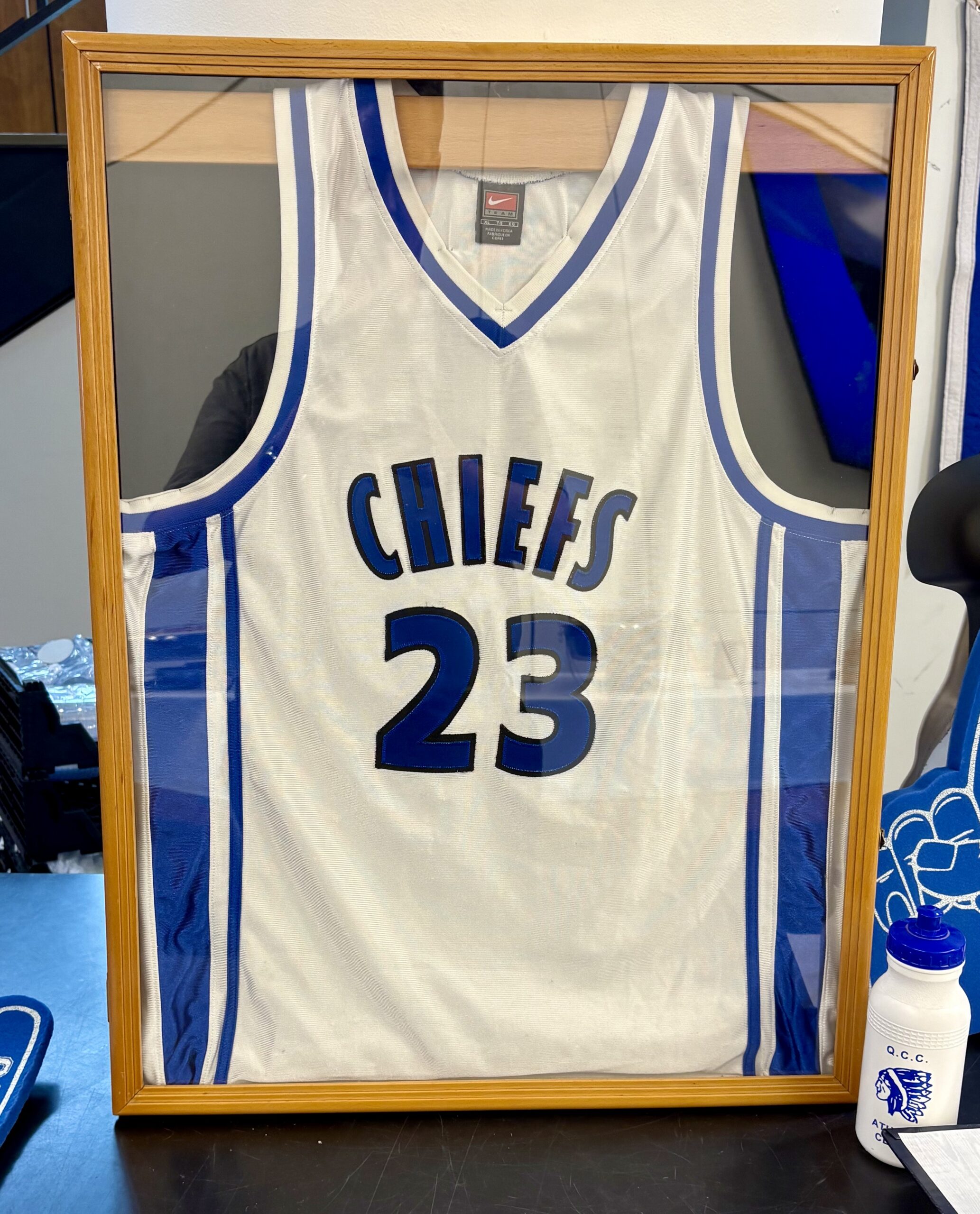
“When Mo went down with his injury I think that really opened up the door for Elijah to score. He was our 1A to Mo,” said Winer.
By February, Horton’s thumb had healed enough that he returned to action for the stretch run and the playoffs.
“I want those guys to know that without them, there is no Mo Horton. Everyone of them helped me be a better player, leader and teammate. So I want to thank them all for always passing me the ball,” said a smiling Horton during his remarks at the event.
“The shot”
In the semifinals of the Region 21 tournament, QCC went on the road to face Springfield Technical Community College (STCC), a team the Chiefs had easily defeated the week before in the state tournament.
QCC had an off game and missed a key blockout on the defensive end in the closing minute that led to an easy putback for STCC and a one-point lead with about 10 seconds remaining.
Winer called a timeout and drew up a play designed to go to Horton at the foul line. But that’s not exactly how it played out in reality. Sims caught the inbounds pass, made some moves to free himself from his defender and launched a last-second shot at the basket.
“I made a Paul Pierce move. I went to the right side, went between my legs, behind the back and came back,” said Sims. “But I saw a dude coming from the corner to double team. That’s when I threw that shot up and it went nothing but net.”
His shot from the top of the key was good for the 73-72 win and saved QCC’s season from ending prematurely. The Chiefs went on to win in the regional finals, paced by 18 points and seven rebounds from Sims, who was named Tournament MVP. With the win, the Chiefs advanced to the national tournament in New York.
Nationals in Delhi, New York
In the opening round of the NJCAA tournament, QCC defeated defending national champion North Lake of Texas, 72-67. Horton led the way with 31 points but tweaked his ankle near the end of the game.
The Chiefs advanced to the second round but fell 83-76 in a close game to undefeated and eventual 2007 national champion Sullivan County Community College of New York. QCC finished in fifth place, winning one of three games.
Despite being slowed by a gimpy ankle, Horton was named to the All-Tournament Team. After the historic season, he was selected as a first-team All-American. Horton finished fourth in the nation in scoring (23.5 ppg) and second in rebounding (13.2 rpg).
Sims was named first-team All-Region while Charles Horton earned honorable mention All-Region status. As a testament to his balance as a well-rounded player, Sims ranked first in the nation in steals (5.5 spg) and ninth in assists (6.8 apg). He averaged 19.9 points per game and finished among the top 25 scorers in the nation.
As a team, QCC scored 85.3 points per game, which ranked seventh in the country. The Chiefs played with a roster of just eight players during nationals and didn’t have a player taller than 6-foot-3. Winer was named District 8 Coach of the Year, the youngest coach to ever win the award at just 25 years old.
Off-the-court focus
A key aspect of the team’s success was an off-the-court focus that Winer put in place for his players. During his first year coaching, he lost several players for the second semester due to poor academic performance.
He knew his players needed off-the-court programs that provided emotional support, mentorship and time dedicated specifically to schoolwork.
Winer, a grammar school teacher in Millbury at the time, added mandatory study hall sessions before practices and also had his players read to and serve as mentors for his third-grade students. These simple measures helped his players develop into complete, mature student-athletes while keeping them engaged in positive activities.
“I think it was more the off the court focus that led to our success on the court,” noted Winer. “It was a special group of guys that looked out for each other.”
In addition to being the team’s academic leader, Asenso gave Williams a ride to and from QCC every day, as they both lived north of Worcester. After QCC, Asenso went on to earn a bachelor’s degree at Worcester Polytechnic Institute and an MBA at Yale.
Impacting lives
It’s hard to miss all the ongoing construction next door to the Harrington Learning Center at the former QCC athletic center.
For the second straight season, the facility won’t host any QCC basketball games this winter. Instead, a major $37.4 million renovation project is transforming the facility into a revitalized space for academics and athletics, slated to open in the fall of 2027 as the new QCC Center.
Twenty years ago, in November 2006, a special project of a different kind was beginning to take shape at the same venue as Winer and his assistants set out to build a new edition of the men’s basketball team.
But the most important product constructed in that gymnasium was not a championship, wins, records or statistics. While all the hard work and dedication led to basketball success, it’s the creation of personal bonds that will last forever among the players and with their coaches.
Many QCC players and coaches have remained in close contact for the last two decades since their time together on West Boylston Street. The group was dealt a personal blow when Jenkins tragically passed away in 2023 at 37 after a short illness.
As always, teammates were there for each other during a difficult time. For Winer, the experience of coaching at QCC 20 years ago will always be something he cherishes.
“Aside from my family, that’s the most meaningful experience I’ve had in my life,” said Winer, now in his mid-40s and an athletic director for a network of public magnet schools in the Hartford area operated by the Capitol Region Education Council (CREC).
“When I’m dead and gone, those guys are the ones that I want at my funeral,” added Winer. “And I probably want Mo speaking at it. It’s a bond that we’ll always have and I’m really grateful for that.”
For Horton, the journey after QCC continued at Worcester State, where he played basketball and scored another 1,000 points in just two seasons. Today, he’s an outreach counselor at Open Sky Community Services in Worcester, where he helps youths and young adults navigate life’s paths. He also coaches basketball at Burncoat and for the Central Xtreme AAU program.
Even though Horton has achieved so much in basketball, the lifelong relationships he forged at QCC far outweigh any points, wins or records.
“When I look back, this is hands down the greatest basketball experience of my life,” he said. “Not just because of what we accomplished, but the brotherhood that we built.”
Who knew that a simple pair of church pants would wind up being such a perfect fit?
