
WORCESTER—
The Worcester City Council on Tuesday moved forward an effort to restrict devices used on animals in rodeos, voting to refer an order to City Manager Eric Batista to draft an ordinance limiting equipment that causes pain or agitation to bulls, horses and other animals.
Councilor Khrystian King, who filed the order, said the goal is to protect both public safety and animal welfare. While Massachusetts has no statewide rodeo regulations, municipalities can adopt their own rules to reduce animal suffering, he noted.
“There have been numerous veterinary groups, like the RSPCA and Associations of Veterinarians, that condemn rodeos outright, because of the stress, fear and pain inflicted on animals for the mere sake of entertainment,” King said. He added that residents have raised concerns — including fears about animals escaping — tied to electric prods, flank straps and other equipment.
“We’re not looking to stop rodeos,” King said. “This ordinance would allow rodeos here in Worcester, but it would restrict the tools that distress the animals, cause agitation and increase the likelihood of dangerous escapes by regulating these devices.”
A Professional Bull Riders (PBR) event was held at the DCU Center earlier this year as part of the group’s “Unleash The Beast” tour. No additional Worcester dates have been announced; the tour next stops in Manchester, N.H. in mid-December and in Boston in early January.
During public comment, several residents urged the council to go even further.
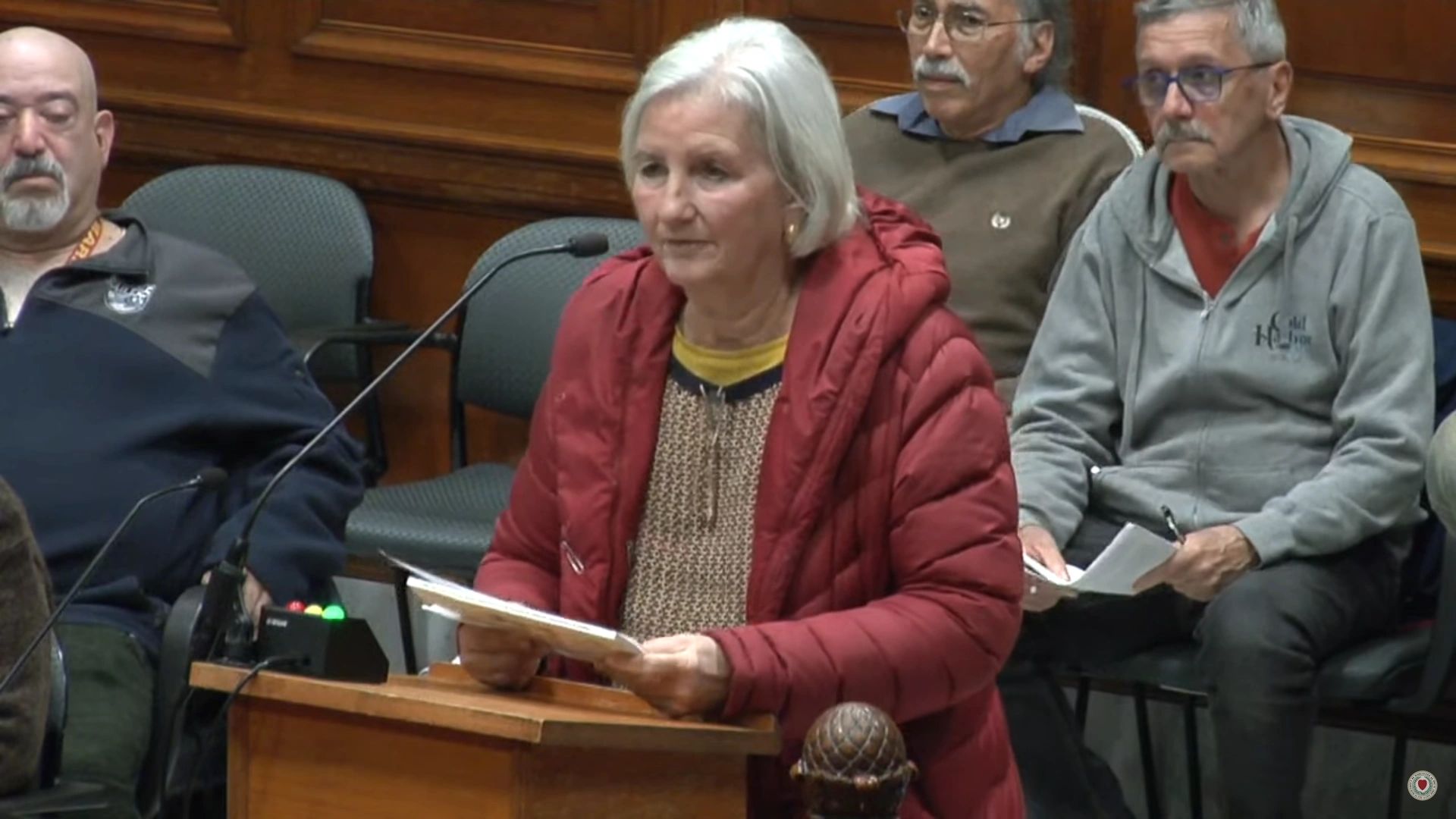
Mary Sacksteder delivered one of the night’s most forceful testimonies, asking men in the chamber to imagine being subjected to treatment similar to rodeo animals.
“I want every male in this room and online to imagine what it would be like to live in an unheated, un-air-conditioned cage,” she said, calling the practice exploitation for entertainment, “where your testicles are prodded with an electric shock, so you are seen bucking and fighting, trying to get away from the excruciating pain.”
Resident Bix Spanierman argued flank straps are inherently harmful. “Flank straps coerce the animals to buck against their will. There is much scientific data to support this,” he said. “Based on observable behavior, the evidence indicates that bull riding is a stressful, frightening experience for the bull. There is no evidence that the bulls enjoy the experience.”
He added that bulls respond to riding as they would to a predator attack — “a situation where they face increased fear, stress and panic” — pointing to signs such as excessive salivation, fixed stare, mouth gaping and tongue protrusion.
Another speaker, Jenn Falcon, urged a full ban rather than tool restrictions. “Even if you just said ‘ok, we can’t use this one cruel instrument,’ then they’ll just come up with another one,” she said.
Matthew King of the Christian Animal Rights Association cited several incidents nationwide in which rodeo bulls escaped and injured spectators. “They’re trying to escape from pain and stress,” he said, referencing events in California, Utah and Oregon, as well as an Attleboro incident in 2024 involving eight loose bulls. “It’s only a matter of time before something like that could happen in Worcester.”
After the council meeting, Andrew Giangola, vice president of Strategic Communications for PBR, reached out to the Worcester Guardian, pushing back on several of the claims made publicly.
“The bulls competing in the sport live a great, long life…loved and cared for the way you love and care for your household pets,” Giangola said. “What makes a bull buck? An 1,800-lb animal cannot be made to do anything. Bucking is natural…it’s in their DNA. These bulls are members of the American Bucking Bull breed – now in their fifth generation and DNA-registered through an organization called ABBI – American Bucking Bull Inc.”
He also disputed the descriptions of methods and tools used in PBR competitions.
“The bulls are not shocked or prodded or coerced or harmed in any way,” he said. “The bulls love their job the way someone’s dog loves retrieving his ball. That dog isn’t being tortured, and neither are the bucking bulls.”
Giangola said the flank strap is “a soft cotton rope tied around the bull’s torso, just snug enough for the bull to know it’s there, and loose enough where he believes he can kick it off.” Early on, it helps train bulls to kick upward and outward with their hind legs; later, it serves as the “go signal” to perform.
He added that electric prods are banned inside the bucking chutes and used only in “back-pen situations where safety is a concern, including loading or unloading animals.” They are limited in power, similar to a static electricity shock created by walking on a carpet, and regulated under state and animal welfare laws. The devices use standard C batteries.
“PBR is committed to the ethical treatment of all animals involved in our events, and the careful, regulated use of tools like electric prods – never used to encourage a bull to compete – reflects that commitment,” Giangola said. “The equipment in PBR does NOT harm the bulls…they’re treated like kings and live a long, full life.”
The draft ordinance returns to the council floor for a vote once it’s written up by city administrators.
This story has been updated to reflect new information and comments provided to the Worcester Guardian.
Steve Smith, a veteran reporter with 17 years at The Hartford Courant, now brings his passion for photojournalism to Worcester. An award-winning photographer, he has covered major events like U.S. soccer, pro football, and UConn basketball. He is also the official photographer for the Miss Massachusetts competition and works as a realtor. Contact him at steve@stevephotographysmith.com
