
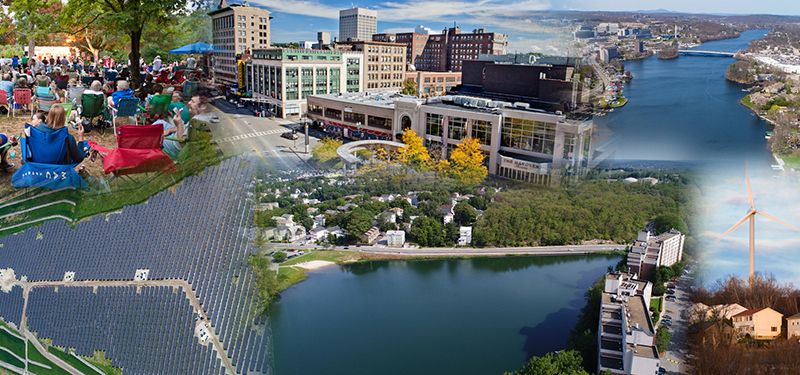
Five years after Worcester adopted an ambitious roadmap to become one of the country’s most sustainable and climate-resilient mid-sized cities, officials say the groundwork is increasingly giving way to action.
The city released its 2025 Green Worcester Plan Annual Report last week, detailing progress over the past year on initiatives ranging from waste reduction and tree planting to flood mitigation, water quality and household energy efficiency.
The five-year report also offers a more sobering assessment of the road ahead. Worcester has reduced greenhouse gas emissions by 9.5% since 2009 even as its population grew by more than 20,000 residents, according to the report. But some of the city’s most ambitious renewable-energy targets may now be out of reach without greater federal support.
The Green Worcester Plan, completed in 2020, lays out the city’s long-term sustainability and climate goals through 2050.
“This year marks the fifth anniversary of our roadmap to making Worcester one of America’s most sustainable and climate-resilient mid-sized cities by 2050,” City Manager Eric Batista said in the city’s announcement. “When the plan was completed in 2020, the future felt uncertain amid the onset of the COVID-19 pandemic. But this roadmap guided us through, and now five years later, Worcester has built the foundation needed to turn vision into action.”
In a letter accompanying the annual report, Batista acknowledged that progress has not come without obstacles, citing shifting federal priorities, global uncertainty and rising utility costs among the pressures affecting municipalities and residents.
“Acknowledging these obstacles is essential to maintaining the trust that meaningful climate action requires,” Batista wrote in the report.
Among the most visible efforts highlighted in the report are changes to the way Worcester handles waste.
The city installed 150 WooBins in 2025 and conducted its first citywide Waste Characterization Study, while continuing work on a Zero Waste Master Plan expected to be completed in late 2026.
The plan is intended to provide a broader strategy for reducing the amount of material Worcester sends into the waste stream. City officials expect to begin implementing early recommendations from the plan in 2026.
Green infrastructure also remained a focus. Worcester planted additional street trees, launched a three-year effort to revitalize rain gardens and continued maintaining two Miyawaki forests planted in 2024.
The tiny, densely planted forests — one adjacent to the Worcester Public Library and another at Plumley Village — are intended to increase biodiversity and provide some of the environmental benefits of much larger forests within relatively small urban spaces.
The work comes as Worcester continues to grapple with significant differences in tree canopy from one neighborhood to another. A recent Worcester Guardian/GBH News examination found that some of the city’s densest neighborhoods remain among its least shaded, despite years of tree planting and state and local investment.
The city plans to continue expanding tree canopy and biodiversity efforts in 2026, according to the annual report.
Flooding and water quality are another major piece of Worcester’s sustainability strategy.
According to the report, Worcester continued work on Project Blue Worcester, an initiative focused on watershed health and water quality, while completing the first phase of its Stormwater and Green Infrastructure Master Plan in spring 2025.
By fall, the city had launched the plan’s second phase, which includes development of an Integrated Flood Model intended to identify effective flood-mitigation strategies across Worcester.
The Green Worcester Advisory Committee said those efforts are increasingly important as the city prepares not only to reduce its contribution to climate change but also to contend with effects that can no longer be avoided.
“Sustainability involves adjusting our infrastructure, operations and lifestyles in order to prevent or mitigate the lifestyle, financial, ecosystem, and climate disruptions that await us,” the committee wrote in the report. “Resilience is how we adapt to those current and future disruptions when sustainability efforts fall short.”
Energy goals face a tougher road
Reducing greenhouse gas emissions remains central to the Green Worcester Plan, and the city has set a series of benchmarks on the way to its long-term goals.
Worcester aims to use 100% renewable energy for municipal facilities by 2030 and provide 100% renewable residential electricity citywide through its municipal aggregation program by 2035. The citywide goal—including heating and transportation for homes and businesses—is 100% renewable energy by 2045, with an interim goal of 30% of units heated by renewable energy by 2030.
The city has made progress. Worcester’s greenhouse gas emissions have fallen 9.5% since 2009 despite the addition of more than 20,000 residents, according to the report.
But the Green Worcester Advisory Committee cautioned that the changing national climate policy landscape has altered the math.
“Despite Worcester’s commendable efforts, current trajectories indicate that meeting these goals without federal assistance is no longer possible — a challenge faced by municipalities and states nationwide,” the committee wrote.
The committee argued that state and local governments will have to shoulder a greater burden as federal climate policy changes, while also warning that state governments have shown signs of wavering commitment.
At the local level, Worcester plans to install more than 15 electric vehicle charging ports in 2026 and audit municipal buildings for energy-efficiency improvements and potential solar installations.
The city also reported continued growth in its Smart Energy Advice Program, which provides residents with assistance navigating energy-efficiency programs and incentives.
Since launching in 2023, the program has engaged more than 1,000 people and assisted more than 450 low- and moderate-income households, according to the city’s announcement.
The Green Worcester Advisory Committee argued that such investments have benefits beyond reducing carbon emissions, pointing to lower energy costs, cleaner air, reduced heat-related illness and the potential for jobs tied to the transition to a greener economy.
“The economy of the future will be based on green jobs, and municipalities that make this transition first will be positioned to benefit as markets shift in this direction,” the committee wrote.
From a plan to city policy
The Green Worcester Plan encompasses six broad themes, with the Department of Sustainability and Resilience leading most of the programs included in the annual report.
The department works with the Department of Public Works, Department of Parks, Recreation and Cemetery, Department of Transportation and Mobility, Executive Office of Economic Development, Green Worcester Advisory Committee and community partners.
That coordination is itself part of what has changed since the plan’s adoption.
In his letter accompanying the report, Batista pointed to the creation of the Department of Sustainability and Resilience, establishment of the Green Worcester Advisory Committee and stronger partnerships among government, businesses and community organizations as part of the foundation built over the plan’s first five years.
The advisory committee, meanwhile, called for even greater coordination among city departments, arguing that sustainability and resilience should increasingly become part of Worcester’s everyday operations rather than stand-alone environmental initiatives.
The annual report serves both as a progress update and a look toward the city’s next steps. In addition to electric vehicle infrastructure, municipal energy audits and continued tree-canopy work, 2026 is expected to bring completion of the Zero Waste Master Plan and continued development of Worcester’s flood-mitigation strategy.
Five years in, then, the Green Worcester Plan is no longer simply a list of aspirations. Programs have been launched, infrastructure has been built and emissions have fallen.
But the report also makes clear that Worcester’s longest-term goals are colliding with economic and political forces well beyond the city’s borders—even as the clock continues toward 2030, 2045 and, ultimately, 2050.
RELATED: Worcester’s tree canopy grows, but gaps persist in dense neighborhoods—The Worcester Guardian and GBH News examined why some of the city’s neighborhoods with the greatest need for trees are also among the hardest places to plant them
