
Subheading
Worcester Public Schools continued to trail statewide achievement levels on the 2026 MCAS, with about one-quarter of students in grades 3 through 8 meeting or exceeding expectations in English and math and considerably larger gaps emerging at the high school level.
Results released Tuesday by the Massachusetts Department of Elementary and Secondary Education show 25% of WPS students in grades 3 through 8 met or exceeded expectations in English language arts, compared with 40% statewide. In math, 24% of Worcester students met or exceeded expectations, compared with 41% statewide.
The district’s grades 3-8 math result was unchanged from 2025, while English declined by 1 percentage point, from 26% to 25%. Statewide, grades 3-8 math also remained flat at 41%, while English declined 2 points to 40%.
The results also show that neither Worcester nor Massachusetts as a whole has returned to pre-pandemic achievement levels.
In Worcester, the percentage of students in grades 3 through 8 meeting or exceeding expectations in English is 12 percentage points below 2019. Math is 7 points below its 2019 level. Statewide, English remains 12 points below 2019 and math 8 points below.
The declines were more pronounced among Worcester high school students.
Twenty-six percent of Worcester 10th-graders met or exceeded expectations in English, down from 33% last year and 42% in 2019. Statewide, 45% met or exceeded expectations this year.
In 10th-grade math, 20% of Worcester students met or exceeded expectations, down from 24% last year and 36% in 2019. The statewide rate was 44%.
High school science also showed a decline, with 19% of Worcester students meeting or exceeding expectations compared with 41% statewide. Worcester’s rate was 27% in 2025.
Superintendent Brian E. Allen said the accountability results give the district information it can use to determine where its academic strategies are working and where students need additional support.
“Accountability data gives us the urgency to look under the hood,” Allen said in a statement “State testing gives us one piece of the picture. We must stay the course with our core academic strategies, focusing on areas that are working well, and pinpointing learning gaps to target support where it’s most needed.”
The results come as Allen has made improving reading and math performance a central goal for the 2026-27 school year. He told the school committee this month that the district is targeting a 3-percentage-point increase in the share of students meeting or exceeding district STAR assessment benchmarks in reading and math.
STAR is a separate district assessment and its results are not directly comparable with MCAS.
Worcester misses statewide eighth-grade math gains
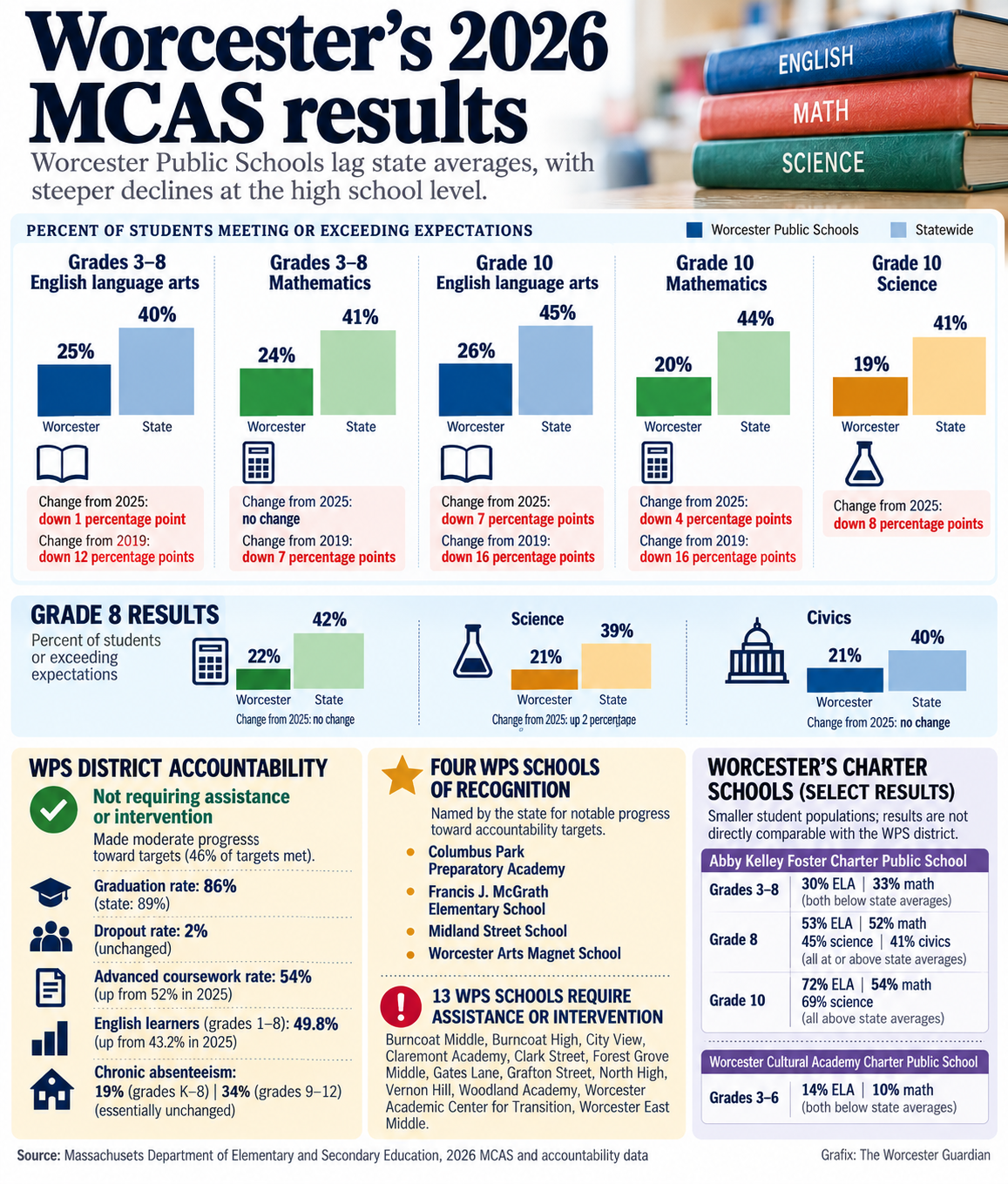
Eighth-grade math was one of the strongest areas of improvement statewide. Forty-two percent of Massachusetts eighth-graders met or exceeded expectations, up 4 percentage points from 2025.
Worcester did not share in that gain. Twenty-two percent of district eighth-graders met or exceeded expectations in math, unchanged from last year and 20 percentage points below the statewide rate.
In eighth-grade English, 26% of Worcester students met or exceeded expectations compared with 42% statewide.
Worcester did show improvement in eighth-grade science, where 21% met or exceeded expectations, up from 19% last year. The statewide rate increased 2 points to 39%.
On the state’s relatively new eighth-grade civics assessment, 21% of Worcester students met or exceeded expectations, compared with 40% statewide.
Results varied by grade elsewhere in the district. Sixth grade produced Worcester’s strongest grades 3-8 results in both major subjects, with 29% meeting or exceeding expectations in English and 32% in math. In seventh-grade math, just 18% met or exceeded expectations, compared with 37% statewide.
District avoids state intervention; 13 schools do not
Despite the achievement gaps, Worcester Public Schools as a district remains classified by DESE as “not requiring assistance or intervention.”
The district made “moderate progress toward targets,” with a cumulative target percentage of 46%, according to the state’s 2026 accountability system.
Of the 44 WPS schools receiving accountability classifications, 31 were classified as not requiring assistance or intervention and 13 as requiring assistance or intervention, according to the district.
Four elementary schools — Columbus Park Preparatory Academy, Francis J. McGrath Elementary School, Midland Street School and Worcester Arts Magnet School — were named Schools of Recognition. DESE gives the designation to a limited number of schools demonstrating notable progress toward accountability targets, including improved achievement and high growth in English and math.
Twenty-one WPS schools increased their overall accountability scores from last year, according to the district. Seven — Flagg Street, Lake View, Wawecus Road, Midland Street, Worcester Arts Magnet, Columbus Park and McGrath — improved by at least 5 percentage points.
Several schools also met at least three-quarters of their annual progress targets. Columbus Park reached 98% of its targets, followed by Worcester Arts Magnet at 90%, Flagg Street and McGrath at 89% each, Worcester Dual Language Magnet at 80% and Elm Park at 78%, according to WPS.
The broader accountability system measures more than MCAS achievement. It also incorporates student growth, graduation and dropout rates, progress toward English language proficiency, chronic absenteeism and advanced coursework.
Worcester’s four-year graduation rate remained at about 86%, compared with 89% statewide, while the district’s dropout rate remained at 2%, according to WPS.
The percentage of high school students completing advanced coursework increased from about 52% in 2025 to 54% this year. DESE’s underlying data put the rates at 52.4% and 53.8%, respectively.
English learners in grades 1 through 8 also exceeded the state’s target for progress toward English language proficiency, with the rate rising from 43.2% to 49.8%. Among high school students, however, the rate fell from 19.9% to 17.2%.
Chronic absenteeism remained another challenge. WPS reported rates of about 19% among students in grades K-8 and 34% among high school students, essentially unchanged from the previous year.
Charter schools post sharply different results
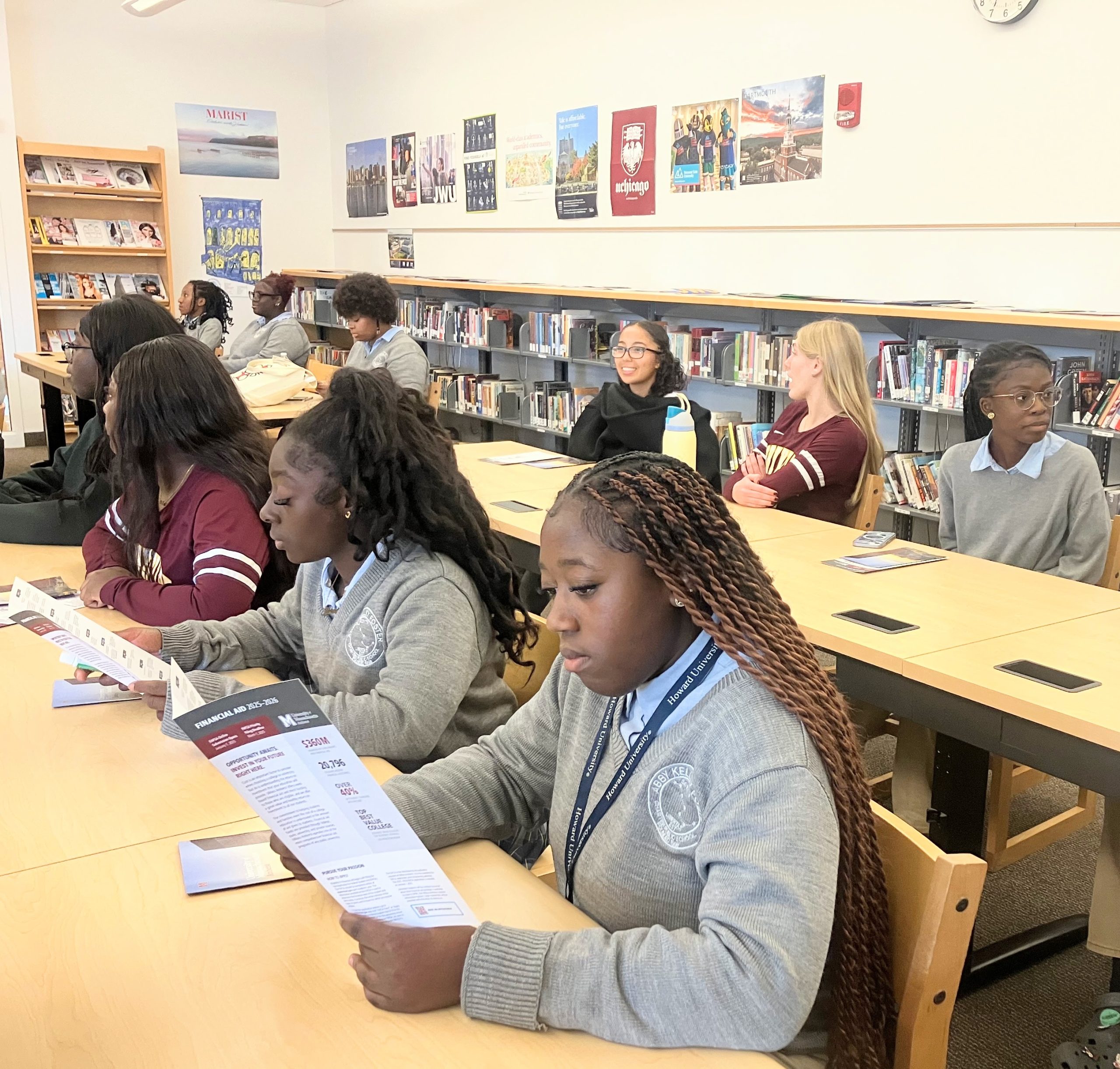
Worcester’s charter schools offered a markedly different picture, although their smaller student populations make direct comparisons with the much larger WPS district difficult.
At Abby Kelley Foster Charter Public School, 30% of students in grades 3 through 8 met or exceeded expectations in English and 33% did so in math. Both remained below statewide rates of 40% and 41%, respectively.
But Abby Kelley’s upper-grade results were substantially stronger.
Among eighth-graders, 53% met or exceeded expectations in English and 52% did so in math, both above the statewide rate of 42%. Forty-five percent met or exceeded expectations in eighth-grade science, compared with 39% statewide, while 41% met or exceeded expectations in civics, compared with 40% statewide.
Abby Kelley’s 10th-grade results were stronger still. Seventy-two percent met or exceeded expectations in English, compared with 45% statewide; 54% did so in math, compared with 44% statewide; and 69% met or exceeded expectations in science, compared with 41% statewide.
Those results were based on considerably smaller groups than WPS, with between 72 and 74 Abby Kelley students included in the 10th-grade assessments.
Worcester Cultural Academy Charter Public School, which serves younger grades, posted lower results. Fourteen percent of its tested students in grades 3 through 6 met or exceeded expectations in English, while 10% did so in math.
The school’s results were based on 112 students in English and 109 in math. Because Worcester Cultural Academy does not yet serve all grades included in the state’s grades 3-8 aggregate, its combined results are not directly comparable with either the full WPS or statewide grades 3-8 figures.
State remains below pre-pandemic levels
Massachusetts education officials described the statewide results as showing areas of progress alongside continuing challenges.
Forty percent of Massachusetts students in grades 3 through 8 met or exceeded expectations in English, down 2 percentage points from last year and 12 points from 2019. In math, 41% met or exceeded expectations, unchanged from 2025 but 8 points below 2019.
Just 14 districts statewide have returned to or exceeded their pre-pandemic performance in both English and math for grades 3 through 8, according to DESE.
Education Secretary Steve Zrike pointed to early literacy as one area where the state is increasing its focus.
“The Healey-Driscoll Administration and the Legislature both recognized the urgent need to focus on early literacy,” Zrike said in the state’s announcement. “With this strong focus and support on early literacy, I am confident that we will see improved outcomes in our English language arts performance.”
MCAS remains part of school accountability
MCAS no longer carries the same consequence for individual high school students that it once did.
Massachusetts voters approved a ballot question in 2024 eliminating a qualifying MCAS score as a requirement for receiving a high school diploma. Students continue to take the exams, however, and MCAS results remain a significant component of the state’s school and district accountability system.
The state is developing a broader graduation framework following the change, with recommendations that include rigorous coursework, end-of-course assessments, postsecondary planning and career and work-based learning opportunities.
For the first time this year, DESE also gave families access to preliminary individual MCAS results through a new online Family Portal before releasing school and district results publicly.
“I’m proud that we were able to give parents access to their child’s preliminary scores online for the first time this year, and with today’s public release, families will be able to learn more about how their school and district performed as a whole,” Elementary and Secondary Education Commissioner Pedro Martinez said in the state’s announcement.
Have a story tip, community concern, or insight to share? Email Editor Charlene Arsenault at carsenault@theworcesterguardian.org.
The Worcester Guardian is a nonprofit newsroom serving Central Massachusetts. Help keep independent reporting alive by making a donation today.