

In the 1800s ladies who lunched could not meet in just any restaurant. Women were not allowed in most dining establishments without a male escort, so they met their friends in female-only dining rooms and restaurants.
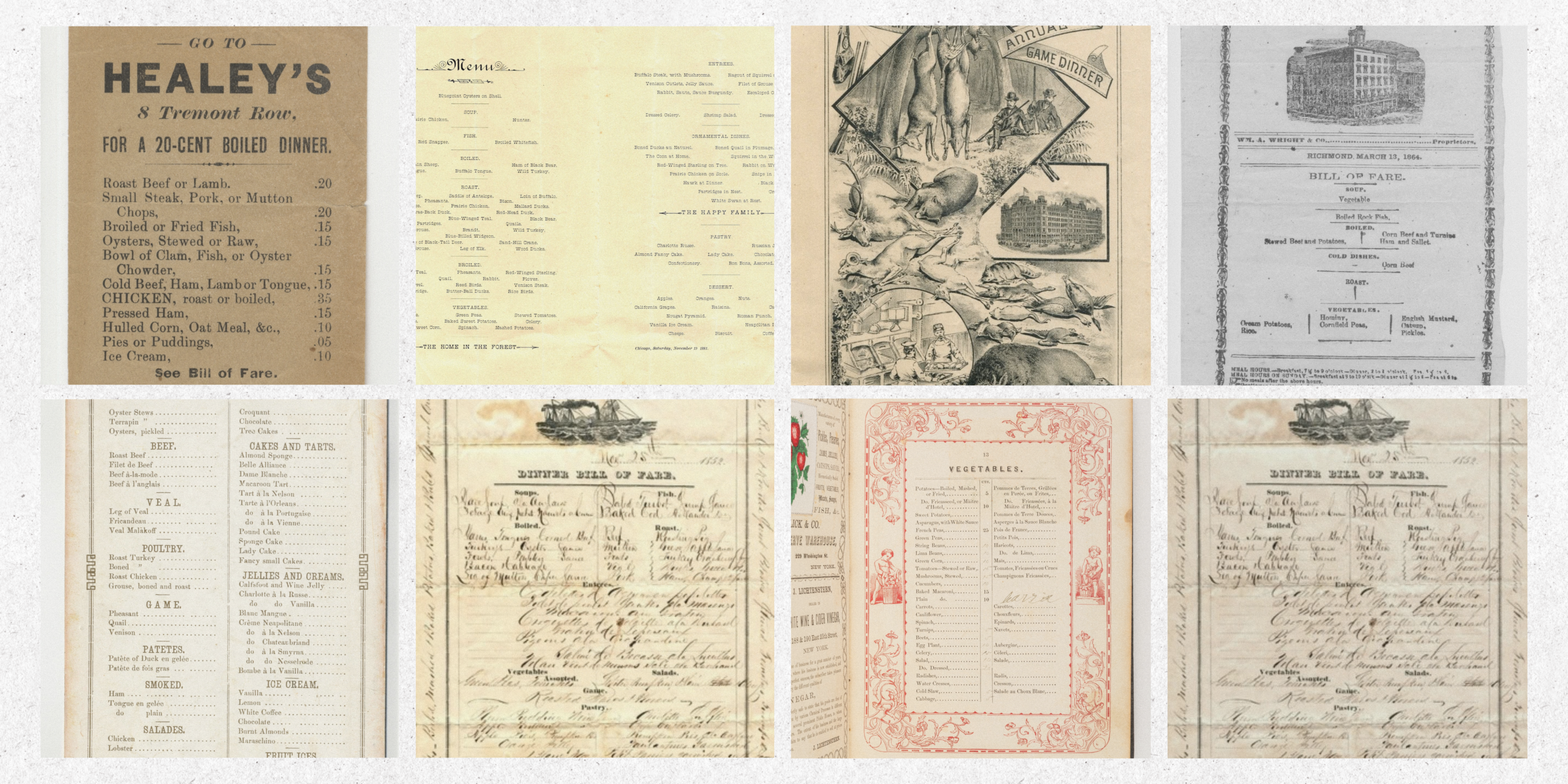
One of the most popular women’s restaurants in mid-nineteenth-century New York was the lavishly decorated Taylor’s Saloon, located at Broadway and Franklin Street. The 1,200-seat venue occupied the ground floor of the International Hotel. Men were allowed to eat unchaperoned in the basement but needed a female escort to use the restaurant. Diners selected their meal choices from ornate fifty-six-page bound menus, featuring a sumptuous variety of dishes.
Just 350 miles southwest of New York, however, restaurant patrons encountered a very different kind of menu. Reflecting widespread shortages of non-local food in the South during the Civil War, visitors to the American Hotel in Richmond in 1864 were handed a one-page menu with a meager selection of dishes, light on meats and sweets and heavy on root vegetables.
Most people don’t give much thought to menus. They serve the practical purpose of listing the food and drinks a person can order at a restaurant or can expect to be served at a private function. But to Henry Voigt, a longtime collector and authority on American menus, they are hugely important for understanding the past.
“Menus are minor, transient documents that are not meant to be saved, but the ones that do survive reveal not just what people ate and where, but also what was happening socially and culturally, even politically, at the time,” he said in a recent interview. “They transport us back to everyday life of the past──from lavish banquets in the Gilded Age to transatlantic steamship crossings to twenty-cent boiled dinners for the working class.”
Menus began to come into general use in the United States during the 1840s as hotels and restaurants replaced inns and taverns, where travelers had only a few home-style meal options. As restaurants expanded their offerings, dining out became a popular form of entertainment. Often listing a stunning selection of dishes—including soups, fish, meats, poultry, game, vegetables, relishes, desserts, fruit, and confectionery──these bills of fare offered diners both the novelty of choice and the anticipation of enjoying the meal to come.
Inspired by his lifelong interest in everyday history and culinary culture, Voigt has spent the last three decades building a collection of approximately 10,000 menus from the mid-nineteenth century to the present day. For the past sixteen years, he has also published his research on his blog, The American Menu. His 200 articles cover the fascinating and endlessly diverse culinary history of the United States, touching almost every aspect of American life.
This spring, the Wilmington, Delaware, resident donated more than 2,600 menus and related ephemera from his collection to the American Antiquarian Society (AAS). Spanning from 1841 to 1900, the gift significantly expands the Society’s menu collection and its ability to preserve nineteenth-century American culinary and social history. It includes menus, invitations, seating charts, and trade cards representing a wide variety of American dining experiences―from elegant restaurants and formal banquets to railroad dining cars and everyday private events.
“The variety of menus in this collection not only highlights culinary trends during the nineteenth century, but also documents class and gender distinctions, political ambitions, technological developments, and patterns of travel and entertainment,” said Christine Morris, curator of graphic arts at AAS.
One example dates from Thanksgiving 1852, when sixty-eight passengers on the side-wheel steamboat, the Baltic, celebrated the holiday during a choppy transatlantic crossing from Liverpool, England, to New York City. The menu shows an astonishing variety of dishes passengers could choose from, including two types of fish, eight boiled meats, eleven roasted meats—including turkey and wild hare—plus eight separate entrees. True to Thanksgiving tradition, apple and pumpkin pies, along with several other sweet desserts, were offered.
The Baltic was one of the seafaring vessels of the American-owned Collins Line. Famous for their luxury and speed, they typically crossed the Atlantic Ocean in a little over ten days. By the end of the decade, however, the ill-fated Collins Line had lost two of its four ships at sea and gone bankrupt.
Voigt’s collection includes a series of unusual menus for six game dinners at the Grand Pacific Hotel in Chicago between 1877 to 1885. This annual feast for 500 people was a nationally renowned event in the late nineteenth century. It featured nearly every conceivable species of game, with dishes like ham of black bear, leg of elk, loin of moose, and buffalo tongue. Small forest animals appeared on the menu as broiled rabbit and ragout of squirrel à la Francaise. Dozens of roasted fowl were at hand, including Blue-billed Widgeons, Red-winged Starlings, and “Sand Peeps,” which according to Voigt, could have referred to any one of the tiny sandpipers that once flitted along in large numbers on the North American beaches. “The New York Times called it ‘Chicago’s great feed,’” he said. “It was a celebration of America’s vast abundance.”
The collection also includes one of only three known surviving menus from President Lincoln’s second inaugural ball, held on March 6, 1865. Printed in gold on stiff board, the menu was seemingly designed to stand upright on the buffet table. Before the dining room opened for the midnight supper for 4,000 guests, the presidential party dined privately at the end of the 250-foot-long table. They may have received these display menus to guide their choices. The bill of fare includes stew made with diamondback terrapins from the nearby brackish waters of the Chesapeake Bay, as well as a wide selection of meat and game dishes and a vast array of desserts, including a huge cake in the shape of the US Capitol.
Lincoln reportedly saved one of the three surviving copies. He was assassinated less than six weeks later.
According to Morris, Henry Voigt’s ability to amass such an extensive and well-preserved collection of menus, which were not meant to be saved and passed down, is truly extraordinary. “It’s a gift for future generations, who will be able to use these cultural artifacts to discover new stories about life in nineteenth-century America.”
This article is part of an ongoing, monthly series supplied by the American Antiquarian Society that focuses on the society’s collections and how they deepen the community’s understanding of Worcester’s–and the American–past. Through wide-ranging programs, community engagement, and research support for scholars and students, the AAS works to cultivate a broad community of inquiry―locally and nationally.
- The Worcester Guardian is an independent nonprofit news organization. Support local journalism by making a DONATION today.