

Raising children on one income is no small feat, particularly when housing costs, child care expenses and the demands of work leave little room for financial surprises. But a new national study suggests Worcester may offer single mothers a better combination of affordability and family resources than many of the country’s larger metropolitan areas.
Worcester ranked first among the U.S. metropolitan areas examined in a 2026 analysis by SingleMothersGrants.org, which compared communities using measures ranging from rent and child care costs to public safety, health care access and education.
The study placed Worcester ahead of Minneapolis-St. Paul, Minnesota, and Omaha, Nebraska, which finished second and third, respectively. Hartford, Connecticut, and Albany, New York, rounded out the top five.
Boston also ranked below Worcester, although the research summary did not provide Boston’s exact placement or the numerical scores separating the two Massachusetts metropolitan areas.
The findings suggest that Worcester’s relative strengths lie in education and the availability of child care programs, two factors that can play an especially important role for parents balancing employment with raising children.
“Worcester takes the top spot with a rare combination of strong education results and broad child care program availability,” the report states.
The researchers argue that access to child care can be as important as its cost. Even affordable care offers little practical benefit to working parents if programs have no openings or waiting lists stretch for months.
The study examined nine categories: rent burden, child care costs, child care program availability, transportation expenses, food costs, unemployment, crime, health care access and education.
Researchers drew on government and other data sources, including the U.S. Census Bureau, the FBI, the U.S. Department of Agriculture and federal health care workforce statistics. Most of the underlying data came from 2023 and 2024, meaning the rankings do not necessarily reflect changes in housing prices, child care availability or other conditions during 2026.
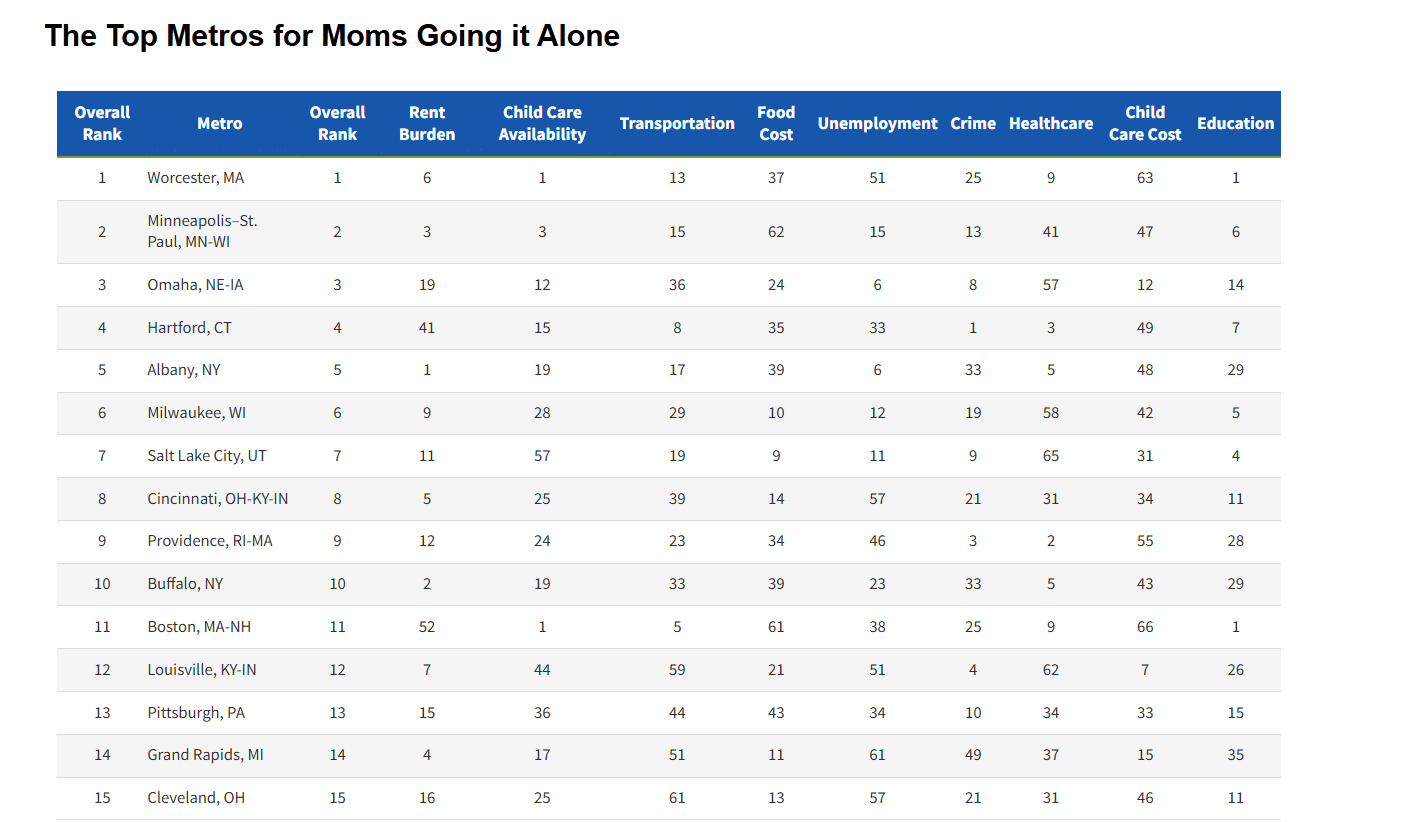
Each measure was standardized and incorporated into a composite score used to compare metropolitan areas and states.
The results offer an interesting contrast within Massachusetts.
Although Worcester topped the metropolitan rankings, Massachusetts as a whole finished in the middle of the state rankings, landing in 17th place, just after Indiana and before Maryland; Vermont came in first. Massachusetts earned particularly strong marks for education but did not perform as well across the full range of affordability and quality-of-life measures.
That distinction underscores one of the study’s central findings: A state’s overall economic conditions do not necessarily tell the full story of what families experience in individual metropolitan areas.
The analysis also found that some of the nation’s most expensive coastal cities performed poorly despite having extensive public transportation networks, highly regarded hospitals and other amenities.
San Francisco, San Jose, Los Angeles and San Diego were among the lowest-ranked metropolitan areas, largely because housing and child care costs outweighed their advantages in other categories.
Minneapolis-St. Paul performed well because of relatively manageable rent burdens and strong school performance, while Omaha benefited from low unemployment and favorable public safety measures, according to the report.
At the state level, Vermont, North Dakota, South Dakota, Maine and Nebraska were among the strongest performers. California, Nevada, New Mexico, Alaska and Washington, D.C., ranked among the lowest.
The researchers emphasized that affordability alone does not determine whether a community is a good place to raise children. Access to reliable transportation, medical care, schools and child care can be just as consequential, particularly for households relying on a single income.
Still, the rankings come with important limitations.
The study compares metropolitan areas, not individual neighborhoods or school districts. Conditions can vary substantially within a region, and an overall ranking does not establish that every single mother in the Worcester area has access to affordable housing, available child care or strong schools.
The report also does not establish how many child care openings are currently available in Worcester or how long families might wait for placement. Its conclusions are based on broader statistical measures rather than a survey of local parents.
And while Worcester placed first overall, the publicly provided research summary does not include the underlying metropolitan scores needed to determine precisely how much better the region performed than Boston or other competitors.
The study’s authors acknowledged that statistical comparisons cannot capture every factor shaping a family’s well-being.
For single parents, proximity to relatives, friends and other trusted caregivers can make a meaningful difference, even when another community appears more affordable on paper.
The report recommends that families considering a move examine housing, child care and grocery expenses together, while also comparing neighborhood-level crime statistics, individual school performance and access to medical services. For single mothers navigating those challenges locally, the Roman Catholic Diocese of Worcester maintains an online directory of community resources, including organizations offering assistance to families and individuals in need.
For Worcester, the findings provide a favorable national comparison at a time when housing affordability and access to essential services remain important concerns for families throughout Central Massachusetts.
But the distinction between ranking well and living comfortably remains significant. A region can perform better than its peers while still presenting substantial financial challenges for the families who call it home.
Have news, tips, or a story worth telling? Feedback to this story? A good recipe, a funny joke or a suggestion? Reach Editor Charlene Arsenault at carsenault@theworcesterguardian.org—because good stories (and great scoops) deserve to be shared.
- The Worcester Guardian is an independent nonprofit news organization. Support local journalism by making a DONATION today.