
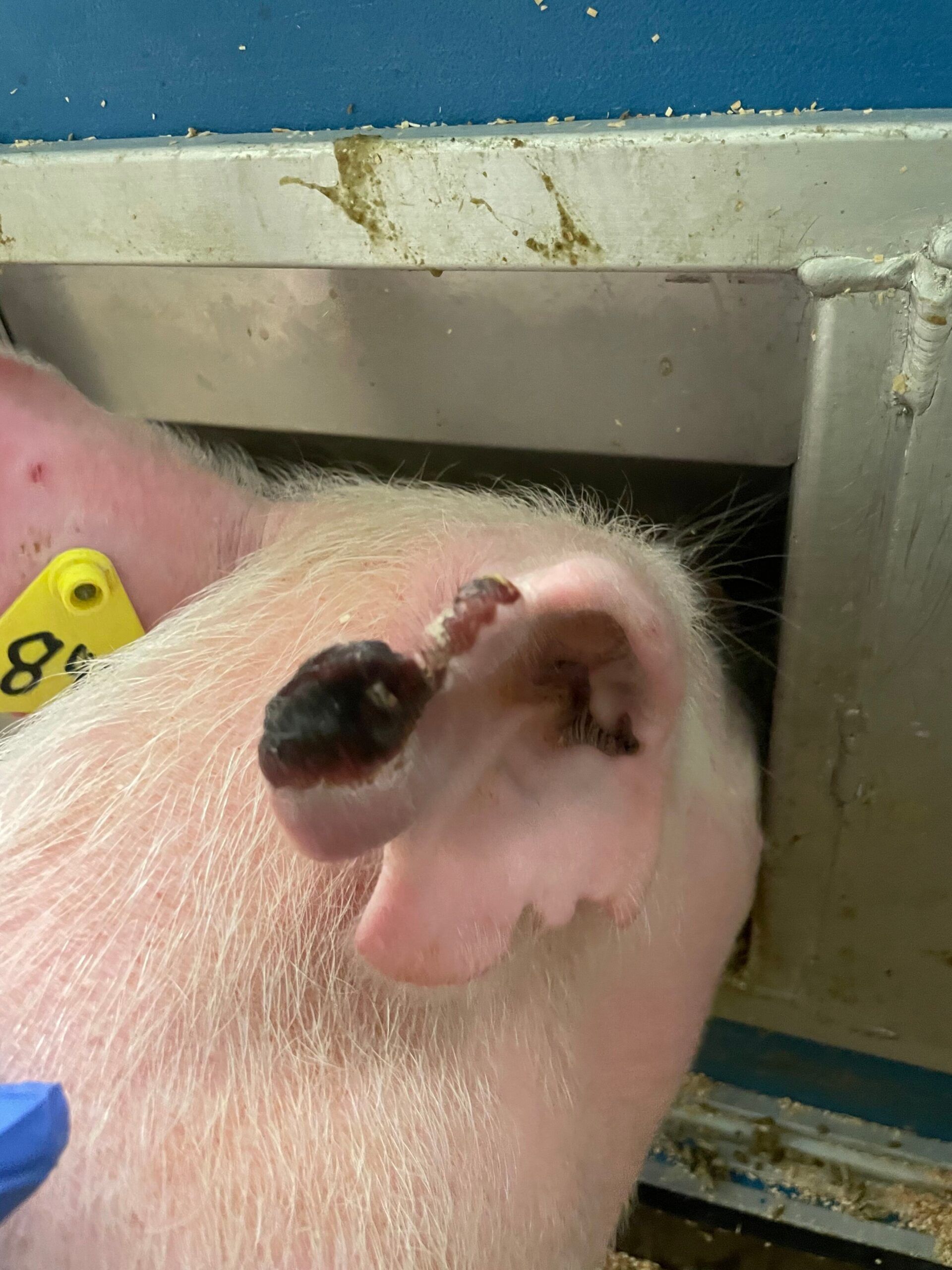
People for the Ethical Treatment of Animals is calling for a federal investigation into the deaths of two young pigs used in cardiac experiments at UMass Chan Medical School, alleging that the animals suffered complications following invasive procedures and may not have received timely veterinary care.
In a complaint filed Monday, Oct. 19, with the U.S. Department of Agriculture, PETA asked federal regulators to investigate possible violations of the Animal Welfare Act after obtaining internal university records detailing the animals’ deaths.
The USDA acknowledged the complaints Wednesday, Oct. 21, confirming that it is reviewing concerns involving both UMass Chan and an animal supplier, Earle M. Parsons & Sons Inc. The agency assigned separate tracking numbers to the complaints and said it would need 30 to 60 days to examine the allegations.
“Please be assured that we will look into your concern(s) and take appropriate action(s),” the USDA’s Animal and Plant Health Inspection Service wrote in correspondence provided to the Worcester Guardian.
The acknowledgment does not establish that violations occurred or indicate whether the agency has opened a formal enforcement investigation.
The complaints are the latest in a series of allegations against the Worcester medical school involving the treatment of research animals and come just two weeks after PETA filed a lawsuit seeking the identities of members of the university committee responsible for overseeing animal research.
According to the complaint and accompanying medical records, one pig, identified as No. 717, died Dec. 6, 2023, after researchers induced a heart attack by blocking blood flow through a vessel for approximately 2½ hours. The procedure, conducted under a research protocol overseen by John Kevin Donahue, also involved implanting a battery-powered defibrillator.
Following surgery, approximately 3 to 4 milliliters of rectal bleeding were observed when a thermometer was removed. The animal was subsequently described as sluggish and was found dead in its enclosure later that evening.
PETA questioned whether the animal received adequate postoperative monitoring and veterinary attention, although its complaint acknowledges that the available records do not establish whether a veterinarian evaluated the bleeding and lethargy.
In a second case, researchers performed open-chest surgery Jan. 9, 2025, on a 12-week-old pig identified as No. 796, exposing its heart, applying experimental gene therapies to the organ’s surface and implanting a pacemaker.
The pig was found dead in its enclosure Jan. 10. According to the complaint, the death was provisionally attributed to cardiac arrest following the apparent displacement of a pacemaker lead from the heart’s atrium into its ventricles, triggering ventricular fibrillation, a potentially fatal abnormal heart rhythm.
PETA questioned whether the pacemaker and its leads had been properly positioned and tested during surgery and whether postoperative monitoring was sufficient to detect a life-threatening complication.
The medical records were provided to PETA by the same internal whistleblower whose allegations prompted the organization’s previous complaints against UMass Chan, Sydney Rader, a media representative with PETA’s laboratory investigations department, told the Worcester Guardian.
The organization’s latest complaint includes animal health records, anesthesia and postoperative monitoring documents, physical examination logs and records identifying the supplier of three pigs.
The records document the procedures and deaths, but questions remain about the adequacy of postoperative care and whether any deficiencies contributed to the animals’ deaths.
“These piglets endured invasive heart experiments, were denied timely care, and were found dead in concrete cells,” Dr. Alka Chandna, PETA’s vice president of laboratory investigations, said in the organization’s Oct. 19 announcement. “They were living, feeling beings who were treated like disposable raw materials in a system that took what it wanted from their bodies—the feds must investigate and hold the medical school accountable.”
PETA is asking federal regulators to examine whether the university complied with requirements governing veterinary care, postoperative monitoring and procedures intended to minimize animal pain and distress.
The complaint also questions whether UMass Chan’s Institutional Animal Care and Use Committee, or IACUC, adequately reviewed the research protocols and established appropriate safeguards, including criteria for determining when animals experiencing severe pain or distress should be euthanized.
Whether the incidents constitute violations of federal animal welfare regulations is a determination for regulators.
Questions about animal supplier
PETA is also asking the USDA to investigate whether a company that supplied pigs to the university was properly authorized to sell animals for research.
According to a packing slip included with the complaint, Earle M. Parsons & Sons Inc., of Hadley, Massachusetts, supplied three 10-week-old Yorkshire pigs to UMass Chan in December 2024, including Pig 796.
The document, dated Dec. 30, 2024, identifies the animals by their tag numbers and lists Donahue’s laboratory as the recipient.
PETA said the company does not appear in the USDA’s public database of licensed animal dealers and is asking regulators to determine whether it held a valid license, operated under another business name or qualified for an exemption from federal licensing requirements.
The company’s absence from the database, as reported by PETA, does not by itself establish that an illegal sale occurred.
In its Oct. 21 acknowledgment, the USDA assigned tracking number INQ-0000071124 to the UMass Chan complaint and INQ-0000071129 to the complaint concerning Earle M. Parsons & Sons.
The agency said it was reviewing both matters and advised PETA that information about the outcome could be requested through the federal Freedom of Information Act process.
Previous allegations and federal oversight
The latest complaint follows earlier allegations involving animal care and oversight at UMass Chan, including cases involving dogs, rabbits, ferrets and pigs.
In December 2025, PETA filed complaints with the Massachusetts Department of Public Health, USDA and National Institutes of Health’s Office of Laboratory Animal Welfare based on information it said was provided by an internal whistleblower.
Those complaints alleged inadequate veterinary staffing, delayed medical treatment, improper pain management and failures to address injuries and complications associated with research procedures.
Among the allegations were cases involving pigs used in cardiac experiments that developed tissue injuries after researchers induced heart attacks. PETA alleged that some animals experienced painful damage to their ears and extremities because of impaired blood circulation.
The organization also cited a February 2024 USDA inspection in which UMass Chan was cited for inadequate veterinary care involving pigs used in cardiac research.
UMass Chan has previously defended its animal research practices.
In a statement provided to the Worcester Guardian in December, the medical school said it was “committed to upholding the highest standards of laboratory animal welfare in our research programs” and dedicated to “rigorous compliance with all regulations governing the ethical and humane treatment of animals in research.”
The university also said animal care professionals and administrators regularly review procedures involving research animals. It noted that its animal research program is accredited by AAALAC International, a private nonprofit organization that evaluates animal care programs, and is subject to USDA inspections.
In a separate response to the Worcester Guardian earlier this month concerning PETA’s public records lawsuit, Sarah Willey, assistant vice chancellor for media relations at UMass Chan, reiterated the university’s position.
“We are dedicated to rigorous compliance with all regulations governing the ethical and humane treatment of animals in research and we strive to abide by all policies and laws concerning the care of animals, which is an integral part of the institution’s research work,” Willey said.
The university also maintains a website outlining its commitment to responsible animal research and its position that animal studies contribute to the development of treatments and advances in medicine.
Those statements preceded the Oct. 19 complaint and do not specifically address the deaths of the two pigs.
Separate lawsuit over research oversight
The new allegations also come amid an ongoing legal dispute over transparency in UMass Chan’s animal research program.
On Oct. 6, PETA filed a lawsuit in Suffolk County Superior Court challenging the medical school’s refusal to release the names of members of its Institutional Animal Care and Use Committee, or IACUC.
The committee is responsible for reviewing and approving research involving vertebrate animals and overseeing compliance with applicable animal welfare regulations.
PETA contends that the identities of committee members are public information and that the university improperly invoked privacy and security exemptions under Massachusetts public records law to withhold them.
The organization filed a separate lawsuit against UMass Amherst involving records from that university’s animal research oversight committee.
Kelsey McLean, senior litigation counsel with the PETA Foundation, previously told the Worcester Guardian that identifying committee members is important because federal regulations require the panels to include individuals from outside the institution and people without scientific backgrounds.
McLean also questioned the university’s justification for withholding the names, saying UMass Chan had not informed PETA of specific threats or incidents involving committee members.
Willey declined to discuss that lawsuit, citing the pending litigation.
The public records case is separate from the new USDA complaint. While the lawsuit concerns access to information about the committee overseeing animal research, the latest complaint asks federal regulators to examine whether UMass Chan complied with animal welfare requirements in its treatment of the pigs.
PETA is urging the university to move away from animal experimentation in favor of research methods that do not involve live animals.
The USDA has confirmed it is reviewing the complaints but has not announced findings concerning the deaths of the two pigs or the licensing status of the animal supplier.
The Worcester Guardian has sought additional comment from UMass Chan Medical School regarding the circumstances surrounding the pigs’ deaths and from Earle M. Parsons & Sons Inc. concerning its licensing status. Neither had responded to the latest inquiries as of publication. This report will be updated as additional information becomes available.
Have news, tips, or a story worth telling? Feedback to this story? A good recipe, a funny joke or a suggestion? Reach Editor Charlene Arsenault at carsenault@theworcesterguardian.org—because good stories (and great scoops) deserve to be shared.
- The Worcester Guardian is an independent nonprofit news organization. Support local journalism by making a DONATION today.