
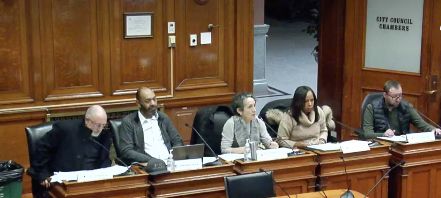
How Worcester police respond to people experiencing mental health crises, interact with transgender individuals and use body-worn cameras is among on the city’s human rights commission on Monday.
The commission is scheduled to begin reviewing three Worcester Police Department policies at its Oct. 26 meeting, with members expected to receive assignments and develop recommendations. The meeting also includes discussion of a proposed city ordinance concerning homelessness and encampments, as well as civilian oversight of the Police Department.
The agenda brings several significant questions about civil rights and city policy before the commission, which is charged with promoting equal access to public services and protecting residents’ civil rights. While no immediate changes to police policies or city ordinances are scheduled for adoption, the discussions could shape recommendations submitted to city officials.
Chief Equity Officer Kevin Lovaincy introduces the three WPD policies under review: the department’s transgender policy, mental health policy and updated body-worn camera policy.
Commission Vice Chairman Randy Feldman is expected to assign the policies to commission members and explain the process for developing and submitting recommendations.
The agenda does not include the text of the policies or identify specific changes under consideration.
Homeless encampment ordinance discussed
The commission also receives a briefing on a proposed city council ordinance concerning homelessness and encampments. Commission Clerk Kerry Whiterell presenta the proposal, which then heads for review along with the police policies. The agenda doesn’t dig in to the ordinance’s language or explain what restrictions, requirements or other measures it might establish.
The commission’s review could provide an opportunity to consider the proposal’s implications for people experiencing homelessness, although the agenda does not specify what recommendations members might make.
Civilian police oversight on agenda
The meeting will also revisit the issue of civilian oversight of Worcester police. Lovaincy is on tap to present and discuss a report concerning the Civilian Review Board, or CRB, that he previously submitted to the city council.
Separately, Feldman discusses a letter he wrote concerning the CRB and leads a question-and-answer session with commission members.
The agenda does not summarize the report’s findings or Feldman’s position, making it unclear which specific recommendations or points of disagreement will be addressed. The discussions come as the commission prepares to examine policies governing police interactions with residents and the use of body-worn cameras.
Immigration advocates plan to raise concerns
Although immigration enforcement is not listed as a separate agenda item, local advocates are encouraging residents to attend Monday’s meeting to discuss the effects of federal immigration enforcement in Worcester County. In a message circulated by Indivisible Worcester, Joanne Gravell, a volunteer with LUCE and longtime Amnesty International member, called for residents to speak about Immigration and Customs Enforcement (ICE) activity and ask city officials to become more involved.
The message raises concerns about recent ICE arrests at courthouses in Worcester County and points to the Massachusetts PROTECT Act, which places restrictions on civil immigration arrests in courthouses and other designated locations. Gov. Maura Healey signed the law Aug. 5. Its courthouse provisions, which generally prohibit civil arrests without a judicial warrant or court order, are scheduled to take effect Nov. 3.
The advocates’ message suggests that immigration enforcement could be raised during the commission’s public-comment period. However, the topic does not appear as a scheduled presentation or commission business item.
The agenda allows individual speakers two minutes during public comment, with a maximum of 30 minutes allotted at the vice chairman’s discretion.
Commission to revisit its origins
The meeting also calls in retired Massachusetts Appeals Court Associate Justice Mel Greenberg, who served on the court from 1983 to 2007, to give a historical perspective on the creation of Worcester’s Human Rights Commission, offering context for the commission’s role in city government.
The Worcester Human Rights Commission meets Monday, Oct. 26, at 6 p.m. in the Esther Howland Chamber at City Hall. The meeting will be held in a hybrid format, with options for remote participation by computer or telephone.
Residents seeking additional information or wishing to submit written comments can contact the city’s Executive Office of Diversity, Equity and Inclusion at EODEI@worcesterma.gov or 508-799-1995.
Have news, tips, or a story worth telling? Feedback to this story? A good recipe, a funny joke or a suggestion? Reach Editor Charlene Arsenault at carsenault@theworcesterguardian.org—because good stories (and great scoops) deserve to be shared.
- The Worcester Guardian is an independent nonprofit news organization. Support local journalism by making a DONATION today.