
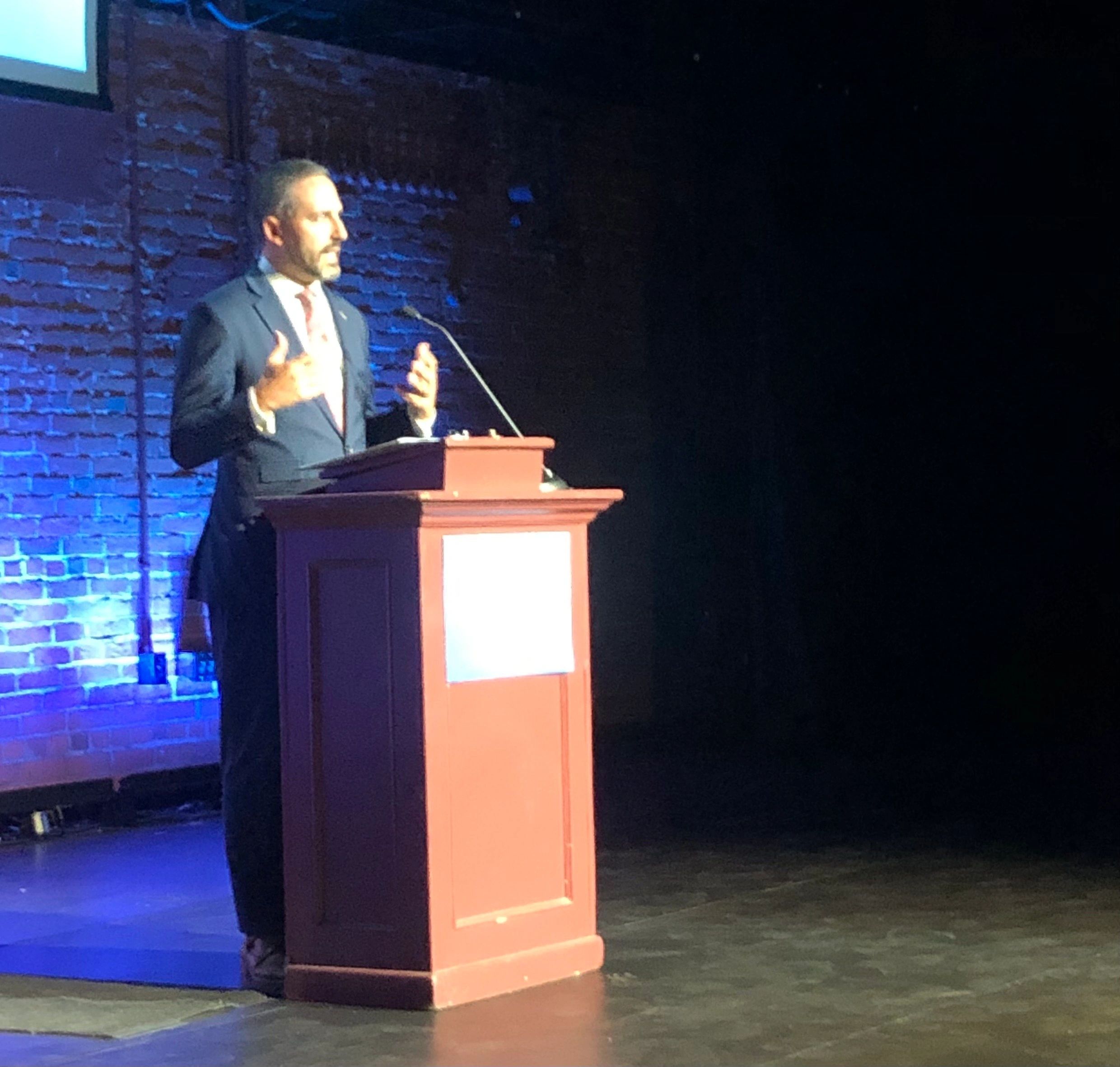
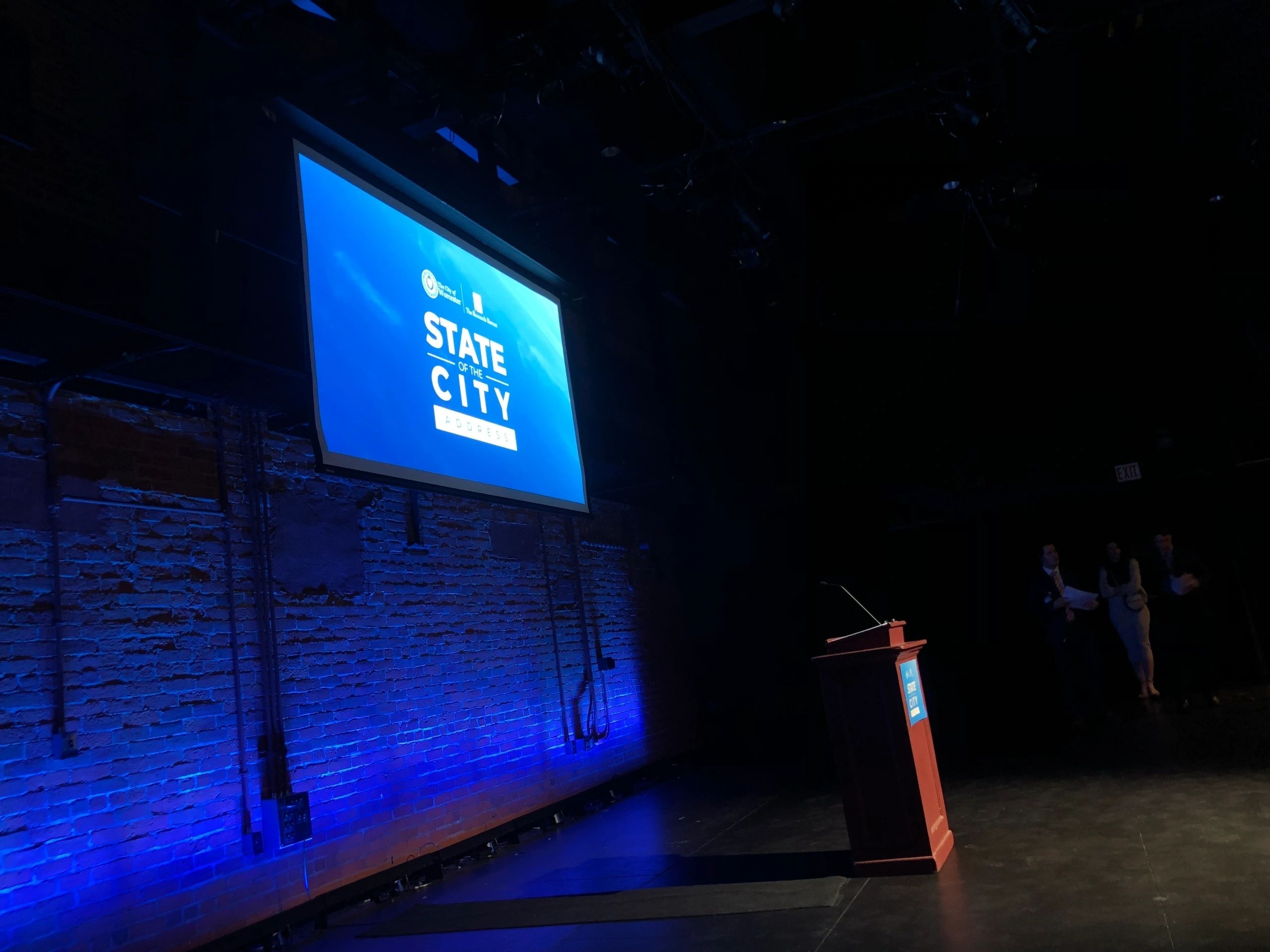
WORCESTER—City Manager Eric Batista delivered his State of the City address Wednesday night at the JMAC BrickBox Theater — but pockets of his speech competed with a barrage of chants, interruptions, and sustained protest from a small but vocal group, primarily in response to a recent immigration enforcement incident that has roiled Worcester.
At times barely audible over cries of “ICE off the streets!” and “Shame!” from a cluster of protesters seated near the center of the audience, Batista opened his second annual address by acknowledging the community’s pain and anger over the May 8 ICE incident on Eureka Street, before urging residents to stand together and outlining six strategic priorities for Worcester’s future.
“Before I talk about the achievements of the past year and look ahead to what I have planned,” Batista began, “I want to take a moment to reflect on one of the most pressing challenges our city, our country, is facing. I know that many of you listening tonight, and residents across Worcester, are in pain after the events on Eureka Street. You are not alone in that pain.”
Batista said that on that day Worcester saw national issues play out “on our own doorsteps” and that families and communities were “terrorized and ripped apart.”
“We are hurting, and in many ways, the community feels fractured,” Batista said early in his remarks, referencing widely viewed video of federal agents detaining a woman as her children screamed. “But I’m calling on you to come together… We are strongest when we stand together.”
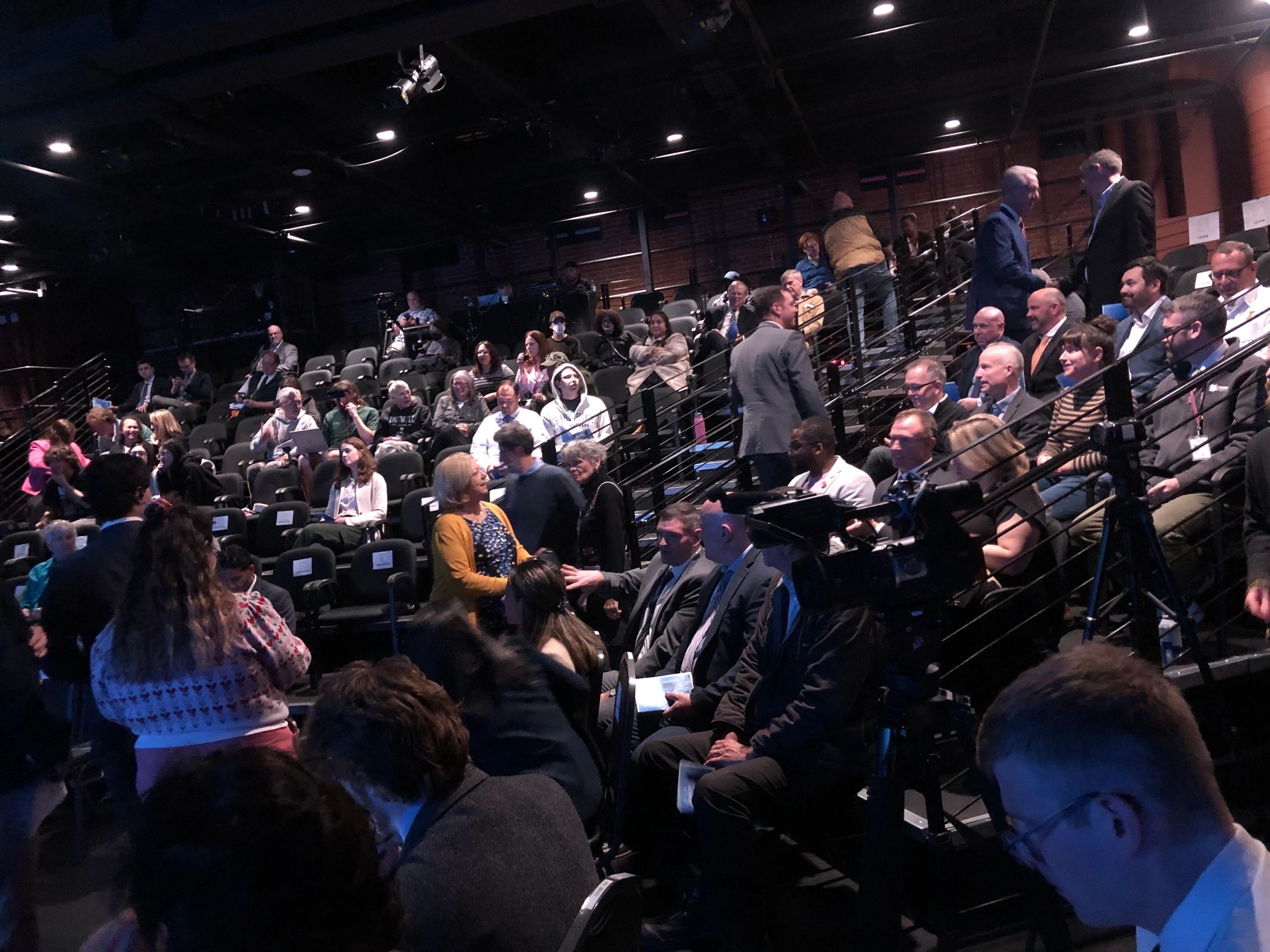
Protesters interrupted Batista repeatedly throughout the evening. Activist David Webb led many of the chants before eventually standing and announcing, “They said if I leave now, I won’t be arrested, so I am leaving,” drawing applause from the crowd. Another woman shouted about “a woman being body-slammed by ICE,” and twice approached the podium directly.
Despite the interruptions, Batista moved forward with his prepared remarks, using much of the evening to reaffirm the city’s commitment to a six-part strategic plan that centers on public health and safety, affordable housing, neighborhood cleanliness, equitable job growth, communication, and education.
Six priorities for Worcester’s future
Batista emphasized that Worcester’s priorities remain consistent despite national unrest and local tensions.
His first priority, he said, is public health and safety. He noted that the city saw 16 homicides in 2024 and that police seized 90 illegal firearms. He praised ongoing efforts to strengthen coordination between the health and human services department and emergency response teams — especially amid rising substance use. Outreach efforts in the last year helped 276 individuals access detox and distributed over 1,400 doses of Narcan, he said.
On affordable housing, Batista maintained the city must be more aggressive and strategic. Worcester is aiming to build 12,000 new housing units by 2033, but Batista acknowledged that many current residents are still being priced out. “Nearly 40% of residents spend more than a third of their income on housing,” he said. “We know these efforts are still leaving some behind.”
“To keep up, the city will need to help bring in over 1,000 new units a year,” he said. “Now, that demand is exciting. People are seeking out Worcester as a place to live, work, and play.”
The city is planning to establish a daytime resource center for unhoused residents and recently opened a dedicated emergency shelter for women.
He referenced that a local woman and her two children who had been in and out of shelters recently moved into a new home through one of the city’s trust fund-supported housing programs. An example, he stressed, of the city plan’s effectiveness.
The clean city initiative was cited as Batista’s third key goal, with recent efforts including the placement of more than 150 new public recycling and trash bins, a new zero waste master plan, and expanded tree planting programs to increase the city’s urban tree canopy.
Batista also spotlighted downtown events and eased permitting processes as part of his fourth goal: supporting small businesses and sustainable job creation. He noted a major upcoming collaboration with Saint-Gobain expected to bring more than 1,000 new jobs to the city. Economic growth defines the priority in Batista’s strategic plan, with the city manager stating that the city is working with business owners to improve their spaces and drive foot traffic with events such as food truck and vendor pop-ups.
“Good experiences at our restaurants, bars, and entertainment venues keep people coming back and encourages them to move here,” he said. “These events are what makes Worcester special.”
Key employment sectors in Worcester continue to be life sciences, administrative services, health care and government, and Batista said that the city could gain as many as 14,000 new jobs by 2034.
“Let me say that again so it really resonates — 14,000 jobs,” he said, twice, to be heard over interruptions.
Batista points to high performing government and strong financial health as the city’s fifth priority goal, and said that “one of the ways we can guarantee high performance is improving residents’ ability to connect with us.”
He said that one way the municipality is working to improve this communication is by creating spaces outside of City Hall at which residents can connect with local government. He also touted the success of the 311 app and said the city is planning to open a second service center due to high demand.
“This year, we piloted a 311 customer service center where the residents of Main South can go for anything from getting their birth certificate to notifying us of a downed tree or pothole to renewing their passport,” he said.
Finally, Batista focused on the city’s investments in education, citing the new Doherty Memorial High School and efforts to build sustainability into school construction. “To secure Worcester’s future, we have to secure the future of our students,” he said.
Batista has proposed a $947.9 million operating budget for FY2026. The proposal emphasizes education, public safety, and infrastructure investments, while building a contingency fund to weather financial uncertainties. Education comprises the largest line item at over 60% of the budget.
“Every aspect of school construction is forward-looking,” he said, adding that the city reduced its greenhouse gas emissions by 8.2% from 2009 to 2023 and its energy savings contract has resulted in an 18% reduction in municipal energy over the past decade.
A city under pressure
Wednesday’s speech came just two weeks after ICE agents attempted to detain a woman on Eureka Street, a scene that escalated into a public clash involving police, protesters, and multiple arrests, including a 16-year-old and a local school committee candidate. Batista has called the footage “disturbing to watch” and reiterated that the city does not assist ICE with civil detainments. The body-worn camera footage is expected to be released in full this week.
Batista closed his remarks with a call for unity: “Even though times are uncertain now, there is still something we can count on — each other,” he said, urging residents to resist anger and division. “Commit to standing up and standing together… because if we do, I know we will not break. We will elevate the state of Worcester for generations to come.”
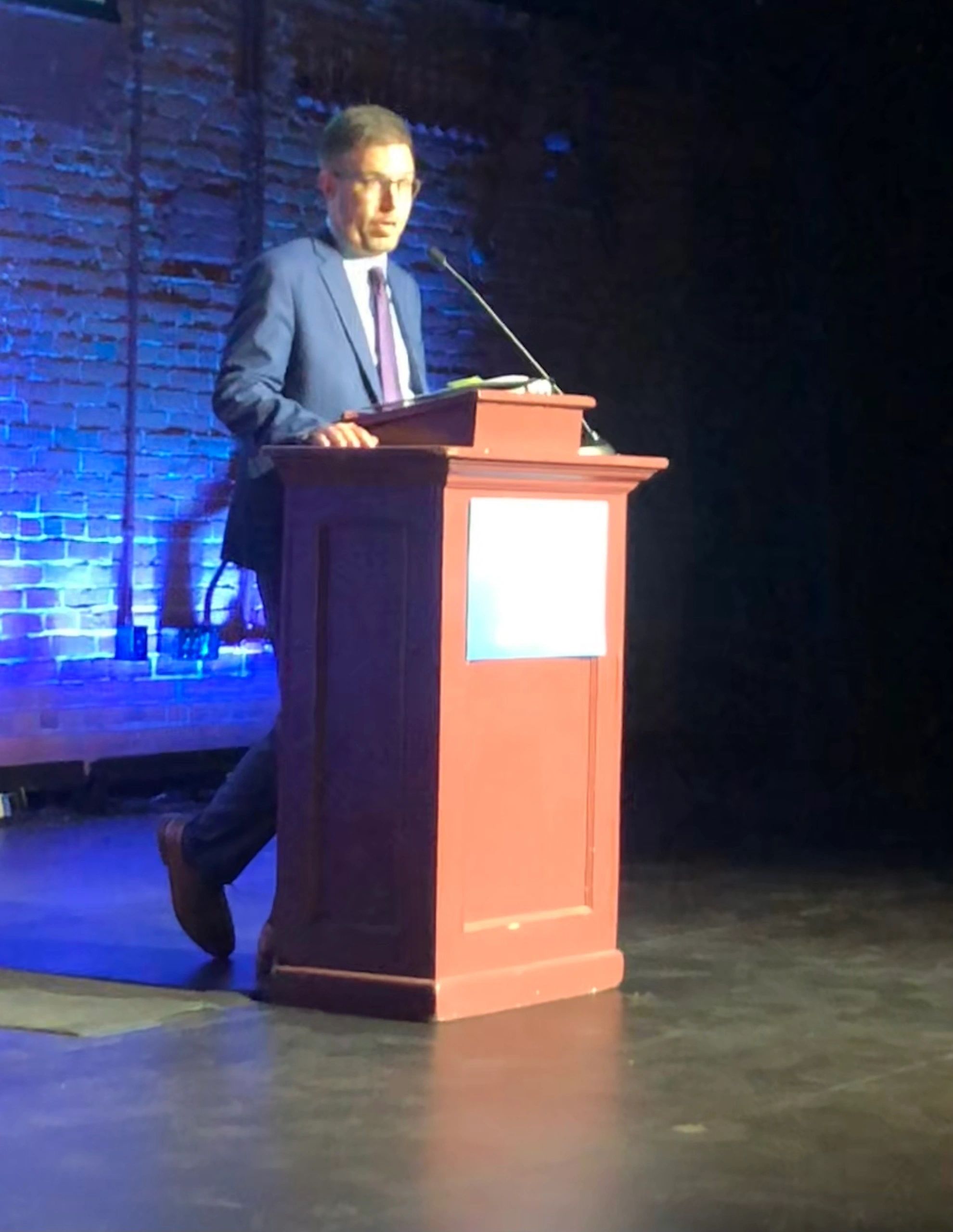
As the crowd rose to leave, Worcester Regional Research Bureau CEO Paul Matthews — whose organization has hosted the annual State of the City address for the past three years — praised Batista’s steadiness throughout the disruption.
“We’ve seen grace under pressure here tonight,” he said.
Have news, tips, or a story worth telling? Reach Editor Charlene Arsenault at carsenault@theworcesterguardian.org—because good stories (and great scoops) deserve to be shared.
- The Worcester Guardian is an independent nonprofit news organization. Support local journalism by making a DONATION today.
