
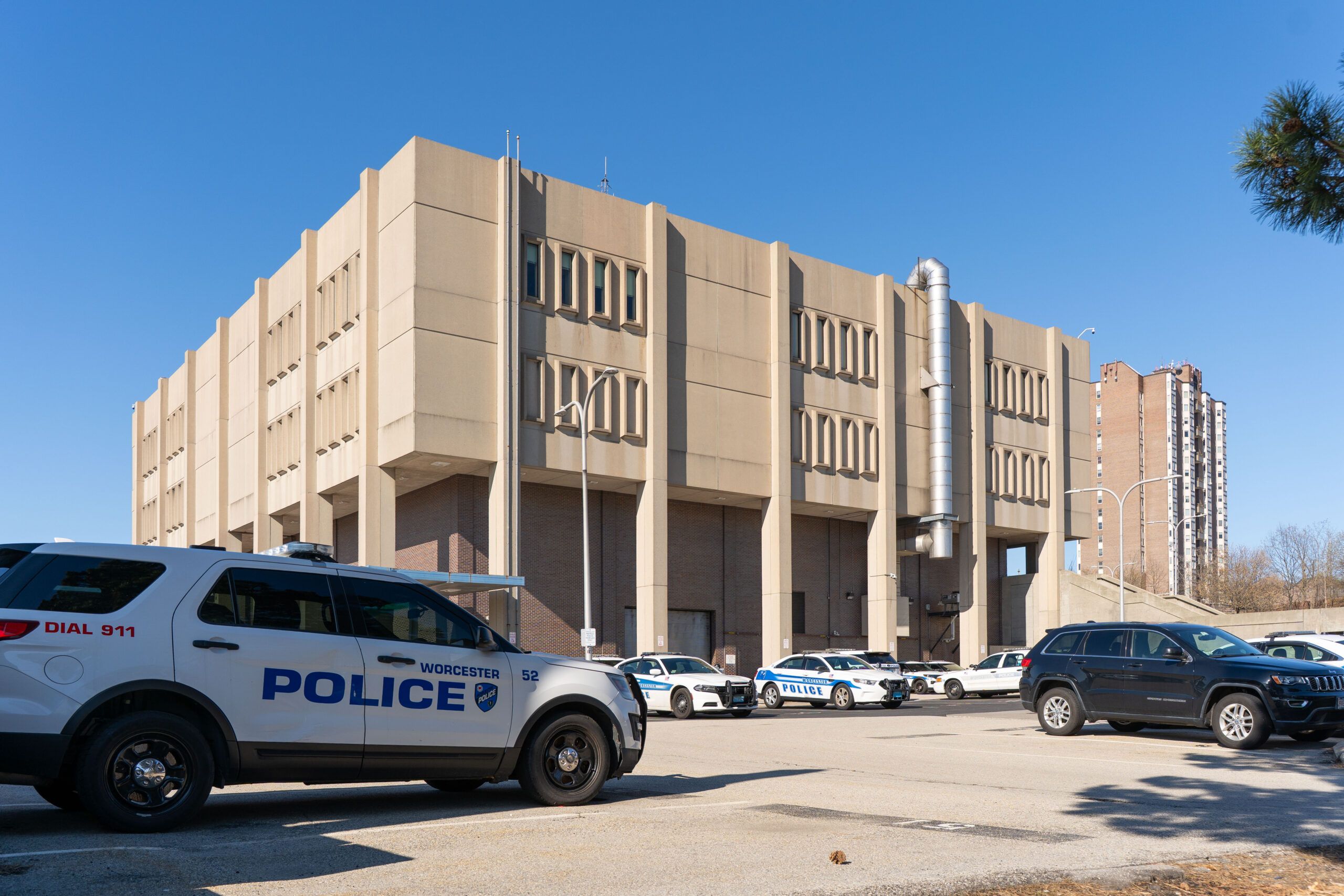
After months of anticipation, City Manager Eric Batista is recommending that Worcester not establish a civilian review board to oversee complaints against the Worcester Police Department, arguing the city should instead continue investing in and expanding its existing accountability framework.
The recommendation, which hits Tuesday’s council agenda, comes nearly a year after the Worcester Regional Research Bureau urged the city to create an independent civilian oversight body in response to longstanding community concerns and a U.S. Department of Justice report that found systemic deficiencies in the department’s accountability systems.
A coalition of community organizations and two former members of the Worcester Human Rights Commission is now urging the city council to reject Batista’s recommendation and establish a civilian review board with subpoena powers.
The groups plan to hold a press conference at 5:30 p.m. Tuesday outside City Hall, shortly before the council meeting begins.
In a joint statement released Monday, the organizations said Batista’s recommendation disregards years of complaints and legal claims against Worcester police, the Justice Department’s findings, the Research Bureau’s recommendation and a Human Rights Commission resolution supporting civilian oversight.
“We call on the city council to reject the city manager’s recommendation and create a Civilian Review Board with full subpoena powers,” the groups said in the release.
The statement was signed by the Worcester NAACP, Black Families Together, Neighbor to Neighbor Massachusetts, Progressive Worcester, The Village Worcester, Her Way Home, Massachusetts Organization of African Descendants, Showing Up for Racial Justice Worcester, Safe Exit Initiative, Worcester Interfaith and Friends of Worcester. Former Human Rights Commission Chair Ellen Shemitz and former Vice Chair Liz O’Callahan also signed it.
Instead of endorsing the research bureau’s recommendation, Batista submitted a memo to the council anchored by a 34-page report prepared by the Executive Office of Diversity, Equity and Inclusion concluding that Worcester already has many of the core elements associated with effective civilian oversight and should continue building on those systems rather than creating a separate review board.
“Based on the findings and recommendations presented in this report, which weigh the benefits of an independent CRB against the significant resources required for it to be impactful, my recommendation is to not pursue a CRB,” Batista wrote. “Rather, my administration will continue to refine the municipality’s existing structure.”
Batista said the recommendation should not bring the city’s police accountability efforts to an end.
“This recommendation should not be viewed as the conclusion of the municipality’s accountability efforts,” he wrote. “Accountability requires continuous evaluation, transparency, and responsiveness to community expectations.”
The recommendation marks the city’s formal response to the Worcester Regional Research Bureau’s October 2025 report, “Overdue for Civilian Oversight: A Pathway for Lasting Police Reform,” which concluded Worcester should establish an independent civilian review board after examining national practices and the city’s existing oversight structure.
“Today, Worcester stands as the 114th largest city in the United States and the second largest in New England, yet it remains one of the few major cities in the nation without a civilian review board or comparable oversight structure,” reads the executive summary in the Research Bureau report.
The report noted that more than half of the country’s 200 largest cities have adopted civilian oversight mechanisms and that Boston, Providence, Cambridge, Hartford and New Haven have oversight bodies.
“Worcester’s absence is striking in this context—and even more so in light of the December 2024 U.S. Department of Justice findings report, which identified systemic weaknesses in the city’s internal accountability systems,” the Research Bureau wrote.
Community groups dispute city’s reasoning
The coalition said the administration’s conclusion fails to account for evidence that the existing system has not adequately addressed misconduct.
“This recommendation completely ignores years of civilian complaints against the police, lawsuits against the police for misconduct which have cost millions of taxpayer dollars to settle, a years-long investigation of WPD by the Department of Justice, and an independent review of those DOJ findings by the Worcester Regional Research Bureau, which the City Manager commissioned himself,” the groups said in the release.
The statement cited findings from Worcester’s racial equity audit that Black and Latino residents were arrested at higher rates than white residents and remained underrepresented among Worcester police officers.
The groups also cited legal settlements involving the Police Department, claiming Worcester paid $4 million to settle 27 police-related lawsuits from 2010 through 2020 and more than $2.6 million in additional settlements during the following six years. Those figures were presented by the coalition in its statement.
The coalition pointed to the December 2024 Justice Department report, which found that Worcester police engaged in a pattern or practice of using excessive force and raised serious concerns about sexual misconduct involving women in police custody.
The groups also noted that the Worcester Human Rights Commission voted in favor of pursuing a civilian review board with subpoena powers.
“The city manager’s decision ignores the mountains of advice and evidence as well as the lived reality of his constituents,” the coalition said.
The statement argued that independent review would help distinguish misconduct by individual officers from the work of officers who serve the public appropriately.
“The misdeeds of a handful of officers should not taint the honorable service of the majority, but preventing a few bad apples from real accountability does just that,” the groups said. “We need real police accountability in Worcester.”
Existing oversight instead of a new board
Chief Equity Officer Kevin Lovaincy said the city’s review found that Worcester has developed many of the same oversight functions that civilian review boards are intended to provide.
“In 2025, the municipality partnered with the Worcester Regional Research Bureau (WRRB) to conduct a study examining available data, national best practices, and existing models related to CRBs,” Lovaincy wrote in his memorandum to Batista.
“Building upon that research, this report provides a more comprehensive examination of the components necessary for an effective oversight model. It also outlines the municipality’s approach to strengthening police oversight and recommends building upon that existing framework while responding to the needs and expectations of the community in lieu of a formal civilian oversight model.”
The report argues that the Executive Office of Diversity, Equity and Inclusion already performs independent investigations involving allegations of discrimination, bias and related misconduct involving police officers while working outside the Worcester Police Department’s chain of command.
According to the report, EODEI investigators answer to the city’s chief equity officer rather than police leadership, have access to municipal records necessary to conduct investigations and may recommend discipline, policy changes and other corrective actions.
If the chief equity officer and police chief disagree on the outcome of an investigation or recommended action, the matter is elevated to the city manager for a final decision, according to the report.
Data cited as evidence
City officials also point to declining excessive-force complaints and expanded oversight activity as evidence that the current system is producing results.
The report notes that excessive-force complaints have declined significantly since 2023 while sustained findings have remained relatively uncommon. It also states that EODEI reviewed two Worcester police cases in both 2022 and 2023 before expanding to five cases in 2024 and another five in 2025 as the office’s jurisdiction and staffing grew.
The report says substantiated EODEI investigations have resulted in documented corrective actions, including disciplinary measures, policy reviews and administrative responses. In some instances, investigators conducted additional reviews after residents filed complaints with EODEI concerning matters already investigated by the department’s Bureau of Professional Standards.
“The outcomes of EODEI investigations demonstrate that the office’s role extends beyond identifying violations,” the report states.
The community coalition, however, argued that a city office reporting through the municipal administration is not equivalent to an outside board with independent authority.
The groups also questioned reliance on the state Peace Officer Standards and Training Commission, saying in the release that the commission is understaffed and able to investigate only a small share of the complaints it receives.
Cost and structure among concerns
While acknowledging that civilian review boards can play an important role in police accountability, the city report concludes that establishing one in Worcester would require substantially more than appointing civilian members.
An effective board, it said, would require sustainable funding, trained investigators, administrative staff, legal counsel, access to confidential records, clearly defined investigative authority and negotiated relationships with existing oversight entities.
Many of those systems, the report argues, already exist within Worcester’s current framework.
“The municipality has already invested significant time, resources, and organizational capacity in developing an accountability framework that addresses many of the operational and structural challenges commonly associated with implementing a new civilian oversight body,” the report concludes.
Rather than duplicating those efforts, the report recommends strengthening existing oversight by investing in current systems, increasing transparency, expanding community engagement and continuing to evaluate accountability measures.
Debate heads to council
The conflicting reports and public statements set the stage for a potentially contentious city council discussion Tuesday night.
In his communication to the council, Batista acknowledged the years of advocacy surrounding the issue.
“I also want to acknowledge the residents, community organizations, and stakeholders who have advocated for a CRB over many years,” Batista wrote. “Their advocacy has helped shape important conversations regarding accountability, transparency, and public trust.”
He added that community members “should expect the best from WPD, and we owe it to them to put in place a framework of accountability and transparency that earns their trust in our public safety agencies.”
Although the administration is recommending against creating a civilian review board now, both Batista’s communication and the accompanying report emphasize that the city’s accountability system should continue evolving.
“The decision not to establish a CRB should not be interpreted as the conclusion of accountability efforts,” the report concludes. “Rather, it reflects a recommendation to continue investing in and improving the systems already in place while ensuring that those systems achieve their intended purpose.”
The community coalition made clear that it does not consider continued investment in the existing structure sufficient.
“We continue to demand a civilian review board with subpoena powers,” the groups said, “so that bad cops can be held accountable for violating the rights of Worcester residents, so that good cops can do the job we entrust them to do, and so that the community knows their trust is being placed in officers who understand and uphold their duty to the people.”
Worcester City Council meets Tuesday, July 21, at City Hall in the Esther Howland (south) at 6 p.m. It is also livestreamed on the city’s website.
Have news, tips, or a story worth telling? Reach Editor Charlene Arsenault at carsenault@theworcesterguardian.org—because good stories (and great scoops) deserve to be shared.
