
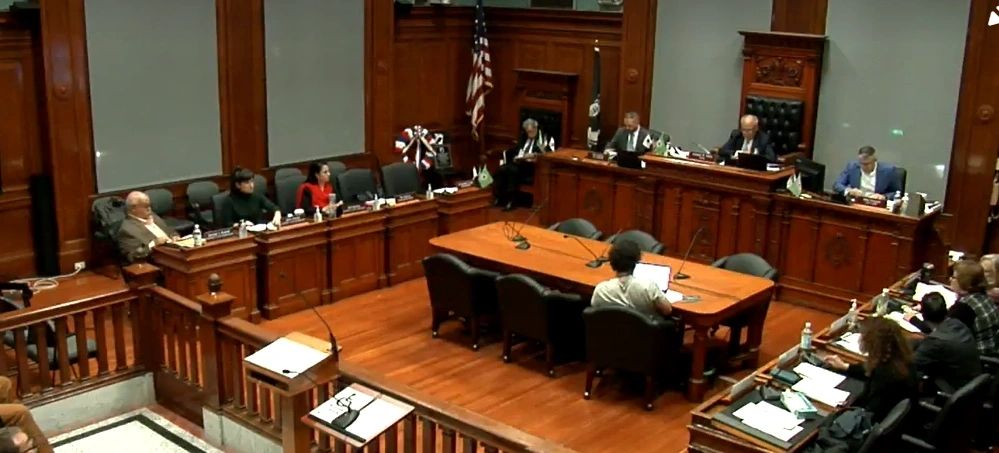
WORCESTER—Tuesday’s city council meeting was highlighted by two unanimous votes on measures that could reshape Worcester’s parking requirements and support major housing initiatives, while setting the stage for crucial tax classification discussions.
In a move stemming from the Worcester Now | Next initiative, a comprehensive two-year citywide planning process, councilors voted to request City Manager Eric Batista begin drafting ordinances addressing two key recommendations: the elimination or reduction of minimum parking requirements and reformed tree protection requirements for developments.
The Worcester Now | Next plan, which engaged the community on issues ranging from land use and housing to transportation and economic opportunity, provides a coordinated roadmap for the city’s future development while establishing frameworks for more detailed studies.
The parking discussion drew robust public commentary, with residents and students presenting data-driven arguments for change. WPI student Kyle Doll emphasized the city’s parking surplus, noting that “35% of downtown is already dedicated to off-street parking… much of this parking goes underutilized.” He added, “I support removing parking minimums and I believe we can create a city that works better for everyone. This is about giving developers, businesses and communities more flexibility to decide what parking makes sense.”
Worcester resident Jacob Seidel connected parking requirements to the city’s housing challenges: “When you require that people have off-street parking, you functionally reduce lot size. And in combination with other distortions of markets that we call zoning regulations, it makes it very difficult to increase the density of use in lots, which means it makes it very difficult to develop more housing.”
“We should be pushing to have the people leading our city to look forward to sustainable transportation,” said resident Kyle Stratton.
“I would ask that when this report comes back, that this administration puts options in it,” Councilor George Russell said. “I hope it comes back as a report that we can digest and see what the options are. It might be eliminating parking requirements altogether or it might be just reducing them. I’d like to see all the different options.”
Councilor Khrystian King stressed the urgency of zoning reform in addressing current challenges. “I think the importance of this is exactly in the title of the executive summary of our program,” he said. “What’s now and what’s next? I certainly agree that zoning reform is a must in our city, neighborhoods and communities. We certainly need that in the midst of this housing crisis.”
In another unanimous vote later in the meeting, the council approved an Urban Center Housing tax increment financing (TIF) plan for the Webster Square area. The comprehensive plan covers 125 acres, encompassing Mill Street Plaza, Eddy’s Plaza, the Webster Square Manufacturing District, and businesses along Park Avenue, Mill Street, and Main Street. At its core, the plan will support the Worcester Housing Authority’s ambitious project to reconstruct Lakeside Apartments, expanding from 202 to 374 units.
Chief Development Officer Peter Dunn provided crucial clarification about the TIF designation’s scope and implications. “This district designation is not suggesting that all of the parcels included there are getting some sort of tax break,” Dunn explained. “What it does is it’s a designation for which future projects that includes primarily affordable housing could propose to seek benefits under it, just like we use other tax increment financing strategies for other proposed development projects.”
Dunn added that one of the requirements of the program under the state is that it must meet its definition of an urban center.
“So, it has to include a mix of land uses including commercial land uses,” he said, “so it also extends down into the Webster Square area but not an extensive geographic area where it goes down Stafford or Cambridge Street.”
Batista added that mapping only extended to a number of properties within a specific vicinity of Lakeside.
“This has to be in conjunction with a project that’s developed,” he said. “We’ve been looking at providing different tools and options to hopefully develop that, but to my understanding it does not extend much to Webster Square.”
“This was something I put on council a year ago,” said councilor Etel Haxhiaj, “as I was trying to figure out ways that we can incentivize the Big D developer to not hold that parcel hostage, as he has for many decades. This is a very good economic development incentive. The Webster Square area has been neglected for some time in terms of economic development. This is a really good incentive for the Lakeside apartments which as you all know will be reimagined and our residents are really looking forward to having this opportunity, as that’s a very economically disadvantaged community.”
However, Russell raised concerns about potential tax implications. “If it’s a large parcel of commercial properties that are included,” he said. “If that’s the case that means the businesses across the city and residents will be seeing a difference in the balance sheets at the end of the day. If you’re giving one area a break on taxes, then taxes have to come from some place.”
The council also held several items for future discussion, including the crucial FY2025 tax classification package. The package, which determines tax rates for residential, commercial, industrial, and personal properties, proposes a total assessed value of $24.325 billion for all taxable properties – representing a 9.45% increase from the previous year. The proposed combined single tax rate is $16.44 per $1,000 of assessed value.
This upcoming tax classification discussion follows last year’s decision to adopt the lowest possible residential tax rate of $13.75 per $1,000 of assessed value, which resulted in an average $103 reduction in tax bills for homeowners. The commercial tax rate was set at $30.04 per $1,000, leading to an average $175 increase for business property owners. The Worcester Regional Chamber of Commerce has voiced concerns about this approach, arguing that higher commercial tax rates impede business attraction and retention.
The business community’s concerns have grown more pressing with additional costs from policies such as the Community Preservation Act, inclusionary zoning, and the specialized stretch code. Business leaders, including small business owners and downtown employers, continue to advocate for tax relief to promote sustainable economic growth.
The city manager’s employment agreement discussion was postponed to an executive session scheduled for the next city council meeting on Dec. 10.
Matt Olszewski is a freelance content and news writer based in Boston, MA. In his free time, Matt enjoys running, hiking or skiing. Matt just graduated with his MPH from Tufts University. He can be reached at mattoskier@gmail.com