
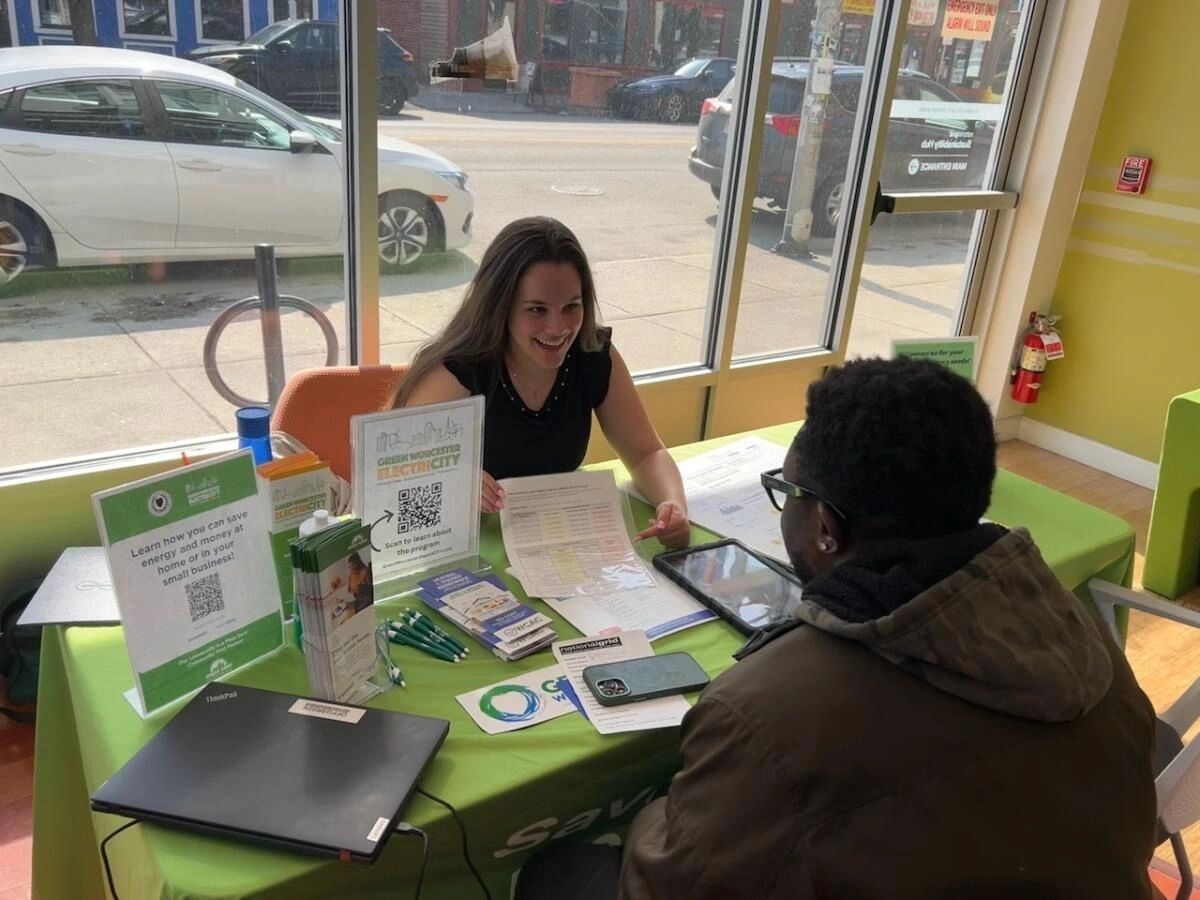
WORCESTER—Launched in 2019 by City Green Worcester, Worcester’s ElectriCITY aggregation program is showing measurable progress in its efforts to manage electricity costs and reduce the city’s carbon footprint.
ElectriCITY is a community-based initiative designed to collectively purchase electricity on behalf of the city’s residents and businesses, with the aim of securing more stable and often lower electricity rates. By pooling the purchasing power of the community, the program seeks to provide more affordable energy options and also offers electricity plans that include higher percentages of renewable energy, thereby helping to reduce the city’s carbon footprint.
Residents are automatically enrolled in the program but have the option to opt out if they prefer to remain with National Grid or choose a different electricity supplier. The program is part of the city’s broader efforts to promote sustainability and make energy costs more predictable for its residents.
During a recent Urban Technologies, Innovation, and Environment Committee meeting, officials shared results from the program and discussed its future potential.
“This program is probably the single most effective program we’ve run for keeping costs manageable for rate pairs who participate in the program,” said John Odell, chief of the Department of Sustainability & Resilience, “as well as complying with our Green Worcester plan goals for reducing carbon emissions,”
Odell and other proponents of the program say the numbers speak for themselves. From the end of 2019 through this past June, ElectiCITY has saved just under $27 million in repairs.
“We’ve also reduced the amount of CO2 [from being released into the atmosphere] by about 167 million pounds,” added Odell. “For relative purposes, it’s equivalent to taking just under 17,000 cars off the road for a year or powering homes for 9,500 homes for a year.”
The program works so effectively, he said, because the city bids on a price, and the lowest price wins. The city then contracts with the aggregation company for 1-3 years, depending on what the market conditions justify, with the end goal being lower prices compared to large companies such as National Grid.
This approach has led to what many consider to be substantial savings for Worcester residents, with the average household saving $26.76 per month over the life of the program. Odell noted, “Electrical prices through this program tend to be similar to National Grid in the summertime, but a lot less in the winter time. We’ve saved about $27 million versus National Grid.”
City Green Worcester’s program offers residents the flexibility to choose between National Grid, the aggregation program, or a third-party supplier. While the program has shown positive results, it maintains transparency by allowing residents to opt in or out at any time.
“When I first moved here four years ago I was paying about $200-400,” said Bethany Mann, a Worcester resident who uses National Grid. “Now it’s outrageous, it’s almost $600 just for a month and I don’t understand it.”
As for residents thinking about switching service providers, Odell cautioned against hastily switching to third-party suppliers. “We’ve been cheaper than most companies but not always the cheapest. I’d caution those who want to shop around to be aware that those third-party suppliers have great rates for the first six to 12 months, but it usually is a two- or three-year contract. And on the back end of those contracts, the prices jack up significantly.”
Mary Knittle, chairperson of the Green Worcester Advisory Committee, echoed Odell’s sentiment, warning about the risks associated with unregulated suppliers. “The Attorney General’s office in Massachusetts and many other advocates are strongly opposed to many of the suppliers who are operating in Massachusetts, to the extent of which there have been proposals to cancel allowing people to direct market electric supply to consumers.”
She added that there is limited regulation, and the companies can’t be managed. Many of them have been harmful particularly towards those who don’t speak English as a first language, according to Knittle.
“I do not think Worcester does a good job of addressing our concerns regarding electrical costs,” said Rachael Ellis, a Worcester resident who urges more guidance from city officials regarding electrical concerns. “They don’t spread much information on programs that help! It would be so helpful if they did.”
Knittle further explained, “A lot of people end up signing over for a good rate for a short period of time, but then they’re locked into a contract that they don’t understand, can’t afford and can’t get out of.” She said that with this aggregation program, the company is vetted, city officials and residents know where the electricity is coming from, and citizens are protected.
The program’s success hasn’t gone unnoticed by city officials. George Russell, District 3 councilor, while supportive, emphasized the importance of maintaining consumer choice. “Ultimately if the city is not on the hook to guarantee some sort of volume, if the residents can find a better deal, we should be able to give them another option.”
Additionally, the program actively promotes greener energy options. While two-thirds of the electricity currently comes from local-green sources, residents have the option to choose 100 percent locally sourced green energy for a small premium.
Looking ahead, city officials have affirmed that they are committed to keeping residents informed about current and historical electricity prices. Updates will be posted on the city’s website, including links to state resources to provide a comprehensive overview of current market conditions and comparisons to National Grid rates.
Matt Olszewski is a freelance content and news writer based in Boston, MA. In his free time, Matt enjoys running, hiking or skiing. Matt is currently finishing up the MPH degree program at Tufts University. He can be reached at mattoskier@gmail.com
As the Worcester Guardian marks nearly a year of delivering free, independent digital news to our city, our dedication to this mission strengthens. Please consider a tax-deductible donation to support our ongoing commitment to providing hyperlocal news coverage to Worcester. Scroll to the bottom of our home page to sign up for our daily newsletter
